Showing posts with label School. Show all posts

Wednesday, December 21, 2011

Miss Thomas

Virginia Thomas Funkhouser

by David Parmer and Philip Thomas

After I completed my trying third grade experience at Burnsville Grade School in 1951, I thought that the rest of elementary school would be a piece of cake. Miss Georgia Haymond, my venerable third grade teacher, would brook no nonsense or senseless chatter from the roomful of testy students, and had a thick maple paddle to back up her short stature. I came to know the business-end of that well-worn paddle on quite a few occasions, as did most of the boys in her class, and a few of the girls as well.

Needless to say, I was glad to move on to the fourth grade.

I was hoping to be able to sit in the same fourth grade chair that Sue Knight, a cute blonde haired girl on whom I had a secret crush, had sat in. The only problem was- I didn’t know what chair she had sat in. But, being only a fourth grader, a school-boy crush only lasted until the next cute girl passed by. So, in the fall of 1951, I moved on to the fourth grade, only one year to go before I could enter the fifth grade and move to the second floor of the Burnsville school building. What an accomplishment that would be! But first, I had the fourth grade to contend with.

Left: the author David Parmer
Right: Virginia (Thomas) Funkhouser

An Astonishing Sight
She stood military erect beside the teacher’s desk at the front of the room, quietly observing the hordes of bare-footed boys and an equal number of girls who were trying their best to ignore the “smelly” boys. Her hair was coal-black, her lips a bright red, and a lighter shade of red adorned her high cheek bones, a contrast to her olive toned complexion. She wore a dress of a type I had never seen before which must have come from New York or some far-off place. Made of a black silky material, the dress displayed colorful swirls of flowers, almost hypnotic to a fourth grade boy. A wide red leather belt matched her bright red high-heeled shoes. Truly, this fourth grader had never seen a truly chic person, which was of course a word I had never heard of before. The other students appeared to be equally mesmerized by the colorful apparition standing beside the desk in the front of the room. This was my memorable introduction to Miss Thomas, my fourth grade teacher.

The fourth grade room at Burnsville Grade School was a large room, filled with stationary desks, securely fastened to the floor. A large gas burning stove stood in the middle of the room, entirely adequate to heat the room beyond need during the months of winter. Approximately 42 desks surrounded the stove and most all of the desks were filled with urchins, still rambunctious from summer vacation. It took all of about sixty seconds for this wild bunch to be broken, tamed, and put securely in their place, never again to act the rogue, or to test the patience of Miss Thomas. Only once did this writer test her resolve to be the absolute ruler of her domain. A math test containing fifty division problems involving dollars and cents was distributed during the first weeks of class. Since I was a fair math student, I finished the assignment quickly and with the utmost confidence that I had gotten all fifty of the questions correctly answered. I strode to the teacher’s desk, the first to finish the test, and handed it to the unblinking, unimpressed and stoic Miss Thomas. Smugness, you might say, quickly changed to doom when Miss Thomas just as confidently strode to my desk and handed me my test, marked with a big red “O.” No, that was not for “Outstanding” but rather because out of fifty questions, I had gotten zero correct. Her admonition was that if I were dividing dollars and cents, the quotient must include a dollar sign, and, in forgetting this important detail, all of my answers were incorrect. I quickly learned that when Miss Thomas acted, there was to be no reaction other than to express remorse in a silent, non-demonstrative way. I forget just exactly what my ill-timed response was, but I do remember that it was followed by a quick trip to the cloak room and a painful introduction to the fourth grade paddle. After school that day, I sullenly made my way home, thinking about the story I was going to tell my mother about my unjust punishment. After relating to her my tale of woe, much to my surprise, I received another paddling because I had received a paddling at school. Thus, I learned the moral of the story. If you get a paddling at school, don’t say a thing about it at home, because there is always more of that where that came from.

The Rest of the School Year
It’s always good to learn an early lesson, and even better not to repeat the same mistake twice. The expression, “once burned, twice shy” is probably apropos and the remainder of my fourth grade year was uneventful, at least in the sense that I encountered no further tragedies of discipline. I remained enamored of her coal black hair, red lips and red rouged cheeks, and particularly of her dazzling dresses. At the end of that school year, Miss Thomas left Burnsville to teach in northern Virginia. I am sure that when school opened the next school year, the students at her Virginia school were as dazzled as I had been the year before.

A Sequel
A couple of years ago, I called Miss Thomas (now Mrs. Funkhouser) about a story I had been researching about the Henline family of Orlando. She was very pleasant. Her memory was vivid and her recollection of me as her student was very surprising, particularly since her memory of my scholarship was flattering. She never mentioned the math test, or its tragic aftermath. I never raised the subject either. The conversation ended with me having a renewed sense of my worth, particularly since Miss Thomas said it.

Right: Marshal and Virginia (Thomas) Funkhouser at their home in Florida.

Sadly, I was informed a few days ago that Virginia (Thomas) Funkhouser had passed away. Not only had she
been my favorite fourth grade teacher, but she was also my wife’s cousin, so my fealty is owed. Often this writer writes “tongue-in-cheek” and actually as my fourth grade experience evolved from a rocky beginning as the school year ended I was sorry that she would not be my teacher when I climbed the long stairs to the fifth grade classroom to be the student of another icon of Burnsville school history – Mr. Harry Wiant.

A Tribute to Miss Thomas
Philip Thomas, a nephew of Miss Thomas and a former Orlando student who moved to Belington to finish school, forwarded the following biographical tribute to Virginia Thomas Funkhouser which was distributed at her funeral in Alexandria, Virginia.


VIRGINIA KATRINE THOMAS FUNKHOUSER
Virginia Funkhouser was born Virginia Katrine Thomas on March 17, 1917 in Orlando, Braxton County, West Virginia, daughter of Mike and Estelle (Henline) Thomas. Virginia was the youngest of 8 siblings: Harry Gofrey, Sofia Jarvis, Tom

Thomas, Bill Thomas, Owen Thomas, Marie Thomas, and Arden Thomas (all deceased). She had 20 nieces and nephews.

Left: Mike Thomas
Right: Estie Thomas, Margaret Nixon (sisters) and Marie Thomas, Virginia (Thomas) Funkhouser and Sophia Jarvis (daughters of Estie Thomas


Virginia’s father, Mike Thomas, emigrated to the United States from Turkey in 1904. He and his brothers settled in the bus
tling railroad town of Orlando, West Virginia where Mike started out as a pack peddler and later worked in a restaurant. In 1905 he married Estelle Henline, a widow with 2 children. Together they had 6 more children, of which Virginia was the youngest. As a young child, she was known as Kate, short for her middle name, Katrine. During their time in Orlando, her mother was introduced to and joined the Reorganized Church of Jesus Christ of Latter Day Saints. The family later moved to Alton, Upshur County, West Virginia, where Mike opened a pool hall. Mike Thomas died at age 52 in 1925 when Virginia was only 7 years old. During her childhood years, Virginia and her brother, Arden, operated a paper route together. She also had her own AVON route by age 11. The Thomas family moved again to Copen, Braxton County, West Virginia. In her early school years, she walked 4 miles each way along a railroad track from Copen to her school and back. From the first day she went to school and set foot in a classroom, she knew immediately that she wanted to become a school teacher. So at an early age, she set her sights on getting a formal education in order to reach that goal. She graduated from Burnsville High School. Her brothers spent many years working for the Baltimore and Ohio Railroad. At age 16, Virginia was given some fabric by her uncle Lewis Thomas and sewed dresses for herself and for her sister, Marie, both made without a printed pattern.

Since her family was unable to meet college expenses, Virginia found a way to borrow $100 to start her freshman year at Glenville State College in nearby Glenville, WV. She earned enough education credits in her first year to receive an interim teaching certificate. In 1941, she used that certificate to land her first teaching job at Squires School, a one room schoolhouse in Gem, WV where she taught 16 students at multiple grade levels. She taught during the school year and studied at college over several summers to complete her Bachelor of Science degree at Glenville State College, Glenville, WV in 1946. While at college, she also waited tables at a boarding house in exchange for meals. After teaching one year at Squires School, 1941-42, she went on to 2 years at Hutchinson School in Gem, WV (1942-43-44), then 7 years at Burnsville, WV Graded School from 1944 to 1951.

In Copen, she used a horse to carry children across a creek to get to school. She talked to local officials about the need for a bridge across that creek, and was so convincing that crews were there the very next day making plans for the bridge. A bridge soon was built to accommodate both children and adults.

She met her future husband, Marshall Funkhouser, from south central Virginia. They were secretly married on December 28, 1950 at the home of Marshall’s aunt Seville in Fairfax County, VA without her mother’s knowledge. At first, her mother didn’t care for Mr. Funkhouser; however, that changed as he frequently took her out for ice cream and on other errands. Together, Mr. and Mrs. Funkhouser owned several horses which were stabled and groomed as racing horses near the Charles Town, West Virginia Race Track. Virginia went back to her hometown of Orlando, WV where she was baptized and became a member of the Reorganized Church of Jesus Christ of Latter Day Saints. Shortly thereafter, following a professor’s recommendation, she and Marshall moved in 1951 to northern Virginia and resided in southern Fairfax County, VA. They later moved to Alexandria, where in September 1951 she started her 31 year career as an educator with the City of Alexandria school system while her husband continued his career with the Virginia Electric Power Company. They were each other’s constant companions in over 45 years of marriage beforeMr. Funkh ouser passed away in 1996 in Naples, Florida at their second home where they enjoyed the area and spending time with friends.

She was an avid walker, and upon her retirement, she enjoyed walking in her Alexandria neighborhood every day as the weather and her health would allow. She was well known in her neighborhood by those walks and by chatting with passersby as she tended to her property. She loved to garden, and was known to grow some of the best tomatoes and green peppers on Russell Road in Alexandria.

From 1951, Mrs. Funkhouser was an active member of the Reorganized Church of Jesus Christ of Latter Day Saints, now known as the Community of Christ. She was a member of this church in Washington, DC and instrumental in founding a new mission and congregation in Springfield, VA. She wanted the best for the children, and saw to it through her benevolent financing that new carpeting and curtains were installed in all the children’s church school classrooms, and that a wonderful playground was provided for the children to have a safe and fun place to play. She was a strong supporter of a children’s Peace Pavilion, initiated by her church denomination at its International Headquarters in Independence, Missouri.

Virginia was a leader and promoter of a nationwide children’s reading program called Reading Is Fundamental (RIF), for many years headed up by Lynda Johnson Robb, who frequently visited schools in the Alexandria school system. In 1991, Mrs. Funkhouser was awarded the Distinguished National Service Award by the RIF Foundation. In 1981, as principal of the James K. Polk Elementary School, she played a part in the production of a National RIF movie. She served as co-President of RIF for Northern Virginia in 1986-87, and remained active as the chairperson for the Alexandria area RIF program for many more years. Virginia even traveled to the White House to represent the interests of that group/foundation before the President of the United States. The nonprofit RIF program helps more than 13 million children across the nation to read with the assistance of more than 120,000 volunteers. Mrs. Funkhouser was passionate in her desire that all children learn to read. It was her gift to them, one that remains with each person throughout his/her life.

Mrs. Funkhouser always stressed the value of getting a good education. Through the years she became quite fond of her church-sponsored college, Graceland University, located in Lamoni, Iowa, between Kansas City and Des Moines. She and Marshall generously supported Graceland, to the point of establishing a scholarship fund in both her and Marshall’s name, a scholarship which continues even today.

Mrs. Funkhouser’s career as an educator in the City of Alexandria began in 1951 as elementary teacher at Mt. Vernon Elementary School, under the leadership of Principal Beatrice Franklin, a pillar among her elementary school peers. Knowing the value of an advanced degree, while teaching during the school year, she used her summers to complete a Master’s Degree at the George Peabody College for Teachers at Vanderbilt University in Nashville, Tennessee in 1955. After four years at Mt. Vernon as a teacher, upon receiving her Master’s, she was promoted to Assistant Principal. The superintendent of the Alexandria Schools, Mr. T.C. Williams, soon recognized Mrs. Funkhouser’s talents and skills, and made the most of her expertise by shifting her to other schools where a strong, energetic leader was needed.

In 1956, Mrs. Funkhouser became Assistant Principal at MacArthur Elementary School. She moved to Minnie Howard Elementary School as Assistant Principal in 1957-58. She then transferred to Prince Street Elementary School as Principal (1958-Feb 60). From Feb. 1960 to 1967, she was Principal at Robert E. Lee Elementary School on Washington Street, near the Woodrow Wilson Bridge. From there, she went to Charles Barrett Elementary School as Principal for 6 years (1968-1973). And in 1973, she transferred to James K. Polk Elementary School where she was Principal for 9 years from 1973 to 1982. Several of her teachers from the earlier schools transferred to Polk to continue their professional association with Virginia. Each time she moved to a new school, it was at the request of Mr. T.C. Williams because he had such faith and trust in Virginia’s leadership and management skills to get the best results, from both teachers and students. She was noted for being able to “straighten out” some of the problems being experienced at schools around the Alexandria school system. While she was principal she led the school through the period of desegregating schools and bussing. She was always known as a dedicated, hard worker, revered by her staff. She would regularly get to school quite early, and stay late most days. She established an excellent reputation by demonstrating her leadership in elementary education, both in teaching and in principal positions at several schools in Alexandria. She was a hard taskmaster, but she inspired teachers and students alike, gaining recognition as a superior educator for the Alexandria community.

Mrs. Funkhouser was invited to join Delta Kappa Gamma, an international professional honor society of women educators with over 150,000 members that promotes professional and personal growth of its members and excellence in education. She enjoyed participating in, and supporting, its several functions for many years.

She was truly admired by all who knew her. Well after her retirement from Polk Elementary School and the Alexandria school system in 1982 she continued to be in the forefront of organizations promoting excellence in education, and maintained her contact and close friendships with many of her teachers, secretaries, other principals, and even superintendents in the school system. She often invited her friends to visit at her home where she enjoyed preparing lunch for them. Perhaps her most favorite dish was crab cakes, for which she was always a popular cook. She was also known for being a “sharp” dresser. For many years after retiring, she maintained her membership in and attended the meetings of the Alexandria Retired Teachers Association.

Virginia was such a lover of good books. She especially enjoyed good children’s books, and she considered herself quite privileged to be a close personal friend to Cheryl Barnes, another Alexandria resident who is an accomplished author of children’s books, many of which are in Virginia’s home library. Virginia thoroughly enjoyed Cheryl’s books and would often give them as gifts to young children who were very special to her.

Virginia was an avid Washington Redskins Football Team fan, and together with Marshall, for many years they would attend all of the Redskins home games. They took pride in having a pair of those “hard to come by” Season Tickets, which offered an excellent view of the field at the 45 yard line on the home team’s side. They’ve held that pair of tickets for over 50 years! She even became good friends with Joe Theismann, the once-star quarterback for the Redskins, who accepted her invitation to come visit her and her students at Polk Elementary School on more than one occasion. She always cherished the “number 7” autographed jersey which Joe personally gave to her, proudly displaying it on the wall of the family room in her Alexandria home.

Her leadership and support of education gained her many friendships with persons in leadership positions at the city, state, and national levels. Often she received invitations to attend special banquets in both Washington, DC and northern Virginia. For many years she received Christmas cards and letters from U.S. Senators as well as the President of the United States.

Though she claimed to be shy, others would recount that she was never bashful, never hesitating to make her views well known. There was no doubt where she stood on just about any issue that you might want to discuss with her. She had a keen sense of humor. Professionally and personally, she was an inspiration to all. She will long be remembered as a highly respected leader in the Alexandria school system.

Mrs. Funkhouser left a legacy of high principles, and stressed the need for studying hard and doing well in school in order to succeed in life. She was admired, respected, and loved by so many people whose lives she touched along her own pathway of life. Many people have had success and been enriched in their own lives by being touched somewhere along the way by Virginia Funkhouser.

Sunday, August 29, 2010

A Tragic End with Barely a Beginning


by David Parmer

Sam Marchio drove slowly along the Goosepen Road, gripping the steering wheel tightly with both hands, oblivious of the tranquil farm scenes which presented themselves around each curve in the road. The hardworking farmers of southern Lewis County kept their farms in tip-top condition but Mr. Marchio, a Physical Education teacher of Weston High School, wasn’t thinking about the haying which was going on, the cattle grazing along the hillsides, or the corn growing in the bottom-land. He did not notice the farmers standing in their fields looking at the strange car coming down their road. A sad duty was in store for him this September day in 1952. It was a duty he dreaded to fulfill. Just how do you tell a mother that her only child, a beautiful, seemingly healthy daughter, who left for school that morning without a care in the world, died suddenly at his school? The eighteen miles to Goosepen were the longest miles Mr. Marchio had ever driven, but the hardest part of the journey would not be begin until he reached the Clarence and Hetty (Nye) Finster home on Goosepen where Carolyn Sue and her mother, Mary Poffenbarger, made their home.

Mary (Beall) Poffenbarger

Mary (Beall) Poffenbarger was the daughter of Newton "N. H." Beall and Clara (McCullough) Beall of Route 1, Orlando. For many years, Newton and Clara operated a country store and post office at Aspinall, a pick-up point on the Orlando mail route. Newton’s father, Charles Henderson Beall, had operated this store and a grist mill for many years before turning the business over to his son Newton.

Born in 1915, Mary was the only child of Newton and Clara Beall to survive to adulthood. She was quite familiar with tragic untimely deaths because her mother Clara died of tuberculosis in 1918 when Mary was just three years of age and her father Newton died four years later in 1924 when she was just seven. Orphaned at an early age in 1924, Mary was fortunate to have been a student of Edna Wiant, the teacher of the Ben’s Run School.

Edna Wiant
When Mary Beall’s widowed father died in 1924, Edna Wiant was an unmarried school teacher, living with her foster parents, John and Mary Blake on Ben’s Run. Edna, who was also orphaned at a very young age, was noted for forming fond attachments with her students. Recognizing the need for a child to have a nurturing parent, Edna took the orphaned Mary into her home and became her de facto mother. The Blake home on Bens Run was a large, commodious two story farm house with plenty of room for the Blakes, their foster daughter Edna, and this new foster daughter, Mary Beall. Consequently, until adulthood, Mary Beall lived with her foster mother, Edna Wiant, on Ben’s Run.

In 1937, when Mary was 22 years of age, she met and married Wade Poffenbarger of Tucker County. Unfortunately for Mary, her marriage was a brief because Mr. Poffenbarger was not the settling-down type and he soon flew the coop, never to be heard of again, when he was informed that Mary was with child. Mary, who had been orphaned at a young age, with a child on the way, now was abandoned by a faithless husband almost before the ink was dry on the marriage certificate. Edna Wiant welcomed her foster daughter back to her home to await the birth of her child. A daughter, Carolyn Sue Poffenbarger was born on August 6, 1938.

Edna, with her strong maternal instinct, took a shine to Carolyn and treated her as if she were a child of her own, as she had done with Carolyn’s mother. A child can never have enough love so the love of two mothers served Carolyn well in her formative years. Some recall that Carolyn was fortunate to have had not one but two mothers. When Carolyn was born, Mrs. Blake, Edna’s foster mother, was still living, and between Mrs. Blake, Edna Wiant, and her mother Mary Poffenbarger, she felt well-loved and was a smiling and happy child.

The Years Following
Velma Heath, a neighbor on Ben’s Run, recalls Carolyn Sue as a “good, pretty little girl, mindful and happy.” A good student at the Ben’s Run School, Carolyn Sue, who would be known primarily as “Sue,” to her peers, undoubtedly brightened the one room school, and was a girl of promise to her teachers.

Mr. and Mrs. Blake passed away and in 1946, Edna Wiant married Frank McPherson and moved to Burnsville. Carolyn Sue’s mother Mary found a position in the home of Clarence and Hetty Finster on Goosepen caring for the children of Mr. and Mrs. Finster. Mary and Carolyn Sue were not forgotten however by their dear friend, Edna (Wiant) McPherson, and their familial relationship continued with frequent visits and shopping trips. Mary and Carolyn Sue had moved into the Finster home and were living there when Carolyn Sue started to school at Weston High School. During the second week of school in September 1952, Carolyn happily boarded the yellow school bus for the long trip to Weston High School and her freshman classes.

The day was hot. The early days of September probably always seemed hot to students of un-air-conditioned schools in central West Virginia. Many students were still thinking of their summer’s vacation, as the warm air wafted into the open windows of their classrooms, making sleepy students sleepier. On this September 10th, Carolyn was in a physical education class on the football field when she started feeling ill. Since it was a hot, muggy day, it was common for a student to be affected by the heat, so no one was alarmed. Allowed to sit on the bleachers while the class participated in physical activities, Carolyn began to feel worse and complained of a headache to her Phys Ed teacher, Sam Marchio. Thinking that a headache indicated the need of an aspirin, Carolyn was given aspirin, but soon was in greater distress. At 2:50 p.m. on September 10th, 1952, Carolyn Sue Poffenbarger collapsed and died.

Stoicism
Stunned by the tragic news carried to her by Mr. Marchio, and aware that she would never again see the smiling face of her daughter Carolyn Sue again, Mary took the loss of her daughter in a stoical manner. She had suffered the loss of her own parents at an early age, had been abandoned by her husband and the father of her child, and now fate had given her another cruel blow.

Mary Poffenbarger died in 1989, thirty seven years after the death of her only child and the searing visit by Mr. Marchio. Those who knew Mary well say that she never talked about her daughter Carolyn Sue but they all say her stoic silence about the loss of her only child masked an inner pain that lesser souls could not bear. Since Mary never mentioned her loss, others never broached the subject, and future condolences were never uttered. Some pain is best left in silence and best handled that way and that is the course Mary Poffenbarger followed with respect to her loss. When Carolyn Sue was laid to rest in the Pumphrey Cemetery, the matter was closed.

The Mystery Remains
Doctor T. M. Snyder, a Weston physician, pronounced the cause of death of Carolyn as “undetermined.” That four-syllable word was carefully written on the death certificate by Orlando funeral director Mike Moran in 1952 and remains the official verdict of death to this day.
Given the great advances in medicine in recent years, the cause of death of Carolyn Sue Poffenbarger could probably now be made, but at best, it would be conjecture, and it now seems pointless to hypothesize. In the early 1950’s many death certificates were unclear regarding the cause of death of a decedent and this was just another of the many such cases. Her caring neighbors decided that Carolyn Sue must have succumbed to a cerebral hemorrhage. Whatever the cause, the mystery remains. The shining girl of promise was buried in the Pumphrey Cemetery, to be joined later by her dear friend, Edna Wiant McPherson in 1967 and her mother, Mary Poffenbarger in 1989.


To enlarge the above death certificate, please click on it.

. . . . .

Comment 1 Carolyn Sue and her mother lived north of the Oil Creek watershed but on Orlando's RFD Route 1 at both the Blake/Wiant home on Ben's Run and the Fenster home on Indian Run. School kids who lived north of Orlando, on Oil Creek, Three Lick, Grass Run, Indian Fork, etc. went to school in Weston.

Comment 2 by Bob Pumphrey

This story was great and brought back lots of memories. It is my recollection that Mary and Carolyn Sue Poffenbarger were living on Ben's Run when Carolyn Sue died. Her mother Mary was babysitting during the day for Clarence and Hettie Finster. Clarence was the school bus driver and drove the bus from the Ben's Run area up Goosepen into Weston. When Clarence got home in the evening, he would pick Mary Poffenbarger up at his house and continue to drive the bus to Ben's Run and then let Carolyn Sue and her mother off the bus. A few days after Carolyn Sue was buried, Clarence and Hettie asked Mary to live with them and continue babysitting. From that time Mary Poffenbarger lived with the Finsters.

I further recall that Clarence Finster told me that the morning Carolyn Sue died. she mentioned to Clarence when she got on the bus that she had a headache. Clarence offered to take her back home but Carlyn Sue declined the offer.

Carolyn Sue's wake was held at the house on Ben's Run and Mike Moran, the Orlando undertaker, was in charge. Many people were there.

Comment 3 by June Nixon Henry
I just finished reading the story of Sue Poffenbarger and tears are running down my face. It brought back the memory of that day that my Mom called me and asked me to go over to City Hospital to see Edna and Mary. There was no way I could describe the grief of those two. What comfort could I give them only just to be there? So glad you told their story. When Mary went to live with the Finsters she certainly channeled her grief into caring for their mentally disabled daughter. Thanks for telling the story.


Thursday, August 12, 2010

Sixty Years of Learning

at Ben’s Run School

by Marcia (Heater) Conrad

Today
Today, it is quite easy to get in your automobile on Ben’s Run and drive to the intersection of the Indian Fork Road. A right turn at the intersection will take you in just ten or fifteen minutes to the location of the former Goosepen School. Or, if you choose to turn left at the intersection of the Indian Fork Road, a few minutes will take you past the locations of the former Pine Run School and the Butchers Fork School. One might say that these three school locations in the modern age are nothing but a “stone’s throw away” from each other. But today these schools are no more. There are no sounds of a hand bell ringing, games at recess on the playground, or the sight of kids walking home from school.


Yesterday
At the turn of the 20th century and for nearly sixty years, the now-abandoned one room schools in southern Courthouse District of Lewis County were bee hives of activity during the school year. Most nearby families were large, with many children close in age. Education was a prized commodity to these families, their teachers were respected, and most children were eager to learn. During that time, roads were dirt, and because automobiles were non-existent early-on, and rare even later, the primary transportation was shoe leather or bare feet, especially for children. In the winter time or in times of rainy weather, the dirt roads became impassable. What is now a short journey by automobile, was an impossible trek a hundred years ago. Because of the still-primitive nature of transportation in by-gone years, one room schools dotted southern Lewis County, and Ben’s Run was the location of one such school.
Right: Down the right side are photos of Ben's Run students. The oldest photo, at the top, appears to be from about 1910. The next was taken in 1915. The boy at the far left of the photo, wearing a dark jacket, is the author's father Coleman Heater. The next two photos are from the 1940s, the next appears to be from the 1950s and the last photo appears to be from the early 1960s.

Ben’s Run Schoolhouse
The small, picturesque, one room school on Ben’s Run was built around the turn of the 20th century. It is believed that the school began educating the youth of the area around 1906. Approximately 400 square feet, the wood frame building still stands on the former Bob McCray property.

When built, the school had no electricity and had none for many years. Large windows on both sides of the building admitted natural lighting. To supplement the natural light, coal-oil lights were used on darker days. In the 1950’s, Thomas Edison’s invention (electric lights) finally came to the Ben’s Run School, and for the waning years of the school, students studied with incandescent lights.

Central heating, however, would never find its way to the Ben’s Run School. Heat was always provided by a pot-bellied stove which was positioned in the center of the one room of the school. On coldest of days, students moved their desks as close to the stove as possible to take advantage of the heat. Occasionally, the stove would be overloaded with coal which resulted in a white hot stove. Fortunately, no accidents occurred when the stove was burning too hot. Of course, there was no state fire marshal in those days, or all of the schools would have been discontinued during the winter months because of the fire hazard.

Students took turns in making sure the stove provided heat during the winter months. For keeping the stove burning, putting out the flag in the morning, bringing in the initial supply of the day’s water, and sweeping the floors of the school, a student was paid a stipend. In the early 1950s, the student who did the janitor work received $12 a month, but by the late 1950s, the monthly amount was $16.00 per month, a handsome sum for the day. After school, the designated student janitor would bring in the flag. Needless to say, students were eager to try their hands at fire-building, dusting erasers and washing the black board, and pushing a broom.

Hot lunch was another modern day amenity which was not available at Ben’s Run. Although some larger schools in the area, such as Orlando and Walnut Grove, did have a hot lunch program provided with paid cooks, the Ben’s Run students either brought their lunch from home or walked home for the noon-time meal. Water was available from a ceramic cooler with a built-in spigot. The water was generously furnished by the McCray farm next door to the school. Each student brought a drinking cup to school and the cups were stored in the cloak room.

The school’s bathroom facilities were very familiar to the students of the school, since all were familiar with the ubiquitous outhouse. In later years, two two-hole outhouses provided the sanitary facilities for the school. While real toilet paper was available during these latter years, during the early years of the school, last year’s Sears Roebuck catalog was probably the toilet paper of choice in the outhouses.

The Ben’s Run School served students from the 1st through the 8th grade. Pre-school programs were not then available, although many students started school when barely five years of age. Since the nearest high school was in Weston, and parents were responsible for transportation for their students to high school, many students who finished the 8th grade could continue attending the Ben’s Run School until they were 16 years of age, at which time they could legally quit school. Bus transportation to Weston High School was not provided until the 1950’s.

Teachers of the Ben’s Run School
The very earliest teachers of the Ben’s Run School are unknown since Lewis County did not keep records of the numerous teachers of the smaller schools in the county. The earliest students of the school are long since deceased and there is little in the way of information available to us to identify the teachers. Some of the latter year teachers of the Ben’s Run School are remembered below.

Mrs. Mick
Perhaps, the earliest teacher of the school in present recollection is a Mrs. Mick. No first name of this teacher is known, nor would one hazard a guess as to the first name of a teacher named Mick. The numerous branches and generations of the Solomon and Mary (Lawman) Mick family of nearby Rocky Fork and the C. C. and Martha (Lawman) Mick family of nearby Dumpling Run provided many male and female teachers to the early one room schools of the southern Lewis County, northern Braxton County, and Gilmer County, anyone of whom could have been the Ben’s Run teacher.

Left, above: believed to be Mrs. Mick.
Left: Edna Wiant

Edna Wiant
Edna Wiant
was the daughter of Perry Wiant and Mary (Henline) Wiant, residents of the Indian Fork area. Orphaned as a young girl, she became the foster daughter of John Thomas Blake and Mary Ellen (Thompson) Blake, a childless couple, farmers on Ben’s Run. Edna taught at the Ben’s Run School from 1920 to 1925. The author’s father, Coleman Heater, reminisced that he was a student of Miss Wiant and that there was not much difference in his age and her age. Coleman was somewhat smitten with his teacher and had a “crush” on her, but a teacher was the teacher and a student was the student. Helen Jeffries, a friend of Edna’s however, recalls that Edna was also smitten with “Coley” and but for the devotion of Edna to her foster parents, Edna and “Coley” might have married.

This writer also recalls her father remembering taking a spelling test from Miss Wiant during his school days and was asked to spell the word “snow.” Laughing, Coleman said he spelled it with a “c” instead of an “s.” Remaining friends and neighbors most of their lives, Coleman and Edna frequently recalled the failed spelling word with humor well into their “golden years.” Edna, late in life, married Frank McPherson of Burnsville. She died in 1966 and was buried in the Pumphrey Cemetery.

Abalene “Tib” Feeney
Giving instruction to students at the Ben’s Run School in 1931 was Abalene “Tib” Feeney. Named for her maternal grandmother, Abalene Rush, she was the daughter of Patrick Feeney and Bridget (Rush) Feeney of Orlando. Miss Feeney taught at the Ben’s Run School for three or four years. In 1944 she married Charles Harris. They resided in Richmond, Virginia at the time of her death around 1985. Velma Heath, who is aged 84 and lives in the former Rosie and Billy Riffle farm on Ben’s Run, recalls “Tib” Feeney as the most beloved of all the teachers at the Ben’s Run School. Miss Feeney was also the “teacher on horseback” since she saddled up her horse each morning and rode it to her Ben’s Run School.

Mildred Riley
Mildred Riley was another early teacher at the Ben’s Run School. Miss Riley taught at the Ben’s Run School during 1937-1938. Velma Heath recalls that the first paddling she ever got in school was administered by Miss Riley. The daughter of James Riley and Dora (Hutchinson) Riley, she was born in Weston in 1917. During World War II, she served in the Women’s Army Corps. She married John Garton of Alum Bridge in 1948. She died in 1969 and was buried at St. Boniface.

Mary Tulley
The daughter of Orlando residents Martin Tulley and Elizabeth (Green) Tulley, Miss Tulley was an early teacher of the Ben’s Run School which was located just across the hill from her home on Tulley’s Ridge. Mary was teaching at the Ben’s Run School in the early 1940’s when she became ill with tuberculosis. She died at the age of 44 in 1943 and was buried at St. Bridget’s on Goosepen.
Left: Mary Tulley

Lloyd Smith
Lloyd Smith is reported to have been a teacher at the Ben’s Run School during the mid-1930’s but little else is known about him. Velma Heath, a present-day resident of Ben’s Run, was a student of Mr. Smith. Velma recalls that Mr. Smith was a quiet man and that he did not participate in playground activities with his students. Velma believes that Mr. Smith was from Jane Lew or Lost Creek.

Zoe Swecker
Perhaps the most prominent of all the teachers of the Ben’s Run School was Zoe Swecker, a native of Canoe Run. Miss Swecker also taught at the nearby Pine Run School. A teacher at Ben’s Run probably in the late 1930s, she returned to college and received both a Master’s and Doctor of Philosophy Degrees, the latter from the University of Chicago. Dr. Swecker was a career history teacher at Clarion University in Pennsylvania. She was quite well-known amongst the nation’s historians and was a member of several historical organizations.

Thomas Byrne
Residing for a while in Orlando in the former Mrs. Ollie Blake home on Flint Knob near the Orlando School, a teacher named Thomas Byrne taught at the Ben’s Run School prior to 1943. Described as being chronically in a hurry, he was also described as being chronically late. Apparently suffering from a sleep disorder, Mr. Byrne would often fall into a deep sleep during school time. Seizing a golden opportunity, some of his students would quietly gather their books and return to their homes during Mr. Byrne’s naps. Upon awakening from his untimely period of sleep he would find few, if any, students in the classroom. Mr. Byrne, the son of Joseph Byrne and Mary (Doonen) Bryne of Lewis County, was married to the former Mary Gissy. He lived for the most part in the Copley area.

Frank Stoneking
Frank Stoneking taught for many years in country schools throughout Lewis County, including the Ben’s Run School from1943-1945. He is perhaps as well known for his restaurant, “Stoneking’s,” which was located across the old U. S. Route 19 at Roanoke from DeGarmo’s Skating Rink, later known as Rose’s Skating Rink. His son Billy was later a teacher and coach at Walkersville High School.

Mary Walsh
Mary Walsh was a single lady and made her home with her sister in Weston. She commuted to the Ben’s Run School with her colleague, Ronald Farnsworth, who was the teacher at the nearby Pine Run School. Velma Heath recalls Miss Walsh as a “very nice lady.” Miss Walsh taught at the Ben’s Run School from 1945 to 1957. For many community children, Mary Walsh was the only teacher they ever had. During her tenure at Ben’s Run, the windows of the school on one side of the building were removed and boarded over. She also presided over the planting of pine trees around the school building which are now huge and over-grown in relation to their location to the former school building. Among the students who helped plant the pine trees were Erma Heater, Earl Heater, Brenda Heater, Orie Lee Heater, Jim Heater, Clarence Heath and Alton Heath Jr. Former students recall that Miss Walsh was not a great believer in testing and that she assessed the progress of her students by interaction with them in the classroom. Miss Walsh often walked with her students to neighboring Goosepen School for ball games. Occasionally during cold weather, Miss Walsh would arrange for a neighbor to make hot chocolate for her students. She retired from teaching after her years at Ben’s Run.

Left above: Mary Walsh
Left: Ronald Farnsworth
Ronald Farnsworth
Mr. Farnsworth replaced Miss Walsh after her retirement. This writer recalls Mr. Farnsworth as a very quiet man who spoke so softly that his students often had difficulty hearing him. He was a very caring teacher who kept tabs on his former students long after he retired from teaching. He taught at Ben’s Run from 1957 to 1959. Velma Heath recalls random acts of kindness by Mr. Farnsworth who was known to buy clothing for needy students. He would also take the time to visit the homes of his students and talk to the parents about their children’s progress in school. Velma also recalls that Mr. Farnsworth had the peculiar habit of crossing his arms and slapping his shoulders during conversations with others.

Dorothy Wilfong
Dorothy (Persinger) Wilfong
was a Burnsville native and graduated from Burnsville High School in 1930. Mrs. Wilfong was one of the many teachers in central West Virginia who taught school on a certificate for many years before getting an actual college degree. She graduated from Glenville State College in 1962. Mrs. Wilfong was married to Basil Wilfong of Linn in Gilmer County. Mrs. Wilfong replaced Mr. Farnsworth as the teacher of the Ben’s Run School. Rather than drive the long distance on country roads, in times of bad weather, she often spent the night with the Heater family. She taught the school for two years from 1959 to 1961.

Left: Dorothy (Persinger) Wilfong
Left, below: Juanita (McClain) Warner

Juanita (McClain) Warner
Mrs. Warner taught the Ben’s Run School during the 1961-1962 school year. A native of Crawford, Mrs. Warner was married to French Warner, a native of Knawl’s Creek. Mrs. Warner was later a teacher at Walkersville, and she also served as a substitute teacher after her retirement. The family moved to Morgantown while their son was a student at West Virginia University. Her son, Gene, achieved a high executive position with the Exxon Corporation. Some years later, Mrs. Warner’s husband, French, operated a taxi service in Weston.

Helena McCudden and the Last Years of the Ben’s Run School
In 1962, Helena McCudden became the final teacher of the Ben’s Run School. This veteran of the teaching profession had taught at many rural schools in Lewis County, including the nearby Pine Run School. A slight woman with firey hair, she was a strict disciplinarian, a magnificent teacher, and a wonderful friend to her students. She told them what she thought they could achieve in the future, and her expectations were high. Even after she sent them on to high school at Weston, she kept up with them.

This writer (Marcia Heater Conrad) was a student of Miss McCudden. After completing the sixth grade, Miss McCudden insisted to my parents (Mr. and Mrs. Coleman Heater) that I be sent to Weston Junior High School for my 7th and 8th grades, rather than remain at Ben’s Run. Although apprehensive (perhaps more like ‘scared to death’) and over my protests, my parents complied with her wishes and I was off to Weston Junior High School for my 7th grade. I recall being embarrassed when my English teacher announced to the entire class that they would have to “make allowances for our friend from the country.” No allowances were necessary, however, because my teachers at Ben’s Run had given me an excellent education and it was soon apparent that I was more advanced academically than the other students in my class. Miss McCudden inspired me to become a teacher, and I use some of her techniques in my classroom today. Although some would call those methods outdated, they are just as effective as they were all those years ago.
Left: Helena McCudden

Miss McCudden was still at the helm at Ben’s Run when the school doors were closed for good and the bell rang for the last time at the last one-room school in Lewis County. Elementary students from Ben’s Run were bused to Roanoke and those above the sixth grade, were taken to Weston to junior high. Miss McCudden ended her teaching career at Weston Central Elementary.

Having spent years in a classroom on both sides of the desk, I can truthfully say that the education I received at Ben’s Run has served me well. In so many ways we were family; older students looked out for and helped the younger ones. There was no bullying and no discrimination. Ben’s Run students are spread far and wide and found in many occupations, but we all have special memories of our little one-room school.

. . . . .
Comment by David Parmer
Bob Pumphrey recalls that when he attended the Three Lick School in the late 1940’s and early 1950’s, Christmas time was always a great occasion at his school. The Three Lick School was located just over the hill from the head of Ben’s Run, and by the way the crow flies it is but a short distance. The older boys in the Three Lick School were familiar with most everybody who lived on Three Lick, Ben’s Run, Goosepen, and Pine Run, as well as the entire Orlando area. On the final day of instruction at the Three Lick School prior to the Christmas vacation, the school children were all excited about the pending holiday and also in expectation that Santa Claus would pay the school a visit and perhaps leave a few treats for the kids. Bob recalls that Santa Claus did not come by sleigh pulled by reindeer, or even a pick-up truck, but came walking up the road to the school. Bob recalls that Santa had a bag-full of treats for the school children. Bob remembers that Mr. Claus did a great job convincing the younger children that he, in fact, was Santa Claus. Bob, however, was one of the older boys in the school, and together with the other older students, determined that Santa Claus was none other than Coley Heater of Ben’s Run, the father of the author of the story about the Ben’s Run School.

Comment fr0m Marcia (Heater) Conrad:
Although Three Lick School closed before I started school at Ben's Run, it does not surprise me that my father would assume the role of Santa Claus for the school. He was a great friend of Ernestine Tully, who taught for sometime at Three Lick; he would also have had friends and relatives at the school, and, most importantly, he loved bringing joy to children. He was Santa Claus at Ben's Run for as long as I can remember and at Finster Chapel on Goosepen where we attended church. While he might have fooled the students at Three Lick, he could not fool his own children--we always knew how special he was.

Wednesday, June 16, 2010

A Teacher’s Memory Book

by David Parmer

Left: Olita Strader – Teacher at the Walnut Grove School near Peterson Siding

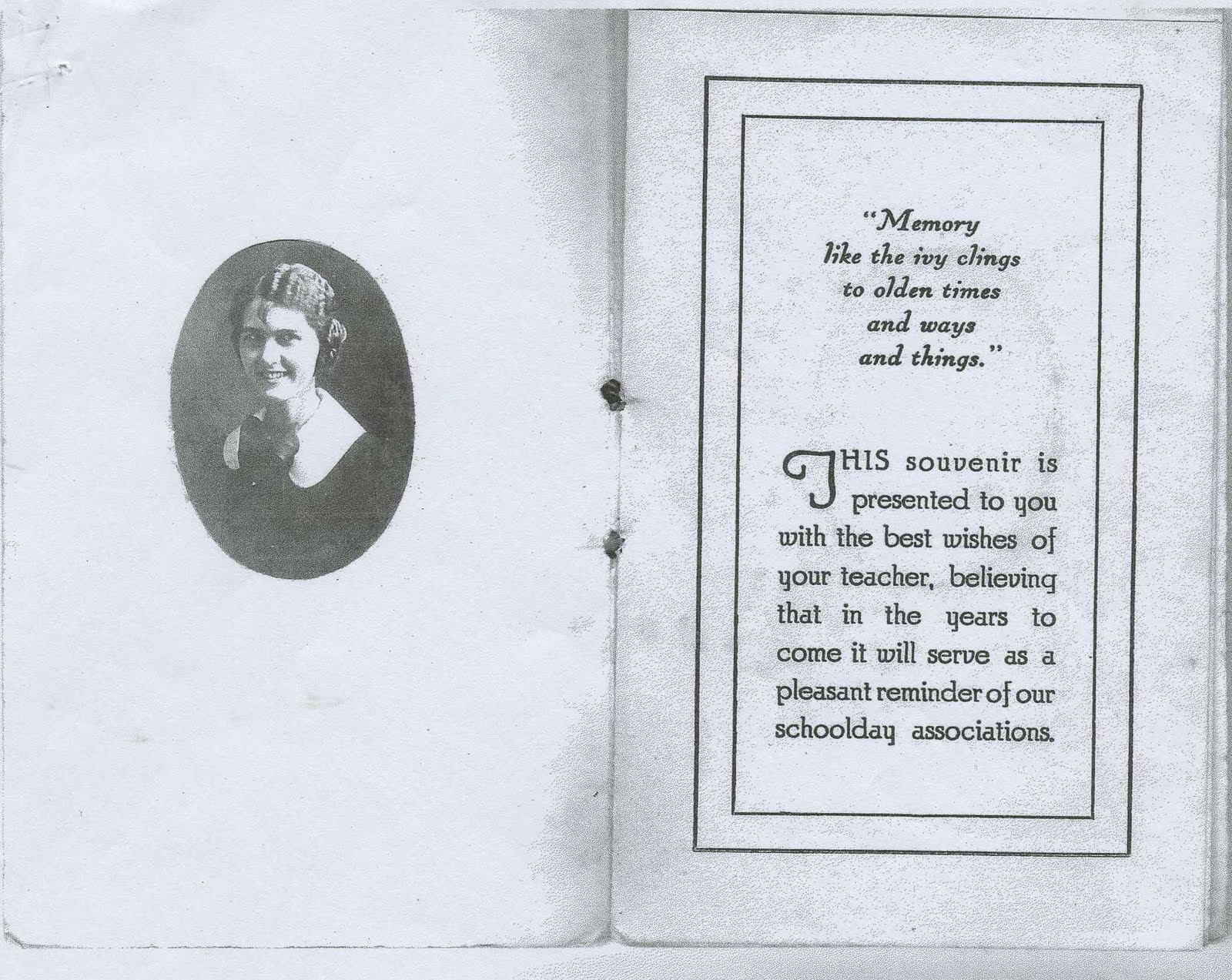
It was just a simple booklet, given by a caring teacher at the end of the school year, but to Terry Blake it was a treasure. Terry had never had a book inscribed with his name before, and besides that, it had the photo of Terry’s Walnut Grove teacher, “Miss Olita,” adorning the front inside cover. The school memory book was taken home by Terry and carefully placed in his secret hiding box. The treasured booklet would be extricated by Terry from its secret place from time to time over the years so that he could gaze upon the photo of “Miss Olita” and see his name, “Terry Blake,” emblazoned (at least in Terry’s mind) in the dedicatory place.

Walnut Grove School
It was 1924 and the Walnut Grove School serving the Peterson Siding community was full of school children. The residents of Oil Creek near Peterson Siding were mostly all subsistence farmers, with some railroaders filling out the slate. There were no luxuries and besides a few marbles, school children, and especially Terry Blake, son of Martha (Posey) and Joseph Blake, had few “treasures.” But now Terry had a memory book with his teacher’s photo and his name written in it. And it was personally given to him by “Miss Olita.”
Olita Strader
Olita Strader was one of the many dedicated school teachers serving in the Oil Creek area during the early part of the 20th century. Although her first name was “Edna,” no one ever referred to her by that name, and instead she was known to her family, friends and acquaintances as “Olita.” To her students, she encouraged the use of “Miss Olita.”

Born to Nicholas and Rosie (Lanham) Strader at Wildcat in 1901, Miss Olita was born to be a teacher, in a family of teachers. The fourth of nine children, Olita attended graded school at Roanoke and, after having exhausted all of the local schooling available to her, prior to 1920, Olita enrolled in Glenville Normal School at Glenville where she earned her teaching certificate.

By 1924, Olita would have been 23 years of age. Whether Walnut Grove was her first teaching assignment we cannot be certain. Memories have faded or died and records are non-existent except for a few mementoes such as Terry Blake’s memory book which provide a record of the students who attended Miss Oita’s school at Walnut Grove.
Miss Olita’s Students at Walnut Grove
Terry Blake
Terry Blake has already been introduced above to the reader. As mentioned, he was the son of Joseph Franklin and Martha (Posey) Blake. In 1924, Terry was listed by “Miss Olita” as a “Beginner – Second” in his Memory Book. Presumably this meant that he was in the second grade. Unfortunately, Terry did not advance much academically because he was afflicted with a speech impediment, as well as mental retardation, and today would be identified as a “Special Needs” student. As he grew older, his physical growth did not keep pace with his age, and he was a very small person after reaching adulthood. To provide him with a sense of security, his mother always accompanied him wherever he went in order to assure that he would not get lost on his short travels away from home. He was however, adept at riding a bicycle which he rode near to his home on Red Lick, a short distance from the Walnut Grove School.. Terry never married and lived his entire life on Red Lick with his sister Ellie and his mother upon whom he was totally dependent.

Violet Blake
In 1924, Violet Blake, sister of Terry, was one of “Miss Olita’s" oldest students. Today, it would almost be unheard of that a seventeen year old would still be attending grade school. However, in 1924, it was quite common that students of that age remained in school as eighth grade students. There was no high school to attend, and with the help an older reliable student for the younger children, teachers would often tailor class work to include post-eighth grade instruction for the older student.

Right, above: Terry Blake
Left: Walnut Grove School near Peterson on Oil Creek
In 1928, when she was twenty-one years of age, Violet married James Townsend, son of Albert Townsend. They lived their married life on Route 2, Weston, until Violet died in 1967 at age fifty-eight. She was buried in the Mitchell Cemetery on Clover Fork.

Oliver, Woodrow and Helen Keith
Oliver, Woodrow and Helen Keith, the three youngest children of Hugh Keith and Margaret “Maggie” Perrine Keith attended the Walnut Grove School in 1924. The four older Keith children, Ruth, Eva, Rudy and Alta had already completed their eight years of schooling and their help was needed on the farm. The Keith family was long associated with the Peterson Siding area. Hugh, the son of Albert and Rosella (Kelley) Keith, operated a general store for several years after he and Maggie were married in 1905. Sometime around 1922, marital bliss ended in the Keith family and Hugh moved to Clarksburg and opened a restaurant. The Peterson Siding Store was sold to Walter Foster and Maggie and her seven children continued to reside at the Keith home a short distance up Red Lick.

Oliver was born in 1914 and attended the Walnut Grove School through the 8th grade. He joined the Civilian Conservation Corps during the 1930’s and served in Greenbrier County where he met his wife. Oliver lived much of his life in Greenbrier County and for many years was manager of a large dairy farm until he developed an allergy to cattle dander. Oliver later worked for the Radford Arsenal in Virginia and for the Department of Highways. He died in 2005.
Oliver’s brother Woodrow was about a year younger. Like his older brother, Woodrow attended Walnut Grove School through the 8th grade and would have been around a third grade student during Miss Olita’s 1924 term. Woodrow served in the United States Army during World War II and after the farm bought a farm near Akron, Ohio. A part-time farmer, Woodrow also worked as an assembler in a plant which manufactured devices used in the space industry. He died at the age of 79 in 1995.
Right above: Oliver Keith
Left: Woodrow Keith
Helen, the youngest of the Keith children, like so many other Oil Creek natives, migrated to Ohio for employment when she was old enough to work. Helen worked in the food and lodging industries at various places in the Columbus area where she died in 1996 at the age of 78. Her married name was McCort.

An interesting historical note about the Keith children is that their great-grandfather John J. Keith (1823-1890) was a veteran of the Mexican War. He is buried in the Keith Cemetery on Red Lick.

Frank, Norman and Henry Ables
Frank, Norman and Henry Ables were sons of Jackson and Eliza (Riffle) Ables, and were born in 1908, 1912, and 1913 respectively. Although their normal residence was on Butchers Fork, during the 1924 school year the Ables brothers were living on Bear Run with their Aunt Fannie Riffle Atkinson (their mother’s sister) and her husband Philip Sheridan Atkinson. At the time Fannie and Philip were in their late 40’s and had a young daughter named Mary. Frank, Norman, and Henry were old enough to do farm chores for their aunt and uncle before and after school, an arrangement which was mutually beneficial.

Frank, the oldest of the three Ables children attending the Walnut Grove School in 1924, married Grace Deletha Posey, the daughter of Martha (Riffle) Posey and “Jack Sam” Posey, a noted hunter of ground hogs who was frequently mentioned in the writings of Uncle Zeke in the Buzzardtown News. Frank worked during his lifetime as a coal miner. He died in 1998 at age 89 and was buried in the Jacksonville Cemetery.

Norman Ables was a farmer and lived most of his life on Butchers Fork, Vandalia, and in the Indian Fork area. He married Ruth Neal, the daughter of Fletcher Neal and Mary Radcliff Neal. Norman served in the Civilian Conservation Corps during the 1930’s in Pocahontas County and was engaged mostly in the building of roads and the planting of trees. Norman died in 1976 at age 64, and was buried in the Harrison Grove Cemetery near Copley.
Henry Ables, the middle in age of the Ables children attending the Walnut Grove School in 1924 was the first to pass away. Henry married the former Mamie Townsend, the daughter of Albert and Virginia Barnett Townsend. Henry and Mamie lived in the Three Lick area. Their children, three decades later, would also attend the Walnut Grove School which their father attended in 1924. Henry was barely 39 years of age when he died in 1948. He was buried in the Jacksonville Cemetery.
Five Puffenbarger Children:
Harry, Lillie, Nellie, Mabel, and Madeline
The Puffenbarger children who attended Walnut Grove School in 1924 were not all siblings. Sisters Mabel and Madeline were the children of Wilbert Puffenbarger and Vera Gay Puffenbarger. Harry M. Puffenbarger and his sisters Lillie and Nellie were the children of the late Roy Puffenbarger and Blanche Ables Puffenbarger. Harry was living with his uncle Addison Puffenbarger on Bear Run and Lillie and Nellie were living with their mother Blanche who later remarried Lloyd Riffle. The fathers of the Puffenbarger children were brothers and were the sons of Joshua Puffenbarger and Louisa Varner Puffenbarger.

Right: Madeline Puffenbarger
Right below: Mabel Puffenbarger

Mabel Puffenbarger never married and lived most of her adult life in the Akron, Ohio area. She was an employee of the Summit County, Ohio Sheriff’s Office for many years and worked as a tax collector. She died in 2000 and was buried at Peterson Siding. Her sister Madeline, who also never married, lived for many years with her elderly cousin Frank Groves at Peterson Siding. After Frank died, she lived with Sylvia and Hayward Groves at Peterson Siding for many years. Late in life, she moved to Akron and lived with Frank’s daughter, Ersel Groves Spencer. Madeline was residing in a nursing home in Ohio when she paased away in August of 2010.
Harry Puffenbarger was raised by his bachelor uncle Addison Puffenbarger on Bear Run after the death of his father Roy in 1922 at the age of 30. Harry followed his uncle into the carpentry and home-building trade, as had many of the Puffenbarger family. An example of the still-existing carpentry handiwork of Addison and his nephew, Harry, is the former J. W. “Bill” Conrad store building in Orlando, now owned by the Burgett family. Around 1930, Harry and his Uncle Addison dismantled the original J. W. “Bill” Conrad Store in Orlando and rebuilt the store in its current location. Harry married Martha Florence Radcliff of Gilmer County in 1941 but they soon separated. He lived at Peterson Siding and died in 1992. Harry’s sister Lillie married Martin Posey and his sister Nellie never married.
Clarence and Mabel Perkey
Clarence and Mabel Perkey were the children of Hayden D. Perkey and his wife Grace Bailey Perkey. Hayden had been a planing mill employee and worked in the busy Braxton County lumber industry during the early 1900’s. He later worked as a carpenter and farmer. Mabel Perkey was twelve years of age when she was a student of Miss Olita at the Walnut Grove School in 1924. After becoming of age, she began work in Clarksburg where she met her future husband Luther Johnson. They married in 1934.

Mabel’s older brother, Clarence, left the Walnut Grove School and Peterson Siding at an early age to work in the coal mines near Boomer, West Virginia. A mere three years after he sat attentively in the Walnut Grove School, he was dead of typhoid fever which he contracted while working for the Boomer Coal and Coke Company. His remains were returned before Christmas in 1927 to the Peterson Siding Cemetery on the hill overlooking the Walnut Grove School.
Not long after their son and brother, Clarence, was laid to rest in the Peterson Village Cemetery, the Perkey family left the upper Oil Creek valley and moved to McKees Rocks, Pennsylvania, a suburb of Pittsburgh, where Hayden found employment.
Floda Hoover
Floda Hoover was the daughter of Clyde and May Peterson Hoover and the granddaughter of Charles Henry and Emeline Smith Peterson with whom she made her home. Her mother’s family was long connected with the Peterson Siding village which was named for her family. In 1924, Floda was an eleven year old student of Miss Olita, and lived close to the Walnut Grove School. Two of her classmates in Miss Olita’s classroom were her close-in-age aunts, Lora and Dorothy Peterson. Since Floda was familiar with the Puffenbarger name, she married the Arthur Puffenbarger, the son of George Harvery Puffenbarger and Rosa Keener Puffenbarger. Arthur was the first cousin of her five Puffenbarger classmates at Walnut Grove School.
Dorothy and Lora Peterson
The daughter of Charles Peterson and Emeline Smith Peterson, Dorothy was twenty-one years of age when she married Walter Currence in 1934. Five short years later she would be a widow with two young children, Delcie and Wilda, when her husband was killed in a slate fall at the Weston State Hospital coal mine. She remarried in 1940 to Silbert Harley Workman of Weston. They became the parents of eight children, all of whose names began with the letter “S” and with a middle name which began with the letter “H.” Dorothy passed away in 1990 and is buried in the Machpelah Cemetery in Weston. Dorothy’s daughter by her first marriage, Delcie, was a frequent visitor to Peterson Siding during her youth and recalls that Sylvia Groves was her Sunday School teacher. Delcie, now a resident of Florida, recalls how she loved to visit the Oil Creek area and how much she misses it.
Lora Peterson was three years older than her sister Dorothy. Dorothy’s and Lora’s older sister Charlotte had married a Connellsville, Pennsylvania native, John Wiltrout, and during a visit with her sister, Lora met her future husband, David Bates, who was also from Connellsville. After their marriages, Lora and Charlotte made Pennsylvania their permanent home.

Stanton and Lena Gay
Lloyd Stanton Gay was the son of Lloyd Glen Gay and Laura (Wellen) Gay. Afflicted with polio when he was young, Stanton had some mobility problems when he was young. After his Walnut Grove school days ended, he took up farming on the family farm. Tragically, an unknown heart ailment proved his end and he died in 1941 at the age of twenty-seven. Like his Walnut Grove School classmate, Clarence Perkey, who died of typhoid while working in the Kanawha coal fields fourteen years prior, Stanton reposes in the Peterson Village Cemetery, not far from his classmate, Clarence.

Stanton’s sister, Lena Gay, was a nine year old student of Miss Olita in 1924. Lena remained single during her lifetime and continued to live on upper Oil Creek. Doris Nicholas of Dunbar recalls pleasant visits with Lena at her home over the years.

Herbert Fox
Herbert Fox was the son of Howard Reese Fox and Elizabeth (Posey) Fox. In 1924, he was fourteen years old, two years younger than his older brother Harley. Herbert began farming for a living after his Walnut Grove school days ended and at age twenty-one married Marnie Elizabeth Taylor Sims. Herbert’s last known address was Jane Lew.
.
Martha Brooks and Charles Brooks
Mary Summers, a kindly woman in her mid-60's who lived at Peterson Siding, was the daughter of Adam Summers and Mary Corathers Summers and a half-sister of Charles Peterson of Peterson Siding. In 1924 Mary took in as foster children a brother and sister, Charles and Martha Brooks, both of whom were enrolled at the Walnut Grove School. The family origin of Charles, who was afflicted with dwarfism, and his sister Martha is unknown and little is known of their life after Walnut Grove. Their foster mother, Mary Summers, eventually moved away from Peterson Siding and into Homewood where she died in 1940 at the age of 82.

The Class Roll is Complete
This completes the class roll of Walnut Grove School of 1924. Nearly ninety years have passed and all of the students of Miss Olita have since died. Few family members of the students still remain in the upper Oil Creek valley and the descendants for the most part have moved away to other sections of the country and have done well. Children of today know little of the struggles of their forebears to make ends meet for the simple things to keep body and soul together. No government programs existed to help educate school children with special needs or to provide support for them if their parents died or became disabled. There were no luxuries in the homes of the families of Peterson Siding and their livings were eked from the soil and from the sweat of the brows of the families. The compassion of neighbors to take in orphans and needy children has mostly been forgotten in the pages of time. Miss Olita, who took from a meager salary the wherewithal to buy each of her students a memory book, was long remembered by her students, and needs to be remembered still, by chronicles such as this one.
.
Miss Olita
It is unknown how long Miss Olita taught at the Walnut Grove School. We do know that she married Karl Post in 1928 when she was twenty-seven years of age and that she gave up her teaching career in order to raise three sons. Tragedy however struck her life when her husband died suddenly in 1936, in the midst of the Depression, leaving her a widow with three children to support. She returned to what she knew best – teaching. She re-enrolled at Glenville State Teachers College to renew her teaching certificate and in 1941 she returned to teaching at the Roanoke School and later at Jane Lew. After touching the lives of many more youngsters with selfless devotion, she retired because of poor health in 1966 and died in 1982.
Right: Olita (Strader) Post with her husband Karl Post

She lies in the serene Mitchell Cemetery, overlooking the picturesque Stonewall Jackson Lake at Roanoke, beside her husband Karl who died many years before her. Many of the students she taught at Walnut Grove School and at the Roanoke School also are at rest in this immaculately kept burial ground. Miss Olita’s son Bill wrote, “Doing for others – that was a way of life for the Strader family, and Olita was no exception.” No better epitaph could mark the stone which lies above her head.
. . . .

Note on the Puffenbarger Family
In the early 1900’s, four sons of Joshua Puffenbarger and Louisa (Varner) Puffenbarger of the Churchville area of Lewis County became residents of the upper Oil Creek valley. Addison, Wilbert, James Roy and George Harvey Puffenbarger found farms in the Peterson Siding and Bear Run areas and raised families there. Addison however remained single and never married although he did help raise the sons of his late brother, James Roy, who died young.

Joshua Puffenbarger (1841-1924) was born in Pendleton County, the son of German-born Henry Puffenbarger and Ireland-born Fanny (Stone) Puffenbarger. Henry was the son of Peter Puffenbarger and the former Sarah Pickle. Henry’s sister Charlotte married Adam Grogg of Highland County. Charlotte’s and Adam’s son, Samuel Grogg, married Margaret Lantz. Their son, Lee Grogg and his wife, the former Mary Montana Tracy, were the great-grandparents of this writer.
.
Note on the photo to the right:
Left to right is Terry Blake, with Jim Townsend and Jennings Roosevelt Blake
.
Comment 1 by Terri Bohl
While investigating my grandfather's family I was very pleased to come across your blog!

I am the granddaughter of the Herbert Fox mentioned in this article. Just to complete what you have listed, I thought I'd add to your information.

Grandpa passed away in Jane Lew on 2/6/88. His wife (my grandma) passed away in St. Louisville, Ohio, on 5/30/94. They had one son, Herbert Blaine (my dad) who is still living.

Great Grandma's full name was Laura Elizabeth Posey.

Thank you for this piece of the puzzle I've been trying to sort out...so many records were destroyed in a courthouse fire that it's been difficult and every little bit counts!