Showing posts with label Family Stutler. Show all posts

Saturday, May 26, 2007

The Dolan House, When the Stutlers Lived There

The Dolan Hotel, the Stutler home, was the big white house that stood in downtown Orlando for at least 75 years. In the late 1940s Oras and Edith (Skinner) Stutler bought the big white house from the Dolan family, who had run a hotel in it as well as used it for living quarters.

Today it lives vividly in the memories of a dozen or so grandkids. Before we forget, we'd like to record what the house was like in the 1950s and '60s, when the Stutlers owned it. Like every house in Orlando, it was pretty much like all the other houses, and at the same time it was unique.
.
To the right above is the first photo we have of the house, (Click on the thumbnail picture below to see downtown Orlando at that time.) To the left is how it looked when it was sold in 1976. The house was torn down maybe ten years after that.
. . . . . . .
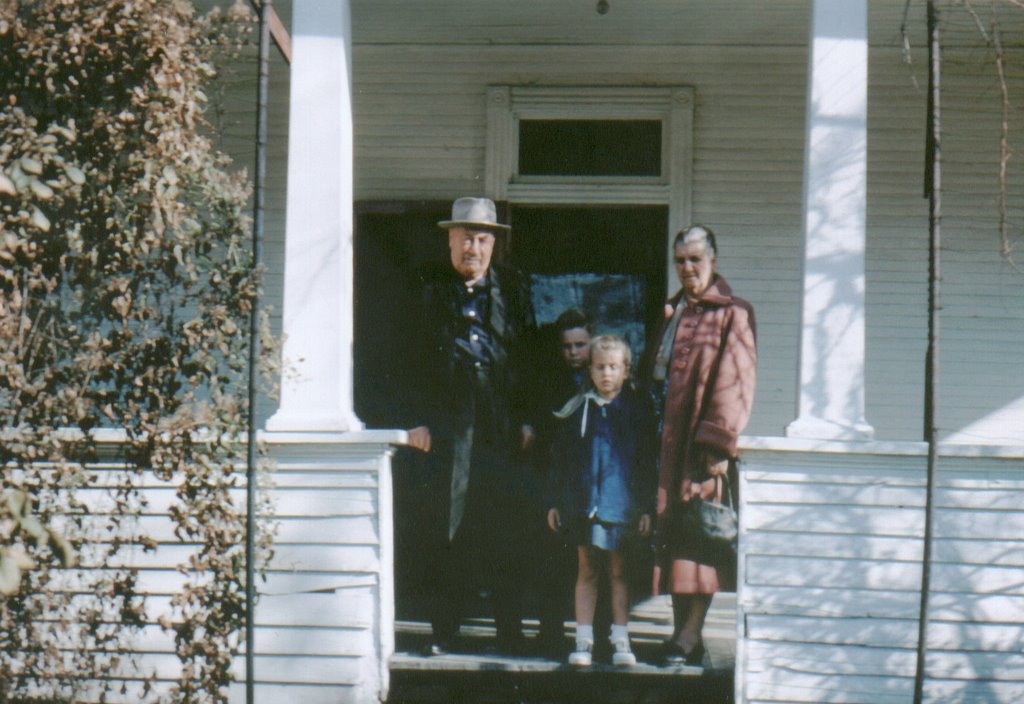
Soooo, welcome to the home of Oras and Edith Stutler. To the left, on their front porch, are Oras and Edith with granchildren Nancy and Gary Stutler, ca. 1960. You can't see the two huge porch swings, one swinging north-south, the other swinging east-west, that Oras built and that Edith loved to swing in while she strung string beans.

As you enter, the wooden screen door slaps closed behind you and you are greeted with the smell of old, old dry wood, blended with whatever smell the day's activites bring: home cured bacon frying, coal burning, starched cotton being ironed. You are facing a hall the length of the house, with a door to the left and right, and a long, dark wood staircase facing you, going up. The door on the left is open, the door on the right is closed. Turning toward the open door, there's a huge, dark wood hall butler to your right, with mirror, hooks for hanging coats, and drawers, for who-knows-what.

The Main Room
Through the open door is the large general room, about 20 feet square, maybe a 14 foot ceiling. Oras & Edith's bed is in the far corner. Their marriage license is framed, and hangs at the head of their bed. There's a nondescript couch and comfy overstuffed rocker and few other furnishings grouped around the coal fireplace, the only source of heat in the room. The fireplace is beautiful wood with a two-shelf mantle, making it an imposing feature, even in this large room. The mantle shelves hold photos and creations of the grandchildren. It is a coal fireplace, which is extremely shallow, too shallow to build a wood fire, and has the grate attached to the back of it, rather than sitting on the floor of it..

To the right is Oras and Edith, with granddaughter Sandy Burgett, of an evening in the general room. (Sandy married Roger Conrad and they raised their three kids on Three Lick.)
Until the mid 1950s the house had gas but no electricity, so gas lights had to be lit each night. After electricity was installed there was an old radio sitting on a library table under the front window, where Oras sat by the hour, listening and smoking the cigarettes he rolled with Prince Albert tobacco in the can. It wasn't until the last 1960s that television reception became generally available in those hills. Then a television joined the room's furnishings. Between the fireplace and the east (Kitchen) wall is a built-in wooden unit, drawers on the bottom and above, a cabinet with frosted glass in the doors. There's nothing special about it, but for some reason we kids always thought it was more magical than anything Mary Poppins ever came up with. In the center of the east wall is a swinging door into the kitchen.
.
The Kitchen
The kitchen is about the same size as the main room, about 20 feet square and 14 feet high. In our earliest memories there was a wood stove immediately to the left. Before electricity the ironing was done in the kitchen with flat irons that heated on the stove. There is a home made wooden pie cupboard on the right side of the room as well as the refrigerator, which we call the ice box. Was there ever an actual ice box? Because the earliest refrigerator was gas powered, there may have always been a refrigerator in the Stutlers' time.
.
A counter runs the length of the north wall of the kitchen, with cupboard doors running underneath, providing storage space. The left third of the wall has shelving for dishes and glasses. The center third of the wall is windows. and to the right is a sink. Before the house got plumbing, the sink drained out of the house through an open pipe in the wall. The pump was on the back porch and water was carried into the kitchen.

.To the right is Edith of a winter morning, getting ready to go out to do the morning chores of caring for the cow and feeding the chickens.
.
Immediately to the right of the sink, on the east wall of the room, is a large mirror with a flamingo, of all things, painted in the corner, like a souvenir of Florida. Before there was a bath room in the house this mirror must have served for a shaving mirror. The window in the center of the east wall looks out onto a covered, L-shaped, ground level porch.
.
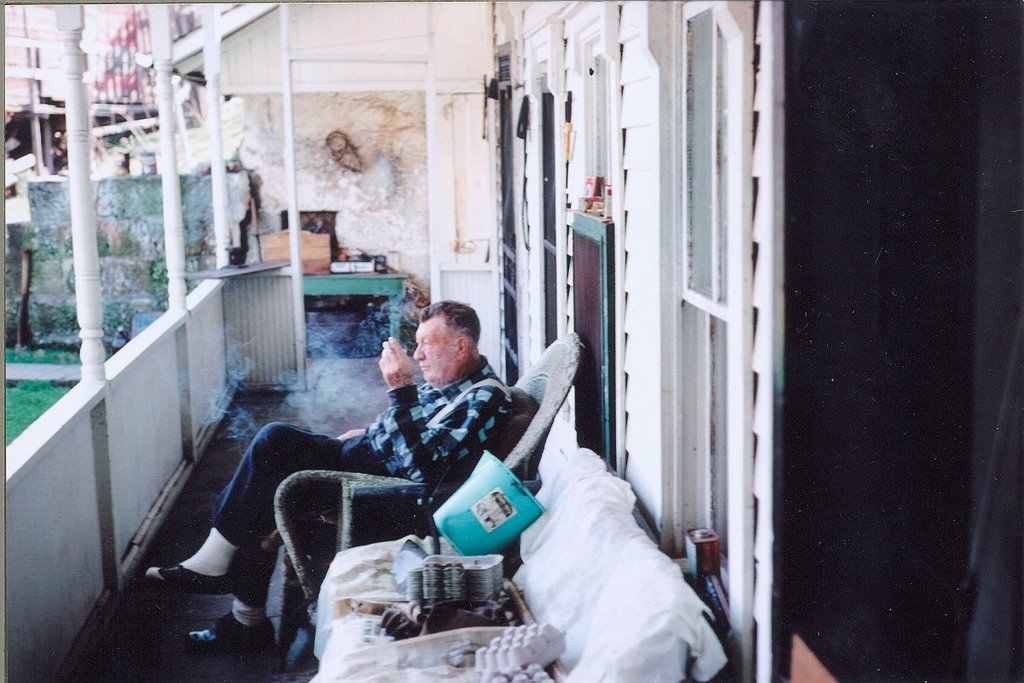
To the right is Oras sitting on the back porch. It was taken looking east, outside the kitchen door.
.
Near the back door, on the opposite side of the room from the stove, is a small, ancient gas space heater with broken tiles that provides whatever heat is needed beyond what the stove provides. Remember, the house has gas outlets throughout for heaters and lights, and whatever else could be operated with natural gas..

In the center of th ekitchen is a large round oak table and wooden, cane seated ladder-back chairs. A door on the south wall leads into the hall.
This kitchen has the craziest smells. Mostly, of course, we notice the cooking smells. Frying home cured hame was unimaginably stronger and more pungent than anything you can imagine, and when the ham hits the pan, the look on the faces of Edith's kids is nothing less than beatific. Depending on the day of the week, there may be baking bread or baking deserts or a chicken frying. Or, maybe there's starched cotton being ironed, or the ammonia of a New Tonette home permanent or . . .
Under those changing smells is a distict and one-of-a-kind smell, with several components. Well water always brought a subtile iron smell to the room. However, when the Barnetts, next farm to the north, allowed natural gas drilling on their property, sulfuric fumes were released and ever after that, the water smelled and tasted miserably of rotten eggs. And that is the only source of water; no one ever heard of bottled water in that time and place. Another smell, since Edith kept a cow, is raw milk. Raw milk, fresh from the cow, has a smell kind of like a baby's breath, but stronger. You either love it or hate it. Because the pigs' slop bucket sits out of the way between the stove and the cupboard, the corner over by the cupboard always has a slight, milky/garbagy smell, but as Edith is an impecable housekeeper, and the slop goes to the hogs every night, it's not a strong or unpleasant smell.
.
Stepping out of the kitchen into the back hall, turning left presents several options including cousin Neil's bedroom, which is small and in the "lean-to" addition at the back of the house. From the late '50s on, there is also a door to room that is much too large for the sink, toilet and bath tub/shower that it holds. There's no window as it has no outside wall.
.
The Spare Room
But directly across from the kitchen is the door to the spare room. It is another large, maybe 20 square feet, room with a high ceiling. It has a coal fireplace on the west wall and shares the flue with the fireplace in the formal living room. This room is used as a spare bedroom, but it is so lare it also holds other furniture, including an old, old horsehair and leather hide-a-bed. It's a good place to put a kid with the measles, or to play 45s on the record player with friends. After the house gets electricity, it's also a nice out-of-the-way place to iron. On the east wall there's a door to a work room, but for now we'll take the door on the right, which goes into a tiny closet with a door on both sides. Through the second door os the formal living room..

The Living Room
In the south west corner of the house is the formal living room. You've just come through a closet on its right side of its east wall. A coal fireplaceis in the center of this wall. The room has huge, overstuffed, oversized furniture in a deeply piled, but simple, burgundy velvet. It is dark and quiet in this room as the windows are never opened and the shades are always pulled. On hot summer days it is always the coolest room in the house. It is a great place to sneak away to.
.
It seems the grandkids mostly found their way into this quiet room by themselves. Some of the cousins found it spooky, sensing a presence that they didn't like, especially in the two large, old-fashioned photographed portraits that hang on the north wall. For others it was mysterious and magical. Part of the majgic came from the closet on the left side of the fireplace. There were old Dick and Jane style school books, and old paper dolls, and more.
.
The living room was rarely used, but we grandkids can recall at least three uses. One is Christmas Eve. The tree was magically already decorated when the door was opened on Chrismas Eve for us kids to rush in.
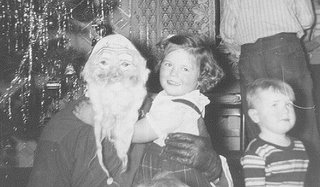
To the left are grandchildren Donna (Witzgall) Gloff and Joe Burgett with the world's scariest Santa.
The living room was also used for Aunt Virginia's1 funeral in the 1950s. Her open casket was in the room, just as we do in a funeral home today and people came to pay their respects. The day she was buried the lid was closed with a prayer and her body was taken to the Methodist Church where it was lovingly carried to the front. The lid was opened again and we said our last goodbye. After the service the coffin was driven up the steep hill to Orlando Cemetery, where she rests with her parents and their parents, and their parents. When Oras died in 1967 Edith had his funeral out of Alkire's Funeral Home.
.
Jackie (Witzgall) Holbrook tells us that the living room, and the spare room behind it, was also used as a Lewis County poling place. Read bout that in the June '07 entry coming soon.
.
Other Parts of the House
There are lots and lots more details to write down just about this, the main floor of the house. There are also the second floor and the rooms, first and second floor, of the additions. There are also numerous out buildings and areas that were used for special purposes outdoors.

To the left is another shot of the house.


Footnotes
1 Oras and Edith's oldest child, Virginia, had married Lambert Beckner and moved to Detroit. She died there, at home, of tuberculosis. Virginia and Lambert had two small boys who went to live with the Orlando grandparents. Bill lived with his dad's parents, Josie and Red Beckner and Neil lived with Oras and Edith.
Comments
comment 1
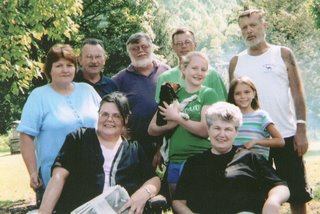
Here's Edith (Skinner) Stutler with most of her grandchildren and their families in the 1960s on her last visit to Detroit. Also, her brother-in-law Jack Stutler and wife Theresa are in the upper left corner.

Saturday, March 24, 2007

O.M. Stutler Came To Work

Ovie Merlin Stutler moved from southern Harrison County in the 1870s.1 By 1880 he was boarding with Andrew Jackson and Ora (Riffle) Heater in Orlando. O. M. worked as a lumberman. The censuses for the 1880s and further forward reveal a steady smattering of young men boarders with names unfamiliar to the Oil Creek watershed as many, just like O. M., came to the area seeking employment in lumbering, road and railroad construction, gas and oil well drilling. (See the notes on Orlando Migrations at the end of this entry.)

O.M. had a son with Ora's younger sister Ennie when Ennie was 16 and O.M. was 20. They named the boy Oras Lenord. For a while Ennie and their son Oras lived with her folks, John Scott and Marianne (Skinner) Riffle. On December 20, 1900, when Oras was four years old, Ovie and Ennie married. They set up housekeeping on Oil Creek and had five more children that lived to adulthood, Mary, "Jack," Frank, Ebe and "Mutt." They also lost one or two children who died very early.
.
Left: Ovie Merlin: "a man out standing in his field".
Right, above: Ora and Andrew Heater.

Right, below, Ovie and Ennie and, we think, son Frank at an unidentified location.

By all indications this was not a particularly happy or successful household. O.M. and Ennie never had any noticeable financial success. Judging from their sons' behavior, O.M. was physically abusive and alcohol probably played a significant role in that.

Piecing together information from land records with the bits that we children overheard, an unflattering family portrait emerges. For example, Ennie wanted to move to town, to Weston. She sold her land2 for a small fraction of its value to the area's land mongers, the Camdens. Their son Oras with his young family lived on that property, too, and had paid a lot of the debt on it. The land records show a few months after his mother sold the property Oras repurchased it for several times its sale price.

But the kids grew up. The oldest, Oras Lenord, b. 2 Aug 1896 stayed in Orlando. As a young man Oras was a hell raiser. However, he went to work for Hope Gas Company and worked for that company his whole life. (See the Nov '06 entry
Orlando Man Drills Large Well for more on Oras' work.) He married a local girl, 2nd cousin Edith Della Skinner. Oras went to France to fight in World War I shortly before the war ended. Like most Orlando folks at that time, he and Edith also maintained a small farm that mostly just supplied the family’s food: hogs, chickens, milk cow(s) corn and other feed and a vegetable garden. They raised five healthy, successful kids.

The second child, John Scott "Jack" b. 13 May 1905 moved to Detroit and worked at the racetrack. He married a couple times in Detroit, but had no children.

Mary Ethel b. 13 Nov. 1901 married Leo Moran of Weston and they lived in Fairmont, WV.

Ebert b. 16 Apr 1909 married Ruth Henlein and they had two daughters, Betty and Carolyn.

Frank b. 5 Apr 1911 married Evelyn Gay, daughter of Noah M. and Rose (Atkinson) Gay and they had a boy, Frank and a daughter, Joyce. Young Frank was killed in an auto accident.

O.M.’s namesake, Ovie Merlin, Jr., b. 18 Dec. 1913, nicknamed "Mutt", married a Maryland girl, Anita Boswell and they had a son, Jerry. Then Mutt fought in World War II. It took its toll on him. His wife knew he came back a different man than he was when he left. Still, he was a good man and they settled in White Sulfur Springs.

Right: with all their children, Ovie and Ennie are in the center. back row, l to r, Jack and Theresa, Leo and Mary, Oras and Edith. Front row: Anita and Mutt, Frank and Evelyn, Ebe and Ruth.


Stutler Ancestors
Ovie Merlin's Stutler line can be traced to Switzerland by DNA testing. The Stutlers' immigrant ancestor was probably the father of Revolutionary War Veteran and pioneer John Stutler.
John Stutler married young Sarah Hughes in 1784 at the frontier fort at West Milford in Harrison County. This was when the pioneers were fighting the Indians and clearing virgin forests. Sarah was a cousin of Jessie Hughes, the Indian fighter. Through Sarah O.M.'s ancestors knew George Washington who, as a very young man, surveyed the Hughes lands on the Great Cacapon River in the WV eastern panhandle.

The sketch was made by Diss Debar under the direction of a man who who knew Thomas Hughes. We have no likenesses of O.M.'s 3g-grandfather Hugh Hughes, 1715-1763, but Thomas was his brother. Also, Thomas was the father of Jesse Hughes, Indian fighter who lived for a time at the source of the Little Kanawha River.

Through Ovie's great grandmother Abigail Jackson one branch of his family can be traced back to Boston's earliest settlers, the Winthrops, and another branch goes back to Britain's Plantagenet rulers and the royal families of Europe.
.
.
NOTE ABOUT MIGRATIONS INTO THE COMMUNITY
1. In the early years of the community that would become Orlando the small population was pretty stable. For the most part, new blood came into the community in three waves. The first settlers are discussed in the Nov. '06 entry First Settlers. They married among themselves and they married kids who lived "just over the hill" from the Oil Creek watershed, on Fleshers Run, Sand Fork, and Riffle Run and such.

2. The Irish Catholics are discussed in a note at the end of the March '07 entry, Margurite Sweeney's Immigrant Great-Grandma. While none settled in the Oil Creek watershed, a few Irish Catholic immigrants were among the early, the pre-Civil War, settlers nearby, including the Griffins on Flesher's Run, just over the hill from Clover Fork. The wave of Irish Catholics into the Orlando area came with the children of early settlers in the northern part of the state, Clarksburg and Weston areas.

3. A third large influx came into the Oil Creek watershed with the railroad construction, lumbering, then the search for natural gas and oil. These were workers who came into the area for the purpose of working. They married into the community of original settlers and settled in. William Beckner was one of these. He married Josie Riffle. Virgina McCoy came to Orlando to teach school and married Glenn Skinner, grandson of Skinners, Blakes, Bennetts and Conrads. Ovie Merlin Stutler who married Ennie Riffle was another of those who came to Orlando to work and married into the community and stayed.


Footnotes
1. This information has been pieced together from the 1890 census, marriage and death certificates.

2. All property was held solely by Ennie; O.M.'s name doesn't appear on any purchase or sales documents.

Monday, February 12, 2007

Grandma Edith Stutler's Apron

By Sandy (Burgett) Conrad

As long as I can remember, grandma, Edith Stutler, always had an apron on. The only time you saw her without an apron on was when she went to town, like Weston or Sutton. I was so used to seeing grandma with an apron that she didn't look right without one. She did not let anything go to waste, she even used feedsacks to make aprons. I still have a couple of grandma's aprons, one she wore and one she made for me when I was a little girl. Who knew that something so simple like an apron would become such a treasure.


Above is one of grandma Edith (Skinner) Stutler's aprons, which she made from two chickenfeed sacks. (When the seams were removed from the sacks the fabric measured 20 inches by 34 inches.) To the right she wearing the apron in her kitchen on a winter morning. She has just come in from milking the cow and has not taken off her "milking cap" yet.


Below is Edith standing in her side yard on a summer day, wearing an apron with a different cut, but also made from feed sacks. Edith's vegetable garden is behind her, Bill & Marie (Parmer) Barnett's house in the distance.

Sandra (Burgett) Conrad, is the daughter of Juanita (Stutler) Burgett (1925-1994), daughter of Edith Della (Skinner) Stutler (1896-1907).

See also the following entries
About Edith Stutler
Apr '06
Oras and Edith Stutler's Family on Oil Creek
Apr '06 Cow Milk & Where Calves Come From
Jul '06
Up the Lady's Leg
Nov '06 Sweet Potatoes

About feedsack fabric
Feb '06
Feedsack Fabric


You might enjoy the following meditation on a grandma's apron by Gloria Jean Husk.
She printed in the Hacker's Creek Pioneer Descendants' member's e-mail

Grandma's Apron
Do you remember your Grandma’s apron?
The principal use of Grandma’s apron was to protect the dress underneath, but along with that, it served as a potholder for removing hot pans from the oven.

It was wonderful for drying children’s tears, and on occasion was even used for cleaning out dirty ears.

From the chicken coop, the apron was used for carrying eggs, fussy chicks, and sometimes half-hatched eggs to be finished in the warming oven.

When company came, those aprons were ideal hiding places for shy kids.

And when the weather was cold, grandma wrapped it around her arms.

Those big old aprons wiped many a perspiring brow, bent over the hot wood stove.

Chips and kindling wood were brought into the kitchen in that apron.

From the garden, it carried all sorts of vegetables.

After the peas had been shelled, it carried out the hulls.

In the fall, the apron was used to bring in apples that had fallen from the trees.

When unexpected company drove up the road, it was surprising how much furniture that old apron could dust in a matter of seconds.

When dinner was ready, Grandma walked out onto the porch, waved her apron, and the men knew it was time to come in from the fields to dinner.

It will be a long time before someone invents something that will replace that "old-time apron" that served so many purposes.

Thank You Grandma for all that you taught me!

Saturday, November 18, 2006

Orlando Man Drills Large Well

First published in 1941, from an unidentifed clipping, probaby from the Braxton Democrat.

By Harriet Jane Kidd
BURNSVILLE-
Oras Stutler, who is spending a short vacation at his home near Orlando, drilled in one of the largest gas wells in Kentucky’s history week before last in Pike County. Gas was struck unexpectedly at a depth of about 3000 feet on reaching sand through which it has been customary to drill about 700 feet.

The well was reported to have made 30,000,000 feet, for four days and nights. It came in with such force that gravels shot through the metal roof, leaving holes the size of a hen’s egg. The roar precluded any conversation between the men. The tool dresser rushed to the motor and Stutler to the dynamo.

The Clay County gas well disaster in which his fellow townsman Bee Heater was seriously burned was too fresh in Stutler’s mind, he said to overlook any rules of safety. The bursting of an electric light bulb would cause an explosion fatal to every living thing nearby. How a singled bulb was not burst as the gravel peppered through the metal roof was a mystery to the driller. Since the well came under control it is reported to be making 5,000,000 feet.

Stutler will return to Kentucky next week. A veteran driller, Stutler is also a World War veteran. His daughter Mary will graduate from Burnsville High School next May. Juanita, a younger daughter, is a freshman.


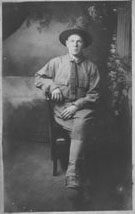
The top left photo is Oras Stutler in 1918.
The top right photo is Oras Stutler sitting on the back porch of his home in the 1960s.
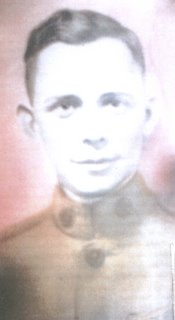
Bottom right photo is of Bee Heater, Oras' brother-in-law, who was seriously burned in the Clay County gas well disaster.

Thursday, November 16, 2006

When Orlando Boys Went "Over There"

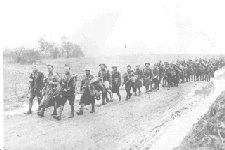
For a small community Orlando seems to have sent off a large number of its boys in every war. Pictured here are four young men who marched off to fight in the War To End All Wars.

To the right is Austin Skinner. He was a Corporal in the 27th Infantry. His parents were William Otto and Clara Oneta (Skinner) Skinner. Cousin Crystal Kearns is the source of this beautiful photo. Later Austin Skinner would work in the glass industry. He died from rheumatic fever in a Clarksburg at the age of 50

Clyde Skinner was the grandson of Alexander & Phebe (Conrad Skinner. His portrait is upper left.

Peter Blake's portrait is center left. He came back to Orlando, married and, like his father Patrick Newton "Uncle Zeke" Blake before him, worked for the B & O.

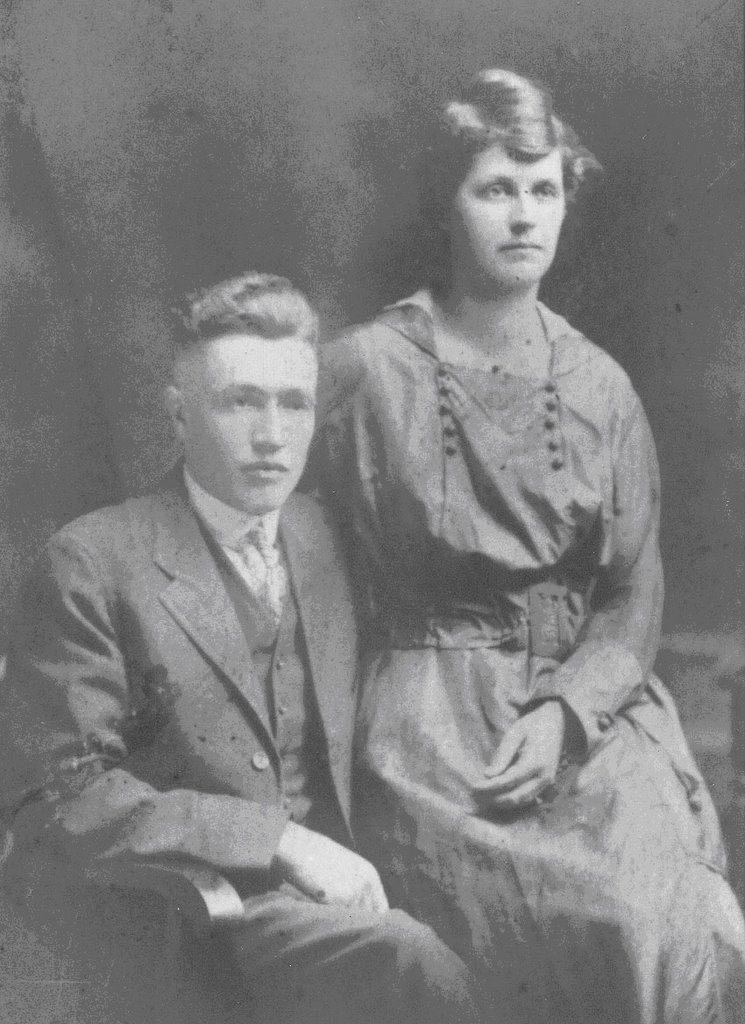
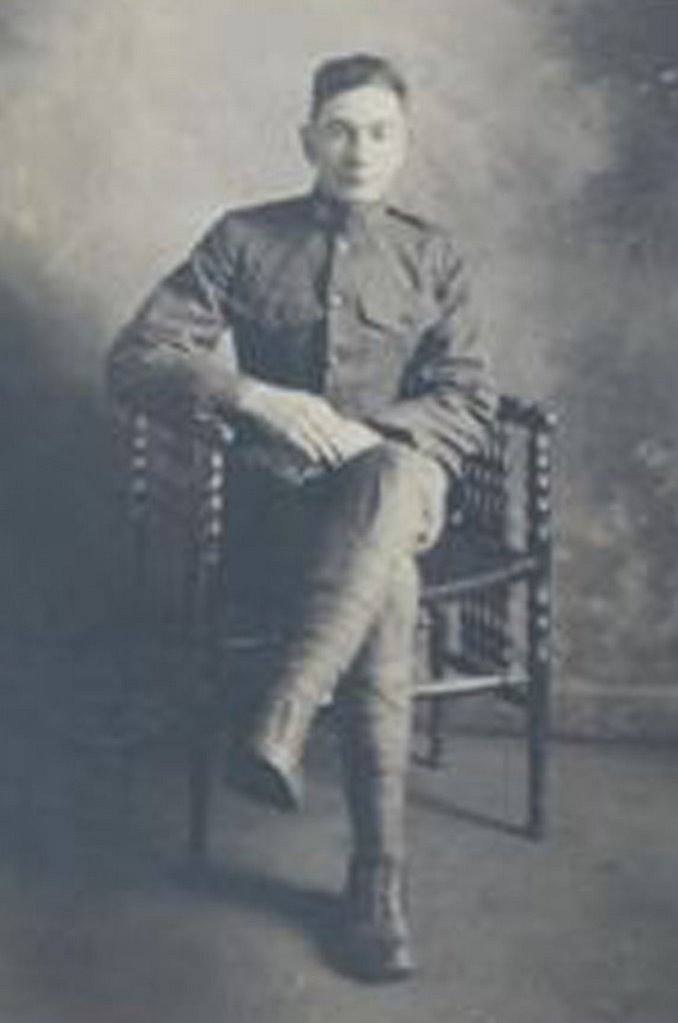
The day before he left for the war in 1918 Oras Stutler and his new bride, Edith (Skinner) had the photo at the lower left taken. He was working for the Hope Gas Company when he entered the service and he retired from there many years later.
Charles McNemar tells us that Okey Strader was gassed during his service in WWI.

Several sources speak of Orlando boys in the First World War. In the 1920s John Sutton1 listed James B. Blake and John Conley as Orlando boys who were wounded in WWI.

The second source is Lee Blake2. He told us "the second son of Thurmissa and Lucy (Skinner) Riffle, Clellie V. Riffle was killed in battle on October the 24. 1918." Clell was a private with the 7th Infantry 3rd Division and is buried at Aisne-Marne Cemetery Belleau in France.

Alfred Lee Skinner, son of Charles and Margaret (Cozer) Skinner born in 1892, was another of our boys. He was in France and and Germany.

West Virginia Archives lists one Orlando soldier killed in action. Private Solomon H. Brown AEF son of Homer Brown, belonged to Company M of the 128 infantry. He was killed in action on 8 November 1918, four days after the Germans asked for the armistace and three days before it was signed. He's buried in the Meuse-Argonne Cemetery, France.

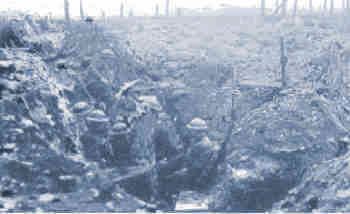
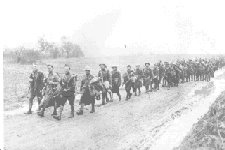
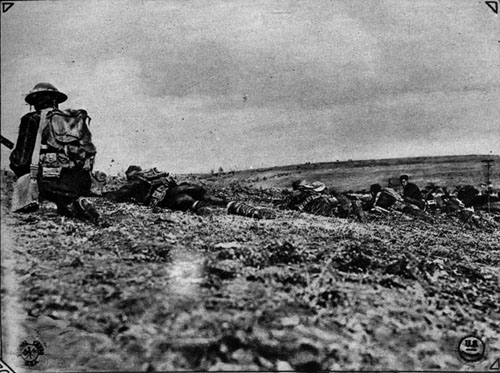
Below are a couple photos from the Meuese Argonne Offensive where we lost Homer Brown.4


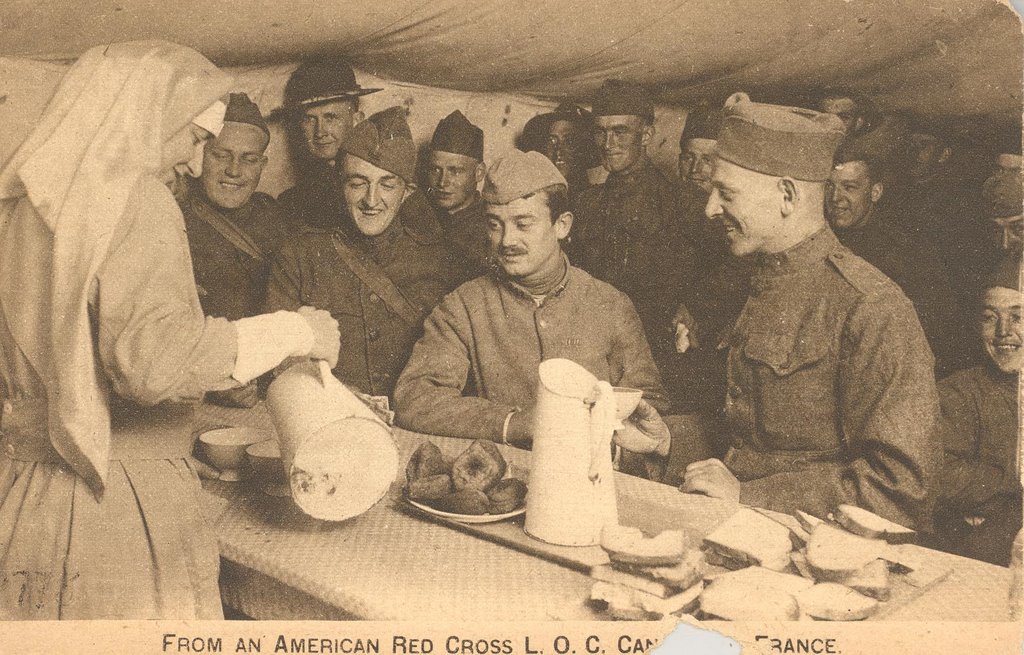
Below is a Red Cross canteen.5


At both the the Meuse-Argonne and the Aisne-Marne Cemeteries the graves look like the photo to the lower right.
See also
Nov 20 '06 Selling WWI War Bonds
April 21, '06 Water Travel


1. Sutton, John Davison. History of Braxton County and Central West Virginia. (McClain Printing Co, Parsons, WV. reprint 1967) pg 457.

2. Blake, Lee. Monograph: Blakes and Riffles Going Back To The Seventh Generation. dated July, 1953 Weston, WV.

3. West Virginia Archives

4. The Doughboy Center The Story of the American Expeditionary Force

5. The Samuel Bloom World War I Archive: Diaries, Letters, and Related Printed Material, 1917-1919, from Samuel Bloom (1895-1976)

Friday, November 03, 2006

Sweet Potatoes

One of grandma Edith (Skinner) Stutler's crops was white sweet potatoes. It seems there's a certain kind of sweet potato that folks grow in central West Virginia that you can't find in the Detroit area. That isn't unusual. In family farming, seeds (and in this case sprouts) for spring planting are taken from last fall's harvest. They are not necessarily the varieties Burpee chooses to market. Grandma grew varieties of vegetables that are now coming back on the market as "heirloom" varieties; her low acid yellow and orange tomatoes, for example.

Bill Beckner picks up a winter's worth of local sweet potatoes at a Weston fruit & vegetable market every fall. Another of the Detroit area cousins has them shipped to his home each fall.

Bill tells how helping our grandmother with the sweet potato planting was a rite of spring that he remembers fondly. Sweet potatoes are planted differently from most crops in that its the green sprouts rather than seeds or eyes that are planted. The kids are sent into the newly greening brambles and woods to find branches and twigs to use to shelter these tender little plants from the elements until their root systems get established. Don't you know grandma must have done the same thing as a kid?

Wikipedia makes it clear why sweet potatoes would be a part of a West Virginian family garden. "Sweet potatoes are often considered a small farmer's crop. They grow well in many farming conditions and have few natural enemies, pesticides are rarely needed. They can be grown in poor soils with little fertilizer. . . Because the rapidly growing vines shade out weeds little weeding is needed, allowing farmers to devote time to other crops."

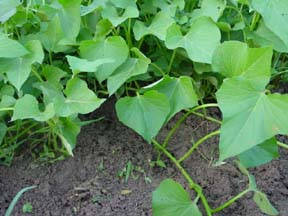
At the top left is a photo of sweet potato vines.
The photo of sweet potatoes with different colored skins and flesh was taken from the Internet to demonstrate the variety that is available even in commercial sweet potatoes.
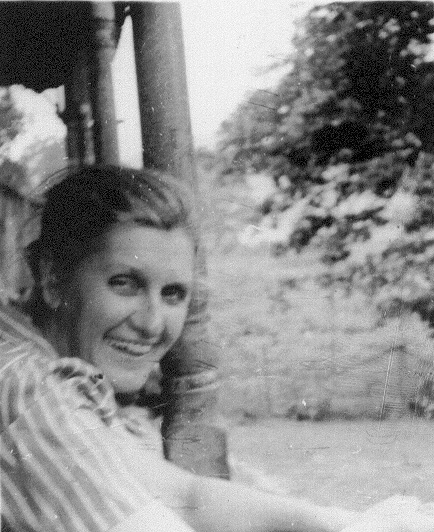
To the left is a photo of our grandmother, Edith (Skinner) Stutler.
To the right is a photo of grandpa Bill Beckner with another variety of home grown sweet potato.

Thursday, November 02, 2006

Telling Tales

There's a kind of story that was common sitting on the porch of the post office or around the Sunday dinner table. It poked gentle fun at those we loved as it exaggerated the qualities of human nature we all share. These stories always had some basis in the truth and some bit of the outrageous.

Patricia (McPherson) Stutler, my Aunt Pat, used to tell this story on one of my great aunts, I can't remember which one. When Aunt Pat was maybe 12, the aunt in question asked little Patty if she would wash her dishes for a dime. Well, there was quite a stack of dirty dishes on the table and sink, but 10 cents was a lot of money, so she said, "sure!" Aunt Pat had pumped the well water, heated it on the stove, and was well into the task when the old lady opened the oven and pulled out a pile of greasy, baked-on-dirty pots and pans. Patty kept washing. Then the old lady opened a cupboard, and in it were stacks of dirty dishes! Kids didn't talk back in those days, but, as you might imagine, Aunt Pat never agreed to wash dishes for the old lady again.

To the right is a photo of Aunt Pat with her new husband Bill Stutler on their wedding day in the early 1950s. Bill Stutler was my mother's baby brother.

Dave Hyre sent the following tale told on Claude Linger2 whose exploits in the Burnsville flood of 1943, reported in the The Clarksburg Telegram, appear in the Oct '06 entry The Burnsville Flood of 1943. There are obvious discrepancies between the following tale and the newspaper report. Even if the reader doesn't believe everything printed in the news, that reader would do well to note Denzil Stillwell's comment that Grandpa Vic was not above embellishing a story.

From Dave Hyre.......Brockton, MA.
"I share the following story sent to me October 2004 from Denzil Stilwell, Glenville, WV. - - -
' I remember your grandfather Victor Hyre. I believe he ran a pool hall which was once located between the old bank building across from the Gulf filling station and Carl West's beer joint about half a block west toward the tracks. I believe he sold beer because of a story that was told in which he was involved. That story has Claude Linger assisting Vic in salvaging things as the water began flooding his place, probably during the 1943 big flood. Claude would ferry stuff by john boat over to dry land and Vic would select stuff etc. Finally Vic loaded Claude up with a few cases of beer for some reason. Claude took that load to his house (about 150 ft away just west of Vern Wiant's house) and didn't return. Vic had to swim out.

'Grandpa Vic always embellished the story about how high the water got. That said, the pool hall was on the upper floors of Victor's Barbershop. So, if he thought that the beer supply needed saving, the water was rising pretty damn high. If I had been Claude emptying out Vic's beer supply, I would have taken a break too! '"
- Dave Hyre.......Brockton, MA


This ca. 1915 photo from David Parmer's collection shows the area in Dave Hyre's story at an earlier and drier time. David Bennett and his young sister-in-law Marie Parmer are in front of the bank and Vic's barber shop can been seen just behind them. At this point it the barber shop had only one storey.

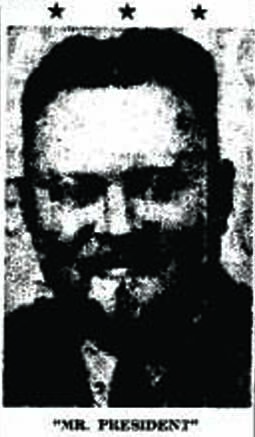
Charles McNemar shares a 1950s article about Claude Linger. Click on the thumbnail of the page on the right to see a readable copy. The article shows that Burnsville's notable Mr. Linger was no stranger to tall tales.

The photo above left of Claude Linger is taken from the newspaper article Charles found for us.
see also
2 Oct '06 entry Buggyride to Burnsville

17 Oct '06 entry The Burnsville Flood of 1943.
3 Nov '06 entry Several of Orlando's Citizens

1. Aunt Pat is Patricia McPherson who married my mother's younger brother, Billy Stutler. I don't recall which of my grandmother Edith Skinner Stutler's sisters was the clever task master, but she would have been a neighbor of Aunt Pat's, and not a relative.

Friday, September 22, 2006

Joe's Song

"Joe Quinton Burgett, 58, of 75 Clover Fork Road, Orlando, died Tuesday, September 5, 2006, at his residence."

Joe had been so ill that most of us hadn't expected him to still be with us when met this past Labor Day weekend on the hill overlooking Orlando, but he was there! He was pretty sick, but he'd just bought a dobro and had set about exploring and learning to play the old songs with Marilyn (Cole) Posey and her cousin, Charley Cole.

Joe was born and grew up in the Detroit area. He was in the Lamphere High School Band and studied landscape design in college. He was bright, creative and had an independent streak that could drive you nuts.

Joe served in special services in Viet Nam. He didn't talk much about his time there, and he carefully edited what he did say. Like so many other young men, when Joe came back he was never the same. He was still bright, caring, independent and sometimes ornery, though. Joe was a truck driver, big rigs, after he came back.

Joe's mom was one of the many Orlando folks that leave the hills to get work and move back as soon as possible. His mom, Juanita (Stutler) Burgett, bought Charley Knight's old store from W.D. Brown, just down from the former Dolan Hotel where her parents Edith (Skinner) & Oras Stutler had been living since the early 1950s. Joe's brother John and sister Sandy settled in the hills, too. Sandy married Roger Conrad and they raised their 3 kids on Three Lick. John, also in the service (Desert Storm & Iraq), and his wife Tammy and 5 kids live near Weston. Joe's 3 kids, Scott Redden, Jonell Barr and Connie Osentoski, all live in southeast Michigan.


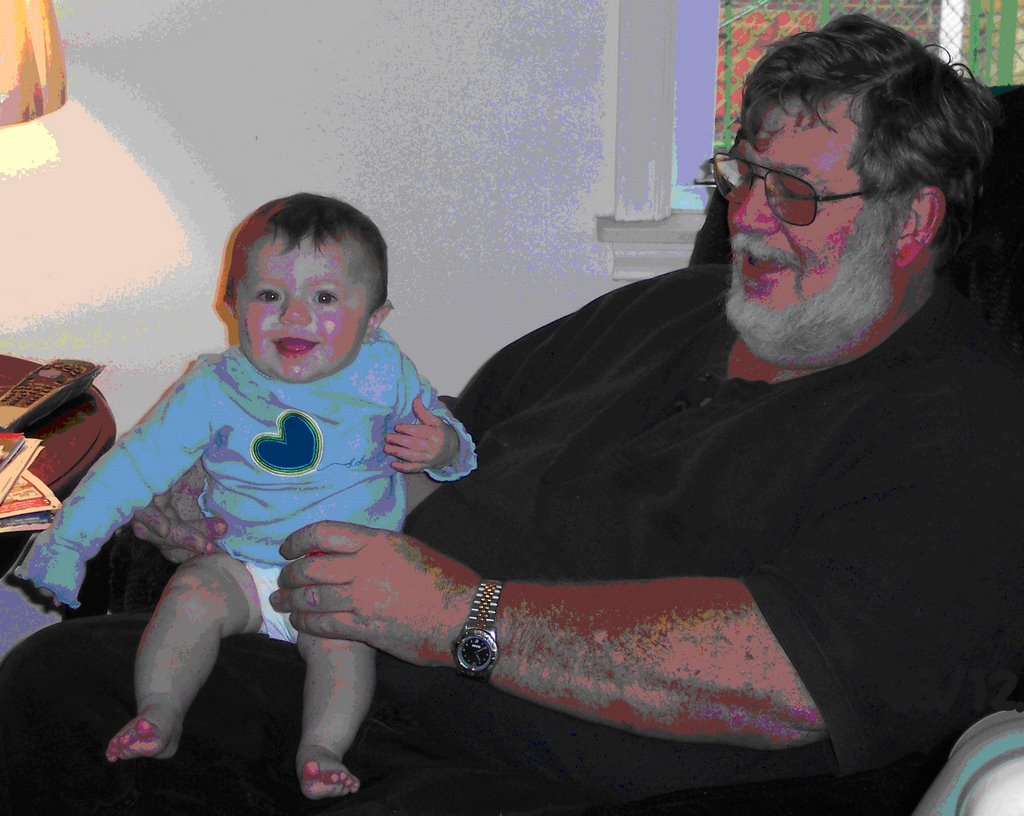
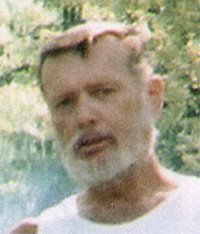
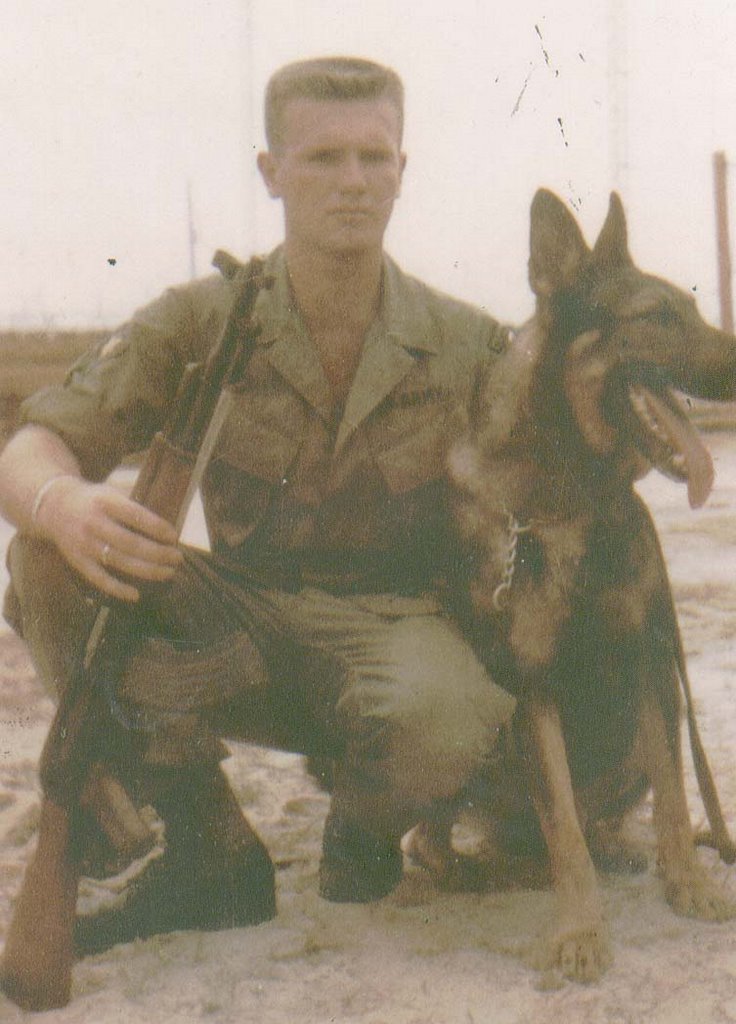
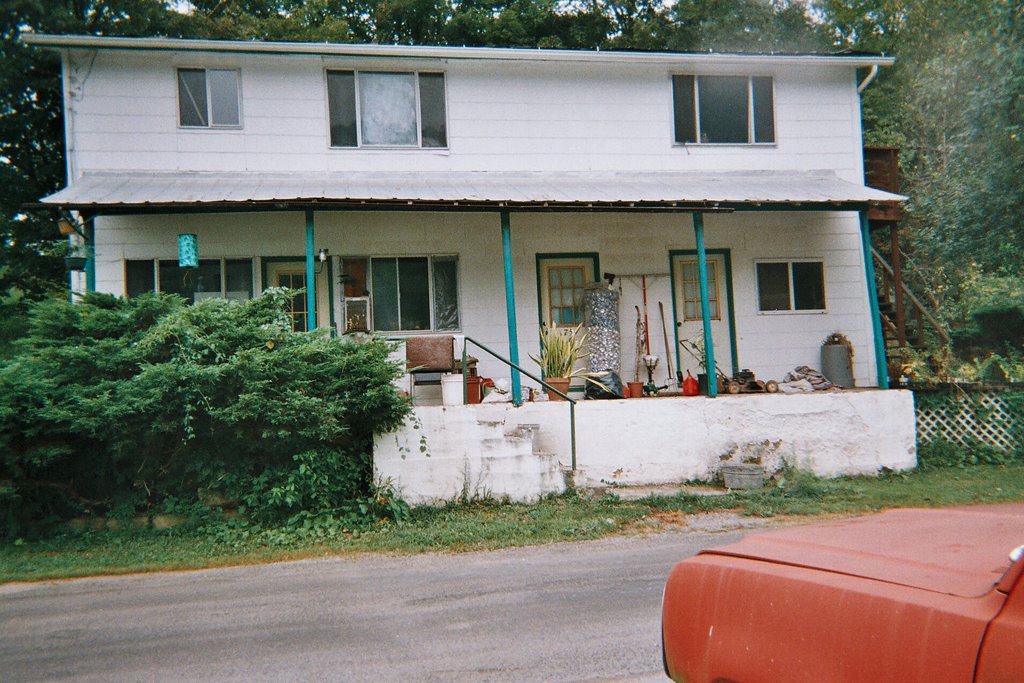
Top left is a photo of Joe with his K-9 partner in 'Nam. To the right is Joe and me in our grandparents' parlor on Christmas Eve with the world's scariest Santa. Lower left is Joe's folks, Juanita (Stutler) and Lee Burgett, both of whom served in WWII. To the right is Joe's home, formerly Charley Knight's, then W.D. Brown's, then Juanita & Lee Burgett's general store. Bottom is an assortment of cousins on Labor Day weekend, 2005. Joe is standing, far right , with the white beard. His brother John is standing beside him in a green shirt and his sister Sandy is sitting, on the right, with light colored hair.
The Coles, Marilyn and Charley, sang at Joe's funeral. Marilyn said, "At the funeral, I explained to everyone that the last song Joe sang with us was Will The Circle Be Unbroken... 1 And it was the only gospel song he knew all the words to. So he loved that song very much. So, I told everyone that from now on when we sing for occasions etc. I will tell the story of Joe and let them know that to them the familiar name is Circle Be Unbroken, but it is " Joe's Song" to us."

In memory of a soldier, a father, a thinker & dreamer, a son of Orlando,

. . . . Will the circle be unbroken . . . .

. . . . By and by, by and by . . . .

. . . . There's a better home awaitin' . . . .

. . . . In the sky Lord, in the sky . . . .

1. Will the Circle... is a traditional folksong that the Carter family brought with them out of the Virginia hills in the 1930s.

Sunday, September 10, 2006

Outbuildings

Our grandparents' place in Orlando in the mid-20th century had the following outbuildings. (Cousins, if I've missed any, or missnamed them, please let me know.)
Barn,
Chicken Coop,
Hog Shed,
Smoke House,
Tool Shed,
Corn Bin, . . . and yes, a
Two-Seater Outhouse that was well used.
The Fruit Cellar was built into the hill behind the house, but it wasn't really an out building because a long porch connected it to the house.

I'd noticed that there were a lot of little outbuildings, each with a single function, but I hadn't noticed that none of the outbuildings were painted, until I visited the new Bulltown Interpretive Park (where the Army Corps of Engineers moved several historical homes, the original St. Michael Church and numerous out buildings.) The Bulltown Interpretive Park brochure mentioned that in West Virginian culture, the outbuildings were left unpainted.

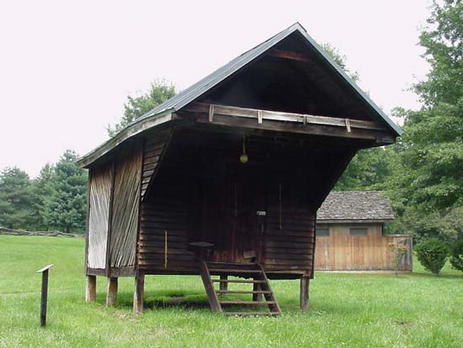
Above to the right is a photo of a few of the outbuildings on Oras & Edith (Skinner) Stutler's land (the former Dolan Hotel in downtown Orlando). To the left is a photo of the front porch of their home to show the care with which it was maintained. Below is the Cunningham House, nicely painted, and the corn crib that sits near it, one of several single purpose, unpainted structures at the Bulltown Interpretive Park.

Monday, September 04, 2006

Funeral Pie

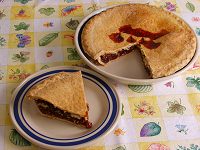
When there was a funeral my sister Jackie had to deliver grandma's raisin pies to the family's home. Jackie would be on foot, of course, or maybe her bike. The home, where the wake would take place after the burial, could easily be several miles away. It wasn't one of her faviorite things to do.

It was a surprise to discover, recently, the pie's relationship to the German in our culture1. The following info comes from Googling "Funeral Pie."
"Also called Raisin Pie and Rosina Pie (German for raisin). For many years raisin pie was served with the meal prepared for family and friends at the wake following a funeral. The probable reason was that this pie could be made at any season and kept well when prepared a day or two before the funeral. It does not need refrigeration. This pie traditionally is served at funerals of Old Order Mennonites and Amish."

We're searching for grandma's receipe, but in the meantime, here's a typical one.
INGREDIENTS:
2 cups raisins
2 cups water
1/2 cup packed light brown sugar
1/2 cup white sugar
3 tablespoons cornstarch
1 1/2 teaspoons ground cinnamon
1/4 teaspoon ground allspice
1 pinch salt
1 tablespoon cider vinegar
3 tablespoons unsalted butter

My mother's piecrust receipe for a double nine inch piecrust was
2 & 1/4C Flour
3/4 C lard (or Crisco)
4 T cold water

Preheat the oven to 400 degrees F. Line a pan with half the pastry and chill. Place the raisins and 2/3 cup of the water in a saucepan and heat over medium heat for 5 minutes. Combine the sugars, cornstarch, spices, and salt in a bowl and , mixing all the time, slowly add the remaining water. Add this mixture to the heating raisins. Cook and stir this until the mixture starts to bubble. Add the vinegar and butter and heat until the butter is melted. Cool until just warm. Pour into the prepared shell and top with the second crust. Bake 25 minutes or until golden. Cool.

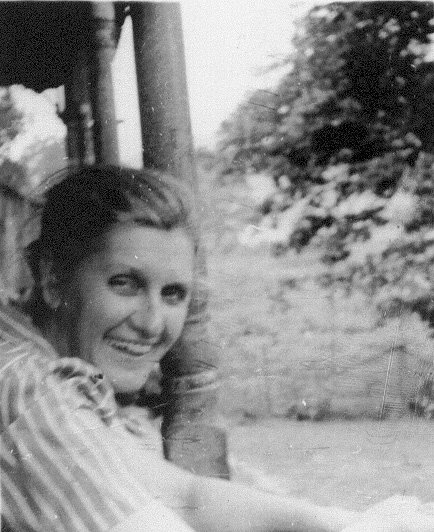
The school photo is 13 year old Jackie, the reluctant funeral pie carrier.

1. See entry from July17, '06: Orlando's Ancestors From The Palatine

Monday, July 24, 2006

Up the Lady's Leg

In the 1950s the Methodist Church's Ladies' Aid Society always had a meeting during the two weeks in August that we visited Orlando. My grandmother, Edith (Skinner) Stutler, was a committed member. My mother would go to the meeting with her, and they usually took me with them. We went "up to the Ladies' Aid." My father, Carl Witzgall, would give Grandma a hard time talking about going "up the lady's leg." Grandma just ignored him.

I was a kid. I have no idea who the other members were or what they did, besides have a business meeting and then a luncheon. Too bad. Even in my youthful oblivion I could tell that this was a long standing, committed group of women.

Photo is of my grandmother, Edith (Skinner) Stutler.

Monday, July 17, 2006

Orlando Ancestors From the Palatine

"At different periods, various causes and diverse motives induced Germans to abandon their Vaterland. Since 1606, millions have left their homes, the dearest spots on earth, whither the heart always turns. Religious persecution, political oppression drove thousands to Pennsylvania - to the asylum from the harassed and depressed sons and daughters of the relics of the Reformation, whither William Penn himself invited the persecuted of every creed and religious opinion."
- History of the Palatine Immigration to Americaas by Daniel Rupp, 1876


The Duvall family were French Hugenauts and the Browns were from Italy. Those and a few others were the exceptions. At the time western Virgina was being explored and settled folks on the frontier were a blend of English, Protestant Scots Irish and Germanic Protestants.

Conrad, Stutler, Riffle, Barbe and Spaunagle are some of the German Protestants, the Palatines, in our ancestry.

The German speaking people who came here in the 16- and 1700s are called Palatines because a great bulk of the Germanic immigrants had poured out of the principality called the Palatinate located on the Rhine River. But German speaking Protestants from what would become Switzerland and parts east also poured down the Rhein River into the ships waiting in Rotterdam. America's Pennsylvania Dutch, the Mennonites and Moravians come from this huge migration.