Priscilla Estella (Henline) Godfrey Thomas
by David Parmer
 Samantha and Beham's First Child
The vows of marriage were exchanged between Samantha Skinner and Beham Henline on April 5th 1876. According to the entries in Samantha’s well-worn hand-stitched Bible, the young couple was married by the Reverend Gabriel Dennison, a pioneer settler on Clover Fork. The ceremony took place at the home of her older sister and brother-in-law, David Newton and Mary Jane (Skinner) Godfrey, who lived a short way down Oil Creek. (Samantha and Beham's first child would marry one of D.N. and Mary Ann's younger son,s Melitus, who was 6 years old at the time of his aunt and uncle's, and future in-laws', marriage.)
The 23-year-old Samantha and Beham, three years her senior, became parents of their first child on January 24, 1877. The new-born would be named “Priscilla

Estella.” (Beham had a sister named Priscilla.) As the child grew and more children came the six syllable name “Priscilla Estella” soon would become shortened to “Estie,” a name which the first born child of Samantha and Beham would carry for the remainder of her life.
.
Left: Beham and Samantha (Skinner) Henline's oldest child, Estie, with her granddaughters Judy and Jetta Thomas.
Right: Samantha (Skinner) and Beham Henline
Left and Right, below: The second Henline home, which replaced the one that burned down.
.
Confluence on Oil Creek
During Estie’s first dozen years she was joined by the birth of five brothers and three sisters. After living on Indian Fork in Gilmer County and later on upper Oil Creek near Bear Run, the Henline family moved to Con

fluence. The Henline home in Confluence was located on a parcel of approximately 40 acres whic

h had been deeded to Samantha by her father
Alexander Skinner. Beham built a simple two-story clapboard home with a shingle shake roof on the south side of Oil Creek, opposite and upstream from the Mt. Zion Methodist Church. He set up a country store in the house which served the sleepy little farming hamlet and farmed his land, as well. The hillside portion of the farm was planted with fruit, nut trees and berries and included large fields which provided grass for the farm animals. The corn field and house garden were located on the lower part of the farm along Oil Creek.
Around 1890, life in Confluence began to change. It had been rumored for some time that the West Virginia and Pittsburgh Railroad was to be located through the Oil Creek Valley and Burnsville with a final destination of Richwood. Soon railroad agents visited Samantha and other landowners along Oil Creek to purchase rights of way for the location of the railroad tracks. As the laying of track along Oil Creek ensued, the Henlines found themselves less than a stone’s throw from the rail tracks and found that smoke from the locomotives which created dirt and an extra washing day. Soon, the unfortunate location of the Henline home too close to the tracks resulted in a roof fire caused by embers from the steam locomotive which burned the house to the ground. Perhaps, just as well. The original location of the home had made it subject to the

periodic flooding of Oil Creek. So, when plans were made to rebuild, the new home was built not only farther away from the railroad but also from the waters of Oil Creek.

.
Miletus Godfrey
Miletus, or “Lete,” Godfrey was the son of David Newton Godfrey and Mary Jane (Skinner) Godfrey and was a first cousin to Estie. Neighbors most of their lives, 26-year-old Lete and 20-year-old Estie decided that they knew each other well enough to marry so in 1897 Lete and Estie were married by Reverend J. H. Mossburg at the residence of C. S. Gainer, an early Confluence merchant. During the first five years of their marriage Lete and Estie became parents of a boy named Harry and a girl named Sophia. According to June Nixon Henry, daughter of Margaret (Henline) Nixon, Lete and Estie lived in a small house near the location of the later built St. Michael’s Catholic Church and across Oil Creek from the Henline homestead.
Left:Estelle and Lete's son Harry
Right: Estelle and Lete's daughter Sophia
Typhoid
Typhoid fever was a deadly scourge of early residents of Oil Creek. Not only were the effects of the disease usually fatal, it was also easily communicable. Many promising lives were cut short by the dreaded disease and its victims and survivors suffered long-lasting great physical pain and debilitation. In 1901, typhoid was running rampant along Oil Creek and 32-year-old
Lete Godfrey became a victim. At the same time, his ten year-old-sister-in-law
Margaret Henline
who lived just across Oil Creek also fell ill from the disease. One of the effects of typhoid is a severe inflammation of the bowels and sometimes perforation, which is usually fatal.
June (Nixon) Henry recalls that her mother
Margaret Henline spoke of her serious childhood illness and that she was very ill for a long time. Young Margaret, after many days of being at death’s door, resisted the hand of death and early one morning rose from her bed recovered, but voraciously hungry. In later years Margaret told her daughter that when she arose that early morning hour she went to the kitchen and found a bowl of creamed tomato dumplings and ate the entire contents of the bowl. After slaking her appetite, Margaret went out on the porch of her home for fresh air. Looking across Oil Creek toward the home of her sister Estie and brother-in-law Lete Godfey, Margaret noticed that the moon in the sky above her sister’s home appeared to be “blood red,” perhaps she thought, an omen of bad things to come.
Right: Margaret, Estie's young sister who survuved Typhoid Fever.
The Hand of Fate, a Red Moon,
a Few Apples and a “Busted Gut”
Lete Godfrey’s condition was serious. During a typhoid illness it is necessary to avoid any physical or mental stress which could aggravate the precarious condition of the ailing patient. Lete had been in his bed fo
r over two weeks, in great pain and with periods of unconsciousness. On one day during a lucid moment, Lete was informed by a visitor that someone had entered his orchard and had stolen apples from his trees. At the turn of the 20th century, a farmer lived by what he raised and could ill-afford any loss of his agricultural efforts. The news of a theft of apples from his orchard infuriated Lete and caused him great emotional stress. Lete’s reaction to this report of crime apparently caused a rupture of his highly inflamed intestines and he immediately took a turn for the worse and died almost immediately, according to the family, of a “busted gut.” Until her dying day, Margaret Henline Nixon remembered the red moon which hung ominously over the home of
Lete Godfrey and brought grief to her sister Estie on September 12, 1902.
The Widow Estie and Her Two Children, Harry and Sophia
Godfrey’s infant daughter
Sophia was but one year of age.
Harry was three.
Lete Godfrey had not reached his 32nd birthday as the last shovelful of dirt was cast upon his wooden coffin. Estie was fortunate
to have a close-knit and supportive family to rely upon. Grandmother Samantha was still in her late 40’s and Beham was just past his 50th birthday. The Henline clan was a strong farm family and familial duty welcomed the widowed Estie and her children back to the fold.
Mike Thomas
He was swarthy in complexion, his English was fractured, he was taller than average, and his roots were in the mid-East in a country called “Syria.” His handsome appearance did not go unnoticed by the widow Estie as
Mike Thomas o

pened his peddler’s pack to reveal the many enticing contents within. Estie was smitten by more than the thimbles and threads and fancy scissors in his pack, and, in the normal course of things, the widow and the Syrian peddler were married in July 1905.
Entries about Mike Thomas:
Pool Room Entrepreneur
It is difficult to be a pack peddler and a married man with a ready-made family. Young Harry and the toddler Sophia needed a father’s hand and Mike therefore couldn’t be trudging along the railroad tracks in some far-off county looking for a customer for some fine silk fabric tucked in the peddler’s pack. And besides those considerations, Estie was pregnant with Mike’s first child. What better reason to leave the peddler’s life and set down roots. Another consideration was the recent completion of the Coal and Coke Railroad through Confluence, the building of a union depot by the Baltimore and Ohio and the Coal and Coke and the great increase in rail passenger traffic through the Confluence junction. With the encouragement of his bride, Mike closed his peddler’s pack for good and took up the pool room trade.
It is unknown where the Mike Thomas pool room was first located in Orlando when he first picked up the rack and said “Break,” but it is known that his pool room was later located on the first floor of the Wholesale Building beginning around 1908. The pool room was equipped with a state-of-the-art pool table and soon nickels and dimes began changing hands for the privilege to pick up a cue stick and lace the multi-colored ivory balls across the green felt.
And Comes the Children
At about the same time, to provide room for his growing family, Mike built a small house at the lower edge of the Henline orchard whi

ch lay on the hill behind the Henline home place. Soon, it seemed, the small house on the hill at the orchard’s edge was full of children:
Tom, the first child, was soon followed by
Bill, Owen, Marie, Arden, and
Virginia. It is family lore that the fifth Thomas child,
Arden, was so small at birth that he could easily fit in the palm of a hand and that to keep him warm he was swaddled in a blanket and kept on the open door of the cook stove.
Left: Mike holding Kate, Tom, Owen, Arden, Marie and Bill.
.
Mike and Estie Move to Copen 
While Orlando could be considered as a railroad boom town in the early 1900’s, Copen during the first quarter of the 20th century could be called a coal mining boom town. The nearby towns of Bower and Gilmer also were hosting busy coal mines at this time employing several hundred mners. Coal mining attracted a younger work force, many of whom were single and who, during their days off, enjoyed shooting a game of pool. Mike decided that that Copen should be a better location for the pool room business than Orlando so the Mike and Estie Thomas family bid adieu to Orlando and moved to Copen.
.
Copen
Land was selling at a premium in Copen in the early 1920s. There was precious little flat land that wasn’t already developed for housing or being used for agricultural use. Mike and Estie Thomas were not wealthy and could not pay the premium prices for the best land, conse
quently they purchased a narrow neck of land along the railroad right of way between the Copen Depot and Bower. Mike built a long and narrow frame house with bedrooms which opened directly onto the porch. These bedrooms could be rented to miners or railroad workers who could come and go as they pleased without disturbing the rest of the household. Mike’s pool room was built at the end of the house toward the Copen Depot. The pool room was not in the most ideal of locations and did not thrive.
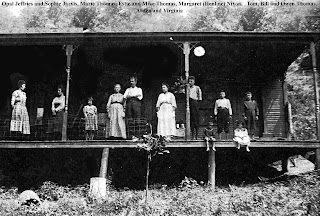
On the porch of the Copen home, Left to right: Opal Jeffries, Sophie (Godfrey) Jarvis, Marie Thomas, Estie and Mike, Margaret (Henline) Nixon, Tom, Bill and Owen, and sitting, Arden and Virginia.
Another important matter which was not thriving was Mike’s health. He was diagnosed with tuberculosis in 1924 and the disease was progressing when Mike decided that the pool room business might better flourish at Alton in Upshur County in another coal mining community.
Alton
Alton is situated about midway between Buckhannon and Pickens. In the 1920’s coal mines were active in Upshur and southern Randolph Counties. Mike rented a small house and pool room in Alton located near the train depot. Unfortunately, Mike miscalculated the business he hoped the pool room would bring in and times were tough. Estie’s granddaughter,
Ruby Brooks recalls her grandmother telling her of the lack of business and that the family “nearly starved to death.” Alton also was at a higher elevation than Copen and Orlando and winters were much more severe. Ruby also recalls her grandmother telling her that she had to paste newspaper to the walls to prevent the cold air and snow from blowing into the tiny house. Such conditions surely worsened Mike’s tubercular condition. He took a turn for the worse and died in February 1925. At the age of 48, Estie was a widow for the second time. Mike was laid to rest in the Orlando Cemetery.
 Return to Copen
 Estie returned to Copen after Mike’s death and lived there the remainder of her life. Her daughters Marie and Virginia, and her sons, Tom, Owen, Bill and Arden, continued to live with her. Her two older children, Harry and Sophia, had married and were living away. In time, all of her sons married and left home. Bill worked at a Clarksburg plant and Tom, Owen, and Arden worked for the railroad. Her daughter Virginia became a school teacher and after teaching for a few years in Braxton County rural schools and Burnsville Grade S chool, moved to northern Virginia around 1951 to continue her teaching career. Marie, the oldest Thomas daughter, was a long-time storekeeper and postmistress in Copen.
Left: Virginia and Marie Thomas
Right: 3 of tghe 4 Thomas brothers Tom Bill and Owen Thomas
Left: the 4th Thomas brother, Arden
Her Grandchildren Remember Estie
Estie's Dust Cap
Ruby Brooks helps us complete the portrait of her grandmother Estie Thomas. Ruby, now 83 years of age, remembers Estie as very short, “maybe only four and a half feet tall.” “I always looked forward to visiting grandmother at Copen and until I turned eight years old, I was able to get a rail pass free of charge. We would stop at Orlando first and visit there for a couple of days and then go on to Copen.” June (Nixon) Henry also remembers her aunt Estie as a short woman who seemed to have a shoulder blade “out of place” as a permanent condition. Apparently her young grandchildren and nieces never inquired about the curious hump on Estie’s back but just accepted it since it never seemed to bother her. “She always wore a dust bonnet and was never without one,” recalled both her granddaughter Ruby and niece June. Helen Jeffries, a niece-in-law, also recalled Estie’s omnipresent dust cap and recalled that Estie was buried in an elaborately crocheted dust bonnet which had been made for her by a friend. Helen also recalled that Estie, like her sister Clora Henline, always wore an apron and was never without one tied at the waist.
 Left: Estie in her dust bonnet.
The Vicious Dog
Granddaughter Ruby also recalls her grandmother as brave and fearless. Ruby recalls on one summer visit with her grandmother at Copen, a large, vicious dog came by Estie’s home and snapped at her toddler brother Franklin. Estie sent word to the dog’s owner about the incident and told the owner to “keep it tied or keep it home.” The following day, the same dog returned to the Thomas home and once again growled and intimidated young Franklin. Ruby remembers vividly that her grandmother went into the house and got her .22 rifle, knelt on one knee, took aim, and shot the threatening dog squarely between the eyes..
The Chamber Pot March
Through the Living Room
Ruby also recalls that her grandmother and Aunt Margaret Nixon were quite the jokesters. It seems Estie was quite protective of her very attractive daughters, Marie and Kate, who had no shortage of suitors. Estie was quite strict with young gentlemen callers and was always ready to discourage the young swains from getting close to her girls. Ruby vividly recalls one visit she and her Aunt Margaret made to Estie’s home. One evening Marie had a gentleman caller with whom she was socializing in the living room. Since the Thomas house had no indoor bathroom, each bedroom was provided with a chamber pot which was kept in an out building during the day.  Estie instructed Ruby, her sister Rose, and her cousins, June and Billy Nixon, to go to the out building and bring the chamber pots into the house, not through the doors to the bedrooms, all of which opened onto the front porch, but rather through the living room where Marie and her young friend were holding forth. Doing as they were told, the youngsters retrieved the chamber pots from the out building and conducted a parade of the glorious chamber pots through the living room, marching past a rather uncomfortable and embarrassed Marie and the nose of her guest. Ruby doesn’t recall the name of the young swain but she doesn’t think he ever returned.
Right: Their Aunt Marie with Rose Jarvis and Lawana "Toodlebugs" Jarvis, daughter of Jesse's son by his first and late wife Nora
Bickering Sisters It is reported that Samantha (Skinner) Henline was not a meek or mild woman but spoke her piece without fear of contradiction. A strict disciplinarian, Samantha ran a matriarchal home and her children, even as adults, were aware of “who was boss.” A strong will seemed to run in the  family, particularly among the female children who also spoke their minds. Oft times, the strong wills among the Henline daughters brought about a clash of opinions, but most usually with tongue-in-cheek, although one anonymous observer who weighed in on the quarrelsome sisters felt the usual and common acrimony between them should not be “sugarcoated.”
Left: Three of the four sisters: Lulu, Estie, Clora
Right: Lulu and brother Ernest Roy "Heaterhuck" cutting up
Clora would say, “Now, Estellie!” whenever she disagreed with her sister on some insignificant thing, and Estie would retort, “Now, Clorie!” The sisters’ brother, Heaterhuck Henline, always got a kick out of the bantering that took place between his two older sisters whenever they got together. Indeed, Heaterhuck was very adept at “egging them on” so he could enjoy the fray. No family gathering was complete without Estie and Clora having a set-to, which was more entertaining than Amos and Andy on the radio. It is also reported that two other Henline sisters, Lula (Henline) Mitchell and Margaret (Henline) Nixon, could also hold their own in the bickering department. Age was no modifier to these amusing occurrences or “bantering sessions” until all the sisters had passed away.
Pleasant Visits
Burlen Henline, son of Estie’s brother Frank, and Audry (Reip) Henline, recalls that he and his mother loved visiting his Aunt Estie at Copen and always managed two or three days each time at Aunt Estie’s whenever he visited the Orlando home folks. Burlen recalls that the train passed through Copen and afforded a convenient means of transportation for the visit from his home in Clarksburg and later in West Union. The visits were always pleasant and a good time was always had by all. Burlen lamented the loss of the passenger train service which limited his mother’s ability to visit Estie at her Copen home and the loss of the pleasant visits.
In 1963, at age 86, Estie passed away, in the arms of her younger sister Lula.
She was buried in the Orlando Cemetery in a plot and beside a plot which would soon be occupied by her brother, Heaterhuck.
. . . . .
Note from David Parmer
Estie Thomas’ two children by Lete Godfrey, Harry Godfrey and Sophia Godfrey, grew up in Orlando. Harry worked for many years at the Hazel Atlas Glass plant in Clarksburg. Sophia worked for Dick Skinner in his wagon restaurant and met her future husband, Jesse Jarvis, while she was working there. Jess was employed by the Baldwin-Felts Detective Agency at the time and was involved in protecting the property of coal companies in southern West Virginia during the mine wars of the the late 1910’s and early 1920’s. Jess later worked in coal mines in Barbour County.
Comment by Tom Jeffries
I really enjoyed the story about Aunt Estie. It brought back a lot of memories. The last time I saw her was before I went into the service in 1962. She was very frail and unable to walk very far. Tom and Arden carried her on a chair. It was a great story, especially about the sisters being quarrelsome. I got myself away from them when they were bickering.
+Extended+Family+Before1900.jpg) Cain and Mary (Simmons) Wimer with children and grandchildren, before 1900.
Cain and Mary (Simmons) Wimer with children and grandchildren, before 1900. 7. Verna Wymer . . . m. Frank Sprouse . . . dtr of Cain and Mary Wymer . . . b. abt 1891 (pictured to the right.)
 10, Cain Wymer . . . m. Mary Simmons . . . son of Jacob and Sarah Wymer . . . b. abt 1832 (pictured to the left with Mary.) .
 19. Oliver “Bee” Heater . . . m Genevieve Skinne . . . son of Sam & Mgt Alice (Wymer) Heater . . . b. 1892 (Pictured to the left.)


+Sprouse,+Bridget+Riffle,+Frena+McCauley,+Eugene+Sprouse+Thelma+Prince.jpg)


+Extended+Family+Bef+1900.jpg)


+Extended+Family+Bef+1900.jpg)


