Showing posts with label Family Beckner. Show all posts

Wednesday, June 03, 2009

Bill and Josie Beckner

by David Parmer

William Earl "Bill" Beckner was a sociable fellow and a man of faith. He was hard working, patient and easy-going. He old friends called him "Red", "Earl" and Willie but his grandchildren, who called him "grandpap" usually heard others call him "Bill".
Bill was born in 1892. His family lived in the Cedar Creek area near Glenville, Gilmer County until he was eight years old. The Beckners had come from eastern Virginia, Botetourt County in the Blue Ridge Mountains, and settled in Gilmer County about the time of the Civil War. Bill's dad was John Wesley Beckner. Bill was was a Skinner-Posey on his mom's, Melissa Skinner's, side. She was the granddaughter of Alexander Skinner and Alfred Posey. We know that Bill's younger sister Glennie was born on Cedar Creek in January, 1900. By the time of the census in the summer of 1900 the family was living near Cowen in Glade District, Webster County. Cowen is about 60 miles south and east of Cedar Creek and 50 miles directly south of Orlando.
.
Left: Bill and Josie Beckner with a grandbaby Rose Elaine Strader, in 1947.

The marriage of William’s parents ended and his mother, Melissa, remarried a man by the name of Hartsaw. She died at Gauley Mills in Webster County in 1927. She was returned to Orlando and buried in the Skinner Cemetery near her parents. There is evidence that Bill’s father, John W. Beckner, had a second family. We know he died in Preston County in 1932 and was buried in the County Home Cemetery in Kingwood.
.
Bill and Josie's Wedding
In April of 1916, times were booming in the Oil Creek valley. Two railroads were busy hauling coal, timber, freight and passengers to points north and south. Some folks still called it Confluence, but it was officially Orlando and it was the hub of this railroad activity. Among the businesses downtown, Doc Means had a store and Oldacker's Mercantile (which would become Charley Knight's store) was well established. Dick Skinner's Wagon Restaurant had been serving apple pie for a couple years. Michael Rush had been dead about ten years, but his family was running their hotel. The warehouse was three stories high and belonged to Mike Moran. The Methodist Protestants were well established. The Roman Catholics were temporarily between churches, as their beautiful frame church on Flint Bluff had burned the year before, but the new brick church would not be finished for another year. The UB congregation had not yet built their first church building, but the congregation was growing and would have their building within the next couple of years.

This was when William E. "Bill" Beckner married an Orlando girl, Josephine "Josie" Riffle. Josie's family were Blakes and Riffles. Her parents were Doni Blake and Charles Lee Riffle. Bill and Josie were married at the Clover Fork home of her mom's cousin Charles Victor "C. V" Blake and his wife Amanda (Scarff) Blake. C. V. Blake was Orlando's postmaster and the brother of P.N. "Uncle Zeke" Blake.

Right: C. V. and Amanda Blake, who hosted Bill & Josie's wedding
.

Bill's and Josie's Faith

Bill and Josie were married by L. L. Westfall, an early minister who had conducted tent meetings in the area before helping to establish Orlando's United Brethren church. They remained faithful members of Orlando's UB Church all their lives. No one living can recall a time when Bill was not a devoted, practicing Christian. He said grace before each meal and in the evenings he often read the Bible aloud for Josie and the children. Bill and Josie lived and raised their children by the exacting standards of their faith. For example, alcohol and dancing were forbidden and Sunday was the Lord's day, a day of worship and rest when no work, and no play, were allowed to interfere.

Right: The Beckners: Rosemary, Marvin, Bill, Ruby and Josephine holding child. Lambert and Louie May are in front of Ruby.

Below left: front row Heater Henline, Ernie Fox, back row Joe Skinner, Bill "Red" Beckner, young Pete Blake, his dad P. N. "Uncle Zeke" Blake and Newt Henline. Joe Skinner was the section leader.


Working for the Railroad

Like many of his generation Bill worked for the railroad. Hard-working railroad workers such as Red Beckner were vital to the health and success of the railroad. Maintenance of way workers had the hardest and most tedious job on the railroad. It was also dangerous work. Their work required them to labor in the scorching sun, the freezing cold, and the driving rain. Their work was difficult, and a camaraderie existed among the track workers, and especially among the men who pulled their weight. Bill devoted his lifetime of work to the railroad and was very respected by his peers.

We know that most of his career Bill served his employer as a maintenance of way worker and worked the tracks between Burnsville and Walkersville. However, the following poem speaks to a time when he worked as a carpenter on the bridge crew for the Baltimore and Ohio Railroad. In December 1925 Bill’s co-worker P. N. Blake, aka “Uncle Zeke,” well known for putting together a rhyme, wrote a poem about the B & O Bridge Crew: The Gang That Works For Walker Wood.

The Gang That Works for Walker Wood
No nicer men, and just as good
Are those who work for Walker Wood.
Harry Wilson, it can be said,
Hits the nail, right on the head.
Minter Jordan, he’s a dandy
With saw and square is real handy.
Levi McQueen with might and main
Can lift as much as a railroad crane.
Murray Clifton, tried and true,
Has most of the hardest work to do.
Earl Beckner works his level best,
And tries to do as much as the rest.
Joe Vandergrift, he is no saint,
But he’s handy with brush and paint.
Cecil Fleming works from day to day
And never fails to earn his pay.
O. B. Hyre, who smiles so sweet,
Makes Walker Wood’s gang complete.

Family and Home

After their marriage, Bill and Josie Beckner wasted no time in starting a family. Lambert was born in 1917 and was followed by Marvin who was born in 1919. Ruby was born in 1922, Rosemary in 1928, and Louie Mae, the youngest child was born in 1935.

During the mid-years of their marriage, Bill and Josie lived on a farm where Road Run joins Oil Creek. On December 12, 1925, Uncle Zeke had reported that Bill Beckner had bought the C. F. (Charles Frances) Skinner property in Orlando and was “tearing down and building greater.” It is unclear where this property was located and why later Bill and Josie moved onto the farm at the mouth of Road Run that belonged to Bill's uncle, John Fountain Posey. The Beckners lived on the Road Run farm during the 1930’s until the late 1940’s. Like most of their neighbors Bill and Josie raised food for the family table: a large kitchen garden, hogs, chickens, a cow.

Left: The Beckners were active workers in the community. In the center of this photo of mothers who worked with the 4-H program is Josie Beckner: l to r, Jessie (Riffle) Bragg, Virgie (McNemar) Henline, Josie (Riffle) Beckner, Irene England (wife of the UB preacher), Opal (Jeffries) McCrobie.

Bill and Josie ended their moving days when in 1946 they bought the large two-story former Ollie Blake home on Flint Knob in Orlando. Their youngest, Louie Mae, was about nine years old at the time. Louie Mae was not the end of their parenting, however. When their son Lambert’s wife, Virginia (Stutler) Beckner, died of tuberculosis in 1954, one of their two grandsons, seven-year old grandson, Bill Beckner, came to live with them. Bill's brother Neil was taken by his mother's folks, Edith and Oras Stutler, who lived in the former Dolan Hotel.


Memories of Grandparents

Young Bill Beckner, grandson of Bill and Josie, was entering the third grade when he came to live with his grandparents on Flint Knob in 1954. Remembering his grandparents, Bill remarked that they were “God-fearing, church-going people.” Bill recalls that his grandfather always referred to people as “Mr. or Mrs., or in the case of a fellow United Brethren, as “Brother or Sister.” “They instilled in me a respect for others and taught me good country sense.” Bill recalls that after lunch on Sunday, his grandfather, who never learned to drive, would walk to visit the Wooddells who lived on Clover Fork, Eb Riffle on Oil Creek or the McPhersons who lived at the mouth of Road Run where he once lived. Bessie McPherson was the sister of Charles L. Riffle who was Josie’s father.

Bill Beckner also recalls that his grandfather was the most patient of fishermen and could watch his fishing line for an eternity, waiting for a bite. This patience frequently paid off. Bill recalls his grandfather landing a twenty one and a half-inch large-mouth bass and a sixteen inch large-mouth bass. “My grandfather was also the most patient of squirrel hunters,” continued young Bill. “He had his squirrel dog trained to return if the squirrel reached safety in a hollow tree which saved a useless pursuit.” Young Bill also recalls his grandfather’s stamina as a hunter. “We would go up the hill behind our home at a steady pace and go out the ridge of the hill to the head of Posey Run. My Grandpap never got tired.”

Left, above: Bill and Josie Beckner
Right: Top: the results of squirrel hunting: Four dusted, fried squirrel. Bottom: the results of fishing: cornmeal breaded fillets of bass.

Young Bill Beckner also recalls enjoying the weekly trip to Weston on the Blue Goose bus. “My grandmother would always carry a basket with her and would visit her sister ‘Rennie’ at the Weston State Hospital. Before we came home we would eat at the cafĂ© at the bus station.”

Young Bill also recalls that every year his grandparents kept a hog which would be butchered in the fall. Usually Hubert Riffle who lived on Oil Creek across the creek from Boss Riffle did the butchering but one year Hubert was sick and wasn’t available to butcher. So, his grandfather sent Bill to see Hayward “Sooey” Skinner to see if he could do the butchering. Hayward was Edith (Skinner) Stutler's youngest brother and the hog butcher who always helped the Stutlers. Apparently, Hayward liked a good joke, and he told young Bill that if his grandfather “would kill the hog, roll it off the hill and leave it in the ditch beside the road, he would come by and do the butchering.”

Death Comes

Those who knew and loved them say that Bill and Josie were good partners and had a good marriage. In 1972, at the age of seventy-nine, Bill Beckner passed away. His life’s companion, Josie, died a little over a year later in 1973 at the age of seventy-eight. All of their children have joined them, as has their grandson Marvin Brown who died in the autumn of 2008. Their number continues to increase as their great-great grandchildren are being born and growing up in Michigan, Ohio and West Virginia.

Left: Grandson Bill Beckner holding his granddaughter Courtney, one of the newest Beckners.

Notes:
Note 1: RE: Levi McQueen of the Walker Wood Bridge Crew by Jenny Morlan

My grandfather, Levi McQueen, was a long-time employee of the Baltimore and Ohio Railroad and the Chesapeake and Ohio Railroad. A native of Birch River, Nicholas County, he married in 1921 Gladys Nuzum of Jackson County. My grandparents lived many years in Flatwoods and Richwood. My grandfather’s railroading occupation took him throughout the mountains of central West Virginia and he was proud of his railroading service.

During World War I, my grandfather served in France and participated in many engagements during the war. He luckily survived the mustard gas offensive of the Kaiser’s army.

My grandfather’s parents, Charles and Ethetta (Tinnel) McQueen, were both teachers and also ran a boarding house for loggers working in the Richwood area timber forests. My grandfather’s father was also a superintendent of the schools in Nicholas County.

Note 2: from Donna Gloff Josie and Bill were probably married in the same home where Josie's parents, Donie and Charles Lee Riffle, were married in 1891. Donie and Charles were married in the home of C.V.'s mother, Elizabeth (Sands) Blake Donaldson and census information suggests that Charles and Amanda later lived in the family home.

Charles Victor Blake (who hosted Bill and Josie's wedding) and Patrick Newton Blake aka Uncle Zeke, (with whom Bill worked, worshiped and who wrote about "Red"/"Earl" Beckner) were sons of Elizabth (Sands) Blake Donaldson and cousins of Donie, Josie's mother.

Note 3: from Donna Gloff William Earl Beckner's grandfather William McClure Beckner came from the Blue Ridge Mountains in eastern Virginia to settle in Gilmer County in the area of Cedar Creek. The area is just beyond the Oil Creek watershed. It is the other side of Tulley Ridge, flowing into the Little Kanawha. This is where Bill's father John Wesley Beckner was born. In the same way the land now covered by Burnsville Lake was flooded, this area was dammed and flooded and today is Cedar Creek State Park. Other blog entries that involve the Cedar Creek watershed are The School Which Nearly Flew and Ethel Posey's Advenure. To the right are photos of the area today.

Note 4: The following material about Bill and Josie Beckner's home is copied from the previous entry by Ed Riffle about visiting his Uncle Bill and Aunt Josie Becker in Orlando.

The Beckner Home on Road Run

"At the mouth of Road Run on Oil Creek, on the south bank and at the base of a large hill, sets the original home of John Fountain Posey. John Fountain, the son of Alfred F. Posey and Christina Murphy Posey, died in 1934, and the home fell into heirship and was rented out. Bill and Josie Beckner were the tenants for several years. Ed Riffle recalls his many visits to the Road Run home of his uncle and aunt. 'When we visited, my father had to drive through Oil Creek to get to the house. When it was flooding, we had to park and walk across the railroad bridge.

“'There was no electricity or natural gas in Uncle Bill and Aunt Josie’s home. There was a fireplace in one room and a wood-burning stove in the kitchen. In the evening after the sun went down, everyone sat around an oil lamp in the dining/sitting room and talked until it was time for bed. When bed-time came, I went upstairs which was very dark to go to bed. One morning, Aunt Josie surprised me by frying a duck egg to go with hot biscuits for my breakfast.” Since there was no running water in the home, Ed recalls that drinking water was cranked from an open well in the back yard. “Aunt Josie was a good cook and before every meal, Uncle Bill returned thanks.'"

"Bill and Josie Beckner lived in the Posey house at the mouth of Road Run until around the end of World War II when they moved to a house on Flint Bluff in Orlando. After Bill and Josie moved out of the Road Run home, Josie’s father, Charles Riffle, moved into this house and lived there a while before finally moving to the Three Lick farm owned by his son, Brownie Riffle, where he died in 1949.

"The Bill Beckner home on Flint Knob was a big change from the home on Road Run. Not quite urban, living in Orlando was quite a bit different from the Road Run farm since it had electricity. However, that the Beckners were still in the country was evidenced by an outhouse and lack of running water. The home of the late Ollie Blake, this large two story house had front and back inside staircases with nice banisters, large rooms and high ceilings, according to Millie McNemar. She was a playmate of the daughter of Mr. and Mrs. Bill Byrne, both of whom taught school in the Orlando area, and were previous tenants of the house. Millie recalls the beautiful views that were available from the porch."

Note 4: Magazine covers from April 1916, the month Bill and Josie wed.

Wednesday, May 20, 2009

My Father Loved Orlando

.
by David Parmer with Ed Riffle
A Visit to Road Run
“Early on Saturday morning, my father would load up the old Ford, and with my father, Jack Riffle and my mother, Bernice (Knapp) Riffle, in the front seat and my sister Donnie and me in the rear seat, off we would go south on U. S. 19 from Clarksburg for an exciting visit to Orlando.”

“My father’s sister, Josie Beckner, or "Jose", as my father called her, lived with her husband, Bill Beckner, in a farm house near the mouth of Road Run. They were always welcoming and friendly, and Aunt Jose made biscuits every day.” Hot biscuits with country butter and jelly always finds a warm reception from a young boy, and Ed was no exception.

Ed Riffle was born in 1937 in Clarksburg. His father, Jackson Riffle, was employed at the Hazel Atlas Glass Plant. After a week of enduring hot furnaces full of molten glass and the clang of machinery making the pressed Depression glassware for which Hazel Atlas was famous, a time for leisure and quiet on Oil Creek rejuvenated the soul and settled the nerves. A visit to Uncle Bill’s and Aunt Jose’s was just the therapeutic dose of tonic needed by glass worker Jack. It also provided an opportunity for son Ed and Beckner cousin, Louie Mae, to scout for darting minnows and menacing crawdads in Oil Creek and roam the hills of the Oil Creek valley. Childhood memories are not forgotten, even with the passage of over a half century. Ed Riffle remembers well the visits by his family to the home of Bill and Josie Beckner.
Examples of Hazel-Atlas Depression Glass. Hazel-Atlas also made Atlas canning jars and a wide variety of every-day ware that is highly collectible today.

Goosepen Hill

The first bit of excitement on a visit to the Beckner home on Oil Creek was the thrill of traveling up and over Ryan’s Hill on Goosepen. The days of modern brakes were still well into the future and war-time shortages of auto parts made the Goosepen Hill into quite an adventure in an aging Ford. To get to the bottom of the hill and the gentler terrain of Three Lick always seemed quite an accomplishment and was the signal that the Beckner home was not far away. And there might also be a visit with Aunt Della Wymer’s family on Three Lick and with cousins Sonny and Sue. To Eddie Riffle, these visits during his youth were memorable.

Left: a view from Goosepen Road, photographed by Debbie Malek. Goosepen Road crosses the divide between the Oil Creek section of the Little Kanawha watershed on the south and east and the West Fork River watershed on the north.

The Beckner Home on Road Run
At the mouth of Road Run on Oil Creek, on the south bank and at the base of a large hill, sets the original home of John Fountain Posey. John Fountain, the son of Alfred F. Posey and Christina Murphy Posey, died in 1934, and the home fell into heirship and was rented out. Bill and Josie Beckner were the tenants for several years. Ed Riffle recalls his many visits to the Road Run home of his uncle and aunt. “When we visited, my father had to drive through Oil Creek to get to the house. When it was flooding, we had to park and walk across the railroad bridge.”
“There was no electricity or natural gas in Uncle Bill and Aunt Josie’s home. There was a fireplace in one room and a wood-burning stove in the kitchen. In the evening after the sun went down, everyone sat around an oil lamp in the dining/sitting room and talked until it was time for bed. When bed-time came, I went upstairs which was very dark to go to bed. One morning, Aunt Josie surprised me by frying a duck egg to go with hot biscuits for my breakfast.” Since there was no running water in the home, Ed recalls that drinking water was cranked from an open well in the back yard. “Aunt Josie was a good cook and before every meal, Uncle Bill returned thanks.”

Upper left: John Fountain Posey, the first owner of the Beckner home on Clover Fork at Road Run, is on the left and Josie's grandfather Stewart L. is on the Right in this detail from a photo of the funeral of Beham Henline in 1912.
Left: Louie Mae Beckner, in Oil Creek.
Right: The Beckners: Rosemary, Marvin, Bill, Ruby and Josephine holding child. Lambert and Louie May are in front of Ruby.

Bill and Josie Beckner lived in the Posey house at the mouth of Road Run until around the end of World War II when they moved to a house on Flint Bluff in Orlando. After Bill and Josie moved out of the Road Run home, Josie’s father, Charles Riffle, moved into this house and lived there a while before finally moving to the Three Lick farm owned by his son, Brownie Riffle, where he died in 1949.

Decoration Day
When they lived in Clarksburg Ed's family trekked to Orlando every Decoration Day. (We call it Memorial Day now.) In the mid-1900’s, the roads from Ohio, Michigan, Maryland and many other states were full of vehicles headed to West Virginia cemeteries during the latter days of May. “We always went to the cemetery at Orlando and the Posey Run cemetery. Aunt Jose had made the small red artificial flowers with green stems to be used for decorating the graves of family and friends. The flowers that she made looked just like the flowers in the story on the Orlando web page.” The Decoration Day journey to Orlando was like an 11th Commandment to family-reverent West Virginia-born factory workers from Akron, Canton, Detroit, Pittsburgh, Baltimore and further.

The Bill Beckner Home on Flint Knob

The Bill Beckner home on Flint Knob was a big change from the home on Road Run. Not quite urban, living in Orlando was quite a bit different from the Road Run farm since it had electricity. However, that the Beckners were still in the country was evidenced by an outhouse and lack of running water. The home of the late Ollie Blake, this large two story house had front and back inside staircases with nice banisters, large rooms and high ceilings, according to Millie McNemar. She was a playmate of the daughter of Mr. and Mrs. Bill Byrne, both of whom taught school in the Orlando area, and were previous tenants of the house. Millie recalls the beautiful views that were available from the porch.

Right: Flint Knob and downtown Orlando from the Orlando Cemetery. Click to enlarge the photo and note the arrow is pointing to the Beckner household. Upwards, to the left is the Orlando School and further upwards to the left is the U.B. Church.

Ed Riffle continued to enjoy and look forward to his visits with Uncle Bill and Aunt Josie who now had a panoramic view of the town of Orlando. Ed’s last visit to the Flint Bluff home was in 1972, just prior to the deaths of Bill and Josie. Not long after his visit, he was at a church camp in Ohio when he received word of his Uncle Bill’s death and drove from Ohio and back on the same day for the funeral in the brick church. (When the Methodist Church and the United Brethren denomination merged into the United Methodist Church, Orlando's two congregations were merged into one congregation, and that congregation took over the vacant brick building that had housed St. Michael's Roman Catholic congregtion.)

Time to Reflect
Now at home and retired in Glasgow, Kentucky, Ed Riffle enjoys the memories of his visits to Orlando. His parents, Jack and Bernice Knapp Riffle, now are deceased, as are his Uncle Bill and Aunt Josie. It has been over thirty five years since his last visit to Orlando but the happy memories are still with him. Recently, Ed was elated to learn from his sister in Texas that Orlando reminiscences could be accessed through the web pages of Orlando Stone Soup. His sister happened to be a fellow church-goer with a friend whose husband, Bob Pumphrey, grew up on Goosepen and is an avid reader of the Orlando stories. It is indeed a small world.

Friday, November 03, 2006

Sweet Potatoes

One of grandma Edith (Skinner) Stutler's crops was white sweet potatoes. It seems there's a certain kind of sweet potato that folks grow in central West Virginia that you can't find in the Detroit area. That isn't unusual. In family farming, seeds (and in this case sprouts) for spring planting are taken from last fall's harvest. They are not necessarily the varieties Burpee chooses to market. Grandma grew varieties of vegetables that are now coming back on the market as "heirloom" varieties; her low acid yellow and orange tomatoes, for example.

Bill Beckner picks up a winter's worth of local sweet potatoes at a Weston fruit & vegetable market every fall. Another of the Detroit area cousins has them shipped to his home each fall.

Bill tells how helping our grandmother with the sweet potato planting was a rite of spring that he remembers fondly. Sweet potatoes are planted differently from most crops in that its the green sprouts rather than seeds or eyes that are planted. The kids are sent into the newly greening brambles and woods to find branches and twigs to use to shelter these tender little plants from the elements until their root systems get established. Don't you know grandma must have done the same thing as a kid?

Wikipedia makes it clear why sweet potatoes would be a part of a West Virginian family garden. "Sweet potatoes are often considered a small farmer's crop. They grow well in many farming conditions and have few natural enemies, pesticides are rarely needed. They can be grown in poor soils with little fertilizer. . . Because the rapidly growing vines shade out weeds little weeding is needed, allowing farmers to devote time to other crops."

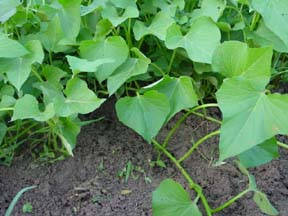
At the top left is a photo of sweet potato vines.
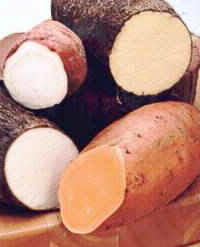
The photo of sweet potatoes with different colored skins and flesh was taken from the Internet to demonstrate the variety that is available even in commercial sweet potatoes.
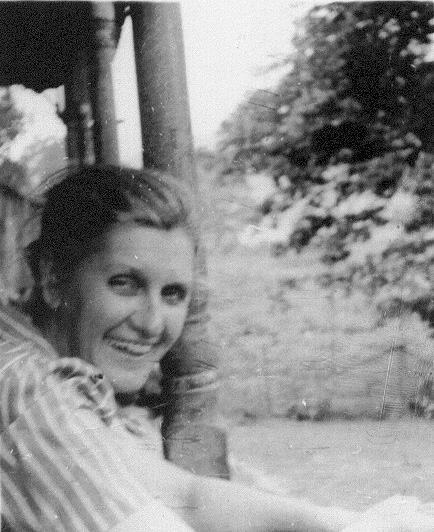
To the left is a photo of our grandmother, Edith (Skinner) Stutler.
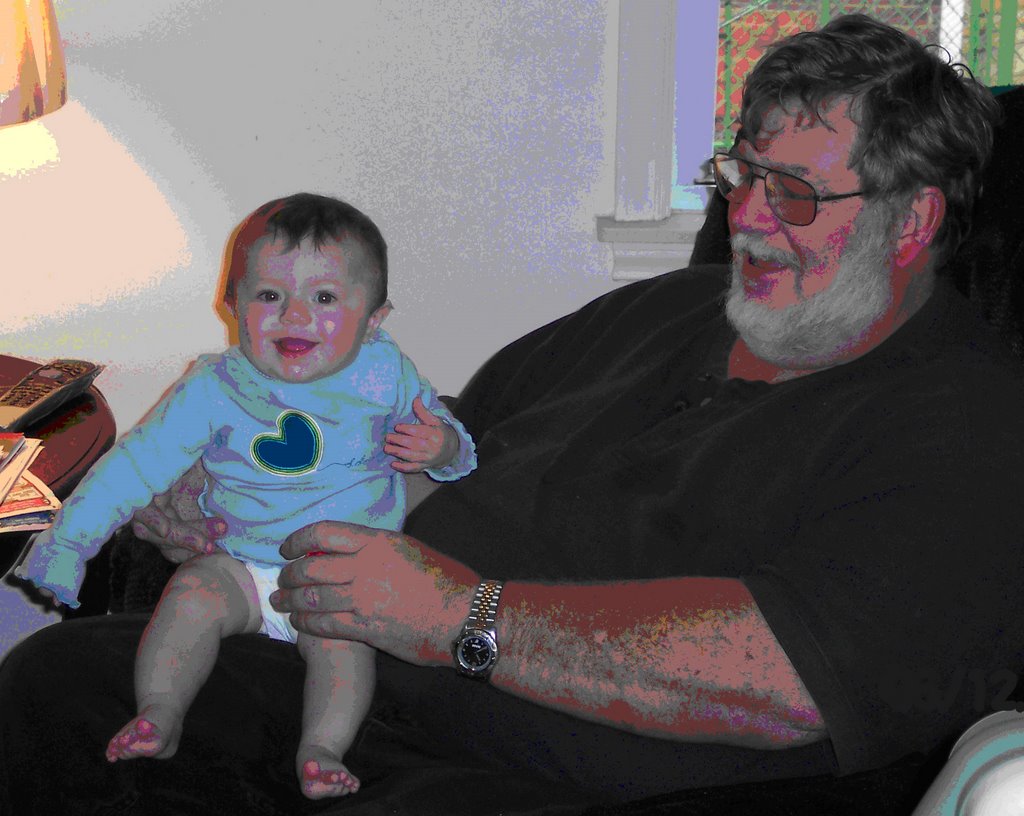
To the right is a photo of grandpa Bill Beckner with another variety of home grown sweet potato.

Saturday, September 30, 2006

Bill & Josie Beckner

Bill Beckner shares information & a couple photos of his grandparents.

William Earl and Josephine (Riffle) Beckner set up housekeeping on Posey Run in the 1920s. The raised two sons, Marvin and Lambert, three daughters, Ruby, Rosemary and Louiemae and one of Lambert's two boys, Bill.

With his red hair and ruddy complexion it isn't surprising that William was nicknamed "Red."
The b&w photo of William Beckner at the left doesn't give us a clue to his nickname.

Red worked for the B&O Railroad, keeping the tracks from Burnsville to the tunnel in working order. He and others in his crew worked out of a way station near the middle of that stretch of track. They ran those little repair cars up and down the track.

By the 1930s the Beckners had moved to a two story white house on the bluff overlooking downtown Orlando. In the photo to the left their house is at the far right side of the photo.

The Beckners were active in their community.
Josie is in the center of the ca. 1953 photo to the left, taken at a recognition for a special group of 4-H-ers at Orlando Elementary School . from the left: Jessie Bragg, Virgie Henline, Josie Beckner, Irene England and Opal McCrobie

To the right two of the Beckner kids, Ruby and Lambert, are nearly hidden in the back row of this photo of a Sunday School class at Orlando's United Brethern Church.


The ca. 1954 Tip Topper photo is from David Parmer
The late 1930s Sunday School photo at the front door of the church is from Lewis County West Virginia by Joy Stalnacker

See also
July 07, '06 Coal Trains
July 12, '06 A Tribute To The Tip Toppers 4-H Club


Thursday, September 28, 2006

Squirrel for Dinner

Hunting game is a part of our heritage that remains strong1. Deer and squirrel are two popular prey. I'd think wild turkey would be, too, but I haven't heard that it is.

Bill Beckner likes that squirrel hunting comes before deer hunting in the fall. In addition to the chance to be out in the wild and the good food squirrel hunting provides, it's good target practice for deer hunting.

This photo from the internet illustrates how the squirrel is fried.

Here is Bill Beckner's recipe for squirrel. Bill cuts the critter into chicken-like pieces and par-boils it to make it tender. Then he goes ahead just like fried chicken. He coats it with four and browns it in a medium high skillet and seasons it with salt and pepper. When it's all crispy brown, he puts a lid on, turns down the heat and lets it cook till it's almost falling off the bone.
Bill makes gravy by thickening the liquid the squirrel was parboiled in.

Just a quick word about "the best part:" a great delicacy for Bill's grandma, Josie Beckner, were the brains. She loved breaded, sauted squirrel brains. This put an extra but welcomed burden on grandson Bill. The standard way to kill a squirrel was to blow its brains out: quick and painless a death as can be. But if he was going to bring home brains for his grandma, Bill had to shoot the squirrels in their body, squarely enough so they didn't suffer. Fortunately, Bill is a very good shot.

Now here is a quite different approach to squirrel, which shows just how versatile squirrel can be. This is not from and Orlando hunter but a hunter from the Hacker's Creek Pioneer Descendants (Don't have his name, but his e-mail "handle" is "Steel78") He offered the following recipe: "The only way we fixed rabbit and squirrel was to drop them off to a neighbor lady, and the next day or so, she sent a cherry pie over. I recommend it."

Friday, February 24, 2006

The Indian Campsite

In the 1950s a cousin, Neil Beckner I believe, took me up past his Beckner grandparents' home and the United Brethren Church to see what he assured me was an old Indian campground. The spot was pretty isolated, back in the woods. I could kind of see where someone might think it looked like a campfire site, the way the stones were, but I couldn't see anything to convince me it had been inhabited. Neil couldn't provide any more verification than to tell me folks used to find arrowheads up there. Now, our mothers' cousins and young uncles were forever telling outrageous stories so that even though I could see my cousin believed what he was saying, I couldn't be sure someone wasn't having him on. Still, it was a lovely place, and when I turned my back to the campfire area I was treated to a breathtaking view. Oil Creek Road (and Oil Creek) were a steep drop below us so that the view east looked out over majestic rolling hills.

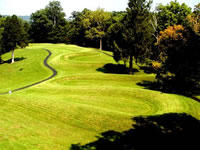
Decades later I visited Serpent Mound at Chillicothe, Ohio. When I finished the walk from the tail to the head of the undulating mound I looked up and saw what seemed to be the exact same, distinctive, view I’d had so long ago from the Indian Campground overlooking Orlando and Oil Creek.

I have no idea what the connection might be between the two sites. As I understand it, the Mound Builders who we believe built the earthworks lived centuries before the Native Americans who would have left arrowheads. Still, the similarity between the two sights was uncanny.

additional note, March 22, 2006:
In 1924 Roy Bird Cook wrote "John P. Duvall . . . secured 1400 acres more embracing the land between Roanoke and Arnold and a large part of Canoe Run. Duvall was a prominent man in frontier days and his "Indian House" was the site of an old Indian village, it seems. The writer has a collection of flint implements secured in this vicinity. John H. Conrad has a similar collection from the lower valley, and for years on the farm of the late George Cook could be discerned a small mound attributed to a race here before the Indians."
from West Virginia Archives & History at http://www.wvculture.org/history/agrext/roanoke.html


Here's an interesting webpage about Native Americans in the area.
http://www.artcom.com/Museums/nv/sz/45660.htm

Above Orlando I saw an arrangement of rocks in the woods that would have made a good campsite. At Chillicothe, OH I saw an earthwork serpent that, by the way, looked like the one to the right. Both sites overlook a similar landscape.