by Marcia (Heater) Conrad
 When Coleman Albert Heater and Leona Beatrice Riffle married in 1938, times were tough. The country was still suffering from the Great Depression; there was little money and no jobs. Odds were definitely against them, but they were both determined and determination can move mountains.
Left: Leona and Coleman in 1965.
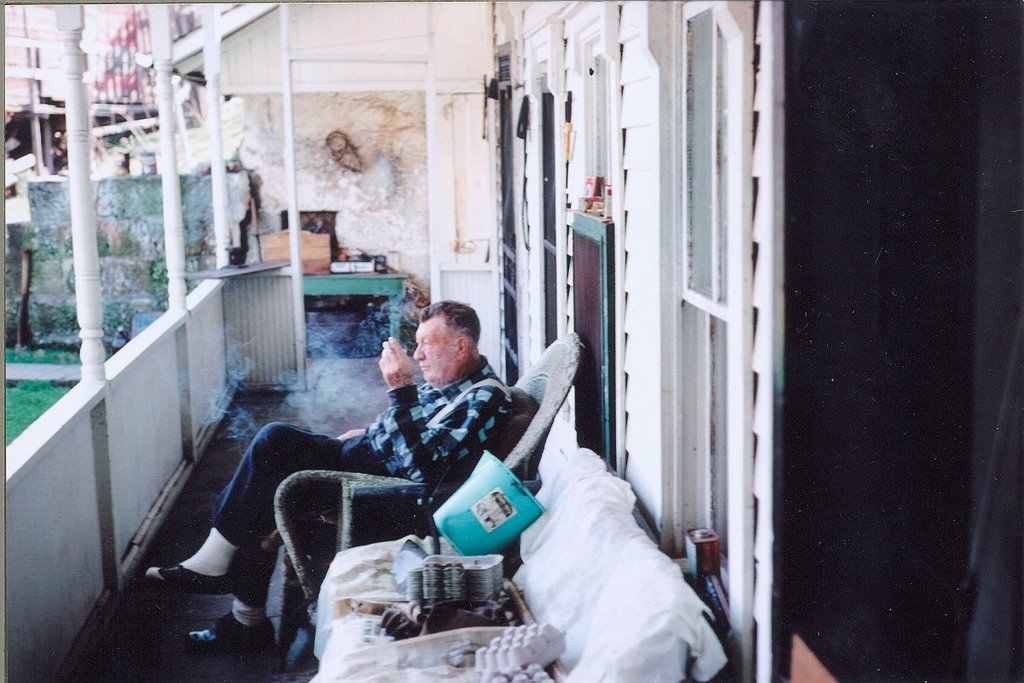
Right, below: Coleman "Coley" Heater in 1970.
Left, below: Leona with son-in-law Dave Conrad, 1980.
 cornflower blue eyes which he passed to all of his progeny. As he was both a gentle man and a gentleman, he always had something good to say about everyone. He laughed a lot and found humor in everyday living.
  n—Leona was both domineering and condescending. In spite of their differences, Leona and Coley developed a relationship and understanding that served them until he preceded her in death in 1985.
 was still floundering in the Great Depression, Coley and Leona married and moved to a log house and thirty acres that Coley had purchased a few years earlier from Nancy McCray. He paid for the property with some money earned from selling livestock and doing farm work for the family. The property was located on Ben’s Run. Making their home with the newlyweds were Coley’s mother, Sarah (Wimer) Heater, and his older sister, “Birdie” and her three children. And, of course, it wasn’t long before the pitter-patter of little feet found its way to the two story log cabin.
  Coleman and Leona had five children: Erma Lou, Earl Thomas, Brenda Sue, Sarah Bell, and Marcia Louise.
Right: map shows Orlando at the bottom, Oil Creek's tributaries in gold and Ben's Run in red at the top.
Left: Heater girls in 1953.
Prosperity never lived at the Heater household, but the children never lacked for anything they needed. They were fastidiously clean; Leona scrubbed the clothes on a washboard and used a wringer washer. A talented seamstress, Leona created attractive clothing for her daughters. In fact, she could look at a sketch in a magazine and fashion a dress from the picture. Some of the cloth came from feed sacks, and a treadle machine that belonged to her mother-in-law saw the family through those childhood years. Years later, Leona got an electric machine and was thrilled at the all the new and fancy things she could do.
 Leona agreed on one thing—what they wanted for their children—all of whom who were as different as their parents. To be respectful and respectable, to have good work ethics and good moral values were the goals they had for their children and to this end they worked together throughout their lifetimes. They never faltered in their determination to educate and nurture their children. Coley always believed in teaching the children to think outside the box. Disagreement with his opinion was fine, as long as the children could justify their thinking. In fact, he enjoyed the banter and opinions of his children. However, Leona was always right, and no one, not even Coley, dared disagree too much with her.
Left: Erma. Earl, Brenda and puppy.
 both lard and for lye soap.
Right: lye soap cooling in the pot.
Cooked outside in a big black kettle, the soap took hours of labor-intensive stirring. Leona’s recipe was as follows: Use about 30 pounds of lard, four gallons of water and seven or eight cans of Red Devil Lye. Heat the lard until melted. While the lard melts, pour the lye slowly into the cold water—never pour the water into the lye. The water will become hot. Let it cool until the lye water and the melted lard are about the same temperature and then pour the lye water into the lard. Be prepared to stir for a long time until the mixture starts to become creamy and begins to thicken. Pour into pans and cover with a cloth for 24 hours, then cut into bars. This soap can be used for anything from bathing dirty children to washing clothes.
Author’s Note: In the early 1990s, I was a librarian in Orange, Texas. One day a local professor and naturalist called the library wanting a recipe for lye soap. I couldn’t find one, so I did the next best thing: I called my mother, Leona Heater, and asked for her recipe, which of course, she gave me. I passed it along and the professor made his lye soap, dubbing it Marcia’s Mother’s Lye Soap. While Leona made lye soap in the early years out of necessity, he wanted to make it just to prove he could have been a pioneer! My sister Brenda and I also demonstrated how to make made lye soap at Fort New Salem in Salem, West Virginia.
 Coley had less formal education than that. Coley took several months worth of adult education classes at Ben’s Run School sometime after World War II. Both were voracious readers. Coley could devour a Zane Grey book and always thought his children should read “the Good Book.” Leona liked romance and movie magazines. When their children were assigned a book to read at school, they read it too. Consequently, they developed a vocabulary beyond their level of education. Once I encountered the name “Jose” in something I was reading. My mother told me that the word was actually pronounced “Hos-ay.” I was impressed when I went to school the next day and was the only one who knew how to pronounce that word.
Coley could calculate in his head better than most people could with a machine. He could tell you how much lumber was needed to complete a project without using a pencil and paper. He could determine how much he needed to plant in order to produce a certain amount of harvest. He always knew to the penny how much was in his checking account without ever balancing the checkbook or using a calculator.
Because they had not had the advantage of education themselves, they set a good education as a priority for each of their children. There were always books in the house, some courtesy of Ernestine Tulley, a neighbor and good friend, who also made it her mission to oversee the Heater children’s education. Getting an education while living in a remote area of Lewis county wasn’t an easy mission, but it never occurred to Coley and Leona that it couldn’t be done, despite the fact that their children often tried their resolve.
My oldest sister, Erma, recalls that one day when she was in second grade, she started off to school as usual. However, it was a beautiful day and she decided that she would enjoy staying home more than going to school, so she turned herself around and went back home. When she got home, Leona met her in the front yard and asked “What are you doing home?” Erma replied that she thought that the day was too pretty to go to school. Needless to say, Leona didn’t agree, and since Erma was a smart little girl, she knew not to challenge her mother too much. She didn’t try skipping school again. Her parents’ resolve to keep her in school paid off handsomely. She has traveled the world and worked in many professional areas.
Earl Thomas, the only boy in the Heater tribe, decided that he didn’t need to finish high school. He came home one day, all of his books in tow, saying that he’d decided to quit school. He didn’t like his teachers, they didn’t like him, and he didn’t need an education, he averred. Leona calmly said that if he didn’t get on the bus the next morning willingly, she would switch him all the way to the bus stop—and she would have done just that. Of course, Earl was on the bus the next day and finished high school. He is today a college graduate, retired from the military with more than twenty years of service, and the father of two military daughters.
I admit that I too tried Mom’s patience. Once while I was in second grade, I decided that I was too ill to go to school. I don’t rec all what my ailment was supposed to have been, but my mother patiently listened while her youngest told her about all the ailments that precluded her presence at school that day and she allowed me to stay home. After awhile, I decided that I felt better, and that I should go out to play. Mom saw things differently. Sentenced to stay in bed all day, deprived of tv, radio, books, and toys, I soon decided that staying home wasn’t all it was cracked up to be. I never missed another day of school. I guess I turned out to be my mother’s pride and joy and her biggest disappointment—I am after all, in my mother’s words “only a teacher.” She had wanted me to become a nurse and I disappointed her tremendously by going into the education field.
Left: Coley with the author.
All of the Heater children attended Ben’s Run School, about a half mile away from their home. Of course, there was no bus service to Ben’s Run and they walked through rain, snow, heat, and cold, but they always made it to school. The four oldest of the Heater children attended Ben’s Run for grades 1-8. The youngest went to Ben’s Run for grades 1-6. When they were old enough to go to high school, they walked from their home to Heath’s store at the junction of Goosepen Road and Indian Fork Road to catch the bus for the sixteen-mile-ride to Weston to High School.
Once someone asked Coley why he spent so much time and money educating girls—they would only get married and have babies anyway, so why bother. Without even thinking, he replied “Well, maybe that’s so, but maybe they’ll know more about how to take care of those babies.” While all of the Heater girls had children, they also became career women. Oldest d aughter Erma has worked in the medical field, the legal field, and the hotel industry, as well as accompanying husband, Bo Bounds, for two stints in Saudi Arabia. Brenda and Sarah are both semi-retired nurses, and youngest daughter Marcia is a teacher, although she has also been a librarian and a museum docent.
Right: Leona and Coley's children, 2004.
Left: Leona and Coley's grandchildren, 2004.
While Coleman and Leona both wanted great things for their brood, they were determined that their children would be respectful and respectable. Their children were taught the value of hard work and always had to help with the work around the farm. Hoeing corn and planting potatoes were among the chores the children w ere taught to do at an early age. Certainly the girls had to help in the kitchen and around the house, learning to cook and can the vegetables and fruits that saw the family through long winters and tough times.
Along with hard work, though, there was time to play. Coley and Leona were always up for a baseball game with their children; pitching horseshoes, badminton, and tag were also forms of recreation on the farm.
Discipline was largely Leona’s forte, and “spare the rod and spoil the child” was definitely her mantra. Once when Earl was a youngster, he, like most young boys, liked to play cowboys and Indians. His horse was Leona’s beautiful and much-loved snowball bush. She warned him many times to stay out of the bush, but, boys being boys, he once again rode the supple branches of the snowball bush into the badlands of his imagination. When Leona discovered her bush was again being used a horse, she got a switch prepared to use on her son. He decided that he could outrun her. He took off down the dirt road and jumped into the deep watering hole in the creek, laughing all the way, thinking he had avoided his mother’s wrath. He didn’t count on Leona’s determination, however; she waded right into the water hole with him. The snowball bush recovered, and so did Earl.
As they say, all good things must end. Coleman succumbed to cancer in 1985. At the time of his death, in addition to five children and their spouses, he was adored by fifteen grandchildren. More than 300 people signed the guest register at his funeral, and he was missed by countless people in Lewis, Braxton, and Gilmer counties. I never knew anyone who ever had a problem with my father. He was a man who would never have turned his back on a neighbor or a stranger.
Leona outlived her beloved Coley by more than twenty years. She died in 2005, only weeks short of her 90th birthday. Now there was another generation, as sixteen great-grandchildren said goodbye to “Grandma Pooch.”
 When Coleman Albert Heater and Leona Beatrice Riffle married in 1938, times were tough. The country was still suffering from the Great Depression; there was little money and no jobs. Odds were definitely against them, but they were both determined and determination can move mountains.
Left: Leona and Coleman in 1965.
Right, below: Coleman "Coley" Heater in 1970.
Left, below: Leona with son-in-law Dave Conrad, 1980.
Coley
Coleman (Coley) was born in 1905 at Cowen, the son of Lorenzo Dow and Sarah (Wimer) Heater. He was the seventh child of this union, with three to come after him. In addition, Lorenzo Dow had six grown children by his first marriage to Emily Cox. Coley was one of two red-haired sons. He had a ruddy complexion and  cornflower blue eyes which he passed to all of his progeny. As he was both a gentle man and a gentleman, he always had something good to say about everyone. He laughed a lot and found humor in everyday living.
 Leona
Coley met Leona Riffle while visiting his sister and her husband, Daisy and Charlie Blake on Clover Fork. Leona was the fourth daughter and sixth child of Newton and Virginia (Riffle) Riffle. We’ve all heard the adage that opposites attract, and so it must have been with Coley and Leona. Leona was born on December 31, 1916 just an hour before midnight. She often quipped that if she’d been born an hour later she would have been a whole year younger. Her hair was black and her dark brown eyes were bright and flashing. She was solemn and fierce, and no one wanted to incur the wrath of Leona. Nicknamed “Pooch” for some unknown reason—at least not one that she ever told her childre n—Leona was both domineering and condescending. In spite of their differences, Leona and Coley developed a relationship and understanding that served them until he preceded her in death in 1985.
Ben’s Run
In 1938, while the country  was still floundering in the Great Depression, Coley and Leona married and moved to a log house and thirty acres that Coley had purchased a few years earlier from Nancy McCray. He paid for the property with some money earned from selling livestock and doing farm work for the family. The property was located on Ben’s Run. Making their home with the newlyweds were Coley’s mother, Sarah (Wimer) Heater, and his older sister, “Birdie” and her three children. And, of course, it wasn’t long before the pitter-patter of little feet found its way to the two story log cabin.
  Coleman and Leona had five children: Erma Lou, Earl Thomas, Brenda Sue, Sarah Bell, and Marcia Louise.
Right: map shows Orlando at the bottom, Oil Creek's tributaries in gold and Ben's Run in red at the top.
Left: Heater girls in 1953.
The Blake – Wiant House
The family lived in their little log house until 1956. With oldest daughter Erma off in Huntington, Leona, Coley and the four remaining children moved to the Edna Wiant property about a half mile away. The house was much bigger, and had a special added feature—electricity. The family got their first television set and was one of the first families on Ben’s Run to have one. On Saturday nights, the house would be filled with friends and neighbors who came to watch such treats at the Lawrence Welk show and Saturday Night Wrestling.
Prosperity never lived at the Heater household, but the children never lacked for anything they needed. They were fastidiously clean; Leona scrubbed the clothes on a washboard and used a wringer washer. A talented seamstress, Leona created attractive clothing for her daughters. In fact, she could look at a sketch in a magazine and fashion a dress from the picture. Some of the cloth came from feed sacks, and a treadle machine that belonged to her mother-in-law saw the family through those childhood years. Years later, Leona got an electric machine and was thrilled at the all the new and fancy things she could do.
Parental Goals
Different as they were, Coley and  Leona agreed on one thing—what they wanted for their children—all of whom who were as different as their parents. To be respectful and respectable, to have good work ethics and good moral values were the goals they had for their children and to this end they worked together throughout their lifetimes. They never faltered in their determination to educate and nurture their children. Coley always believed in teaching the children to think outside the box. Disagreement with his opinion was fine, as long as the children could justify their thinking. In fact, he enjoyed the banter and opinions of his children. However, Leona was always right, and no one, not even Coley, dared disagree too much with her.
Left: Erma. Earl, Brenda and puppy.
Politics
Although both were staunch Democrats, Coley could be persuaded to vote across party lines; Leona would have died before she would have voted Republican. Son Earl recalls that once, when Coley was working in the coal mines in Pennsylvania, he was given money by the company to vote Republican. He took the money, then voted a straight Democrat ticket, saying that his vote was not for sale.
Lye Soap
Living so far from town, the family made use of all the aspects of farm life for necessities. One such necessity was laundry detergent. After the hogs were butchered and the meat was cured and put away, Leona, assisted by her children when they were old enough, would render the fat for  both lard and for lye soap.
Right: lye soap cooling in the pot.
Cooked outside in a big black kettle, the soap took hours of labor-intensive stirring. Leona’s recipe was as follows: Use about 30 pounds of lard, four gallons of water and seven or eight cans of Red Devil Lye. Heat the lard until melted. While the lard melts, pour the lye slowly into the cold water—never pour the water into the lye. The water will become hot. Let it cool until the lye water and the melted lard are about the same temperature and then pour the lye water into the lard. Be prepared to stir for a long time until the mixture starts to become creamy and begins to thicken. Pour into pans and cover with a cloth for 24 hours, then cut into bars. This soap can be used for anything from bathing dirty children to washing clothes.
Author’s Note: In the early 1990s, I was a librarian in Orange, Texas. One day a local professor and naturalist called the library wanting a recipe for lye soap. I couldn’t find one, so I did the next best thing: I called my mother, Leona Heater, and asked for her recipe, which of course, she gave me. I passed it along and the professor made his lye soap, dubbing it Marcia’s Mother’s Lye Soap. While Leona made lye soap in the early years out of necessity, he wanted to make it just to prove he could have been a pioneer! My sister Brenda and I also demonstrated how to make made lye soap at Fort New Salem in Salem, West Virginia.
Butchering Time on Ben’s Run
As one might expect, being so far away from town and so short of money, the family couldn’t run to the store for meat for supper. Yet meat was a staple on the Heater table. Every year, the family raised several hogs to be butchered in the fall, usually around Thanksgiving. Butchering time was a busy time, as well as a social gathering. Many friends and relatives showed up to help slaughter, cut up and process the hogs. During hog-killing time, there was usually a Tulley or two, several more Heaters, and various other neighbors came to lend a hand. While the womenfolk cooked and baked to feed the help, the men would heat tubs of water outside. The hogs would be split wide open and dipped in the boiling water. When the hogs came out of the water, the men would scrape the hair off the hide. Every piece of the hog was used for something. The feet were pickled in a big stone jar; the fat was used for cracklings and rendered for lard and soap. Even the tail was a treat for Leona, and the children got to play with the inflated bladder. The cut-up meat was cured with salt or sugar for preservation since freezers were rare appliances in those mid-century country homes.
Coley was the neighborhood meat-cutter. Many neighbors called upon him during hot-butchering and deer season to cut up the meat and he was always glad to lend a hand.
Coley was the neighborhood meat-cutter. Many neighbors called upon him during hot-butchering and deer season to cut up the meat and he was always glad to lend a hand.
Education
Neither Coley nor Leona had much formal education; however both were keenly intelligent. Leona had finished only the eighth grade and  Coley had less formal education than that. Coley took several months worth of adult education classes at Ben’s Run School sometime after World War II. Both were voracious readers. Coley could devour a Zane Grey book and always thought his children should read “the Good Book.” Leona liked romance and movie magazines. When their children were assigned a book to read at school, they read it too. Consequently, they developed a vocabulary beyond their level of education. Once I encountered the name “Jose” in something I was reading. My mother told me that the word was actually pronounced “Hos-ay.” I was impressed when I went to school the next day and was the only one who knew how to pronounce that word.
Coley could calculate in his head better than most people could with a machine. He could tell you how much lumber was needed to complete a project without using a pencil and paper. He could determine how much he needed to plant in order to produce a certain amount of harvest. He always knew to the penny how much was in his checking account without ever balancing the checkbook or using a calculator.
Because they had not had the advantage of education themselves, they set a good education as a priority for each of their children. There were always books in the house, some courtesy of Ernestine Tulley, a neighbor and good friend, who also made it her mission to oversee the Heater children’s education. Getting an education while living in a remote area of Lewis county wasn’t an easy mission, but it never occurred to Coley and Leona that it couldn’t be done, despite the fact that their children often tried their resolve.
My oldest sister, Erma, recalls that one day when she was in second grade, she started off to school as usual. However, it was a beautiful day and she decided that she would enjoy staying home more than going to school, so she turned herself around and went back home. When she got home, Leona met her in the front yard and asked “What are you doing home?” Erma replied that she thought that the day was too pretty to go to school. Needless to say, Leona didn’t agree, and since Erma was a smart little girl, she knew not to challenge her mother too much. She didn’t try skipping school again. Her parents’ resolve to keep her in school paid off handsomely. She has traveled the world and worked in many professional areas.
Earl Thomas, the only boy in the Heater tribe, decided that he didn’t need to finish high school. He came home one day, all of his books in tow, saying that he’d decided to quit school. He didn’t like his teachers, they didn’t like him, and he didn’t need an education, he averred. Leona calmly said that if he didn’t get on the bus the next morning willingly, she would switch him all the way to the bus stop—and she would have done just that. Of course, Earl was on the bus the next day and finished high school. He is today a college graduate, retired from the military with more than twenty years of service, and the father of two military daughters.
I admit that I too tried Mom’s patience. Once while I was in second grade, I decided that I was too ill to go to school. I don’t rec
 all what my ailment was supposed to have been, but my mother patiently listened while her youngest told her about all the ailments that precluded her presence at school that day and she allowed me to stay home. After awhile, I decided that I felt better, and that I should go out to play. Mom saw things differently. Sentenced to stay in bed all day, deprived of tv, radio, books, and toys, I soon decided that staying home wasn’t all it was cracked up to be. I never missed another day of school. I guess I turned out to be my mother’s pride and joy and her biggest disappointment—I am after all, in my mother’s words “only a teacher.” She had wanted me to become a nurse and I disappointed her tremendously by going into the education field.
Left: Coley with the author.
All of the Heater children attended Ben’s Run School, about a half mile away from their home. Of course, there was no bus service to Ben’s Run and they walked through rain, snow, heat, and cold, but they always made it to school. The four oldest of the Heater children attended Ben’s Run for grades 1-8. The youngest went to Ben’s Run for grades 1-6. When they were old enough to go to high school, they walked from their home to Heath’s store at the junction of Goosepen Road and Indian Fork Road to catch the bus for the sixteen-mile-ride to Weston to High School.
Once someone asked Coley why he spent so much time and money educating girls—they would only get married and have babies anyway, so why bother. Without even thinking, he replied “Well, maybe that’s so, but maybe they’ll know more about how to take care of those babies.” While all of the Heater girls had children, they also became career women. Oldest d
 aughter Erma has worked in the medical field, the legal field, and the hotel industry, as well as accompanying husband, Bo Bounds, for two stints in Saudi Arabia. Brenda and Sarah are both semi-retired nurses, and youngest daughter Marcia is a teacher, although she has also been a librarian and a museum docent.
Right: Leona and Coley's children, 2004.
Left: Leona and Coley's grandchildren, 2004.
While Coleman and Leona both wanted great things for their brood, they were determined that their children would be respectful and respectable. Their children were taught the value of hard work and always had to help with the work around the farm. Hoeing corn and planting potatoes were among the chores the children w
 ere taught to do at an early age. Certainly the girls had to help in the kitchen and around the house, learning to cook and can the vegetables and fruits that saw the family through long winters and tough times.
Along with hard work, though, there was time to play. Coley and Leona were always up for a baseball game with their children; pitching horseshoes, badminton, and tag were also forms of recreation on the farm.
Discipline was largely Leona’s forte, and “spare the rod and spoil the child” was definitely her mantra. Once when Earl was a youngster, he, like most young boys, liked to play cowboys and Indians. His horse was Leona’s beautiful and much-loved snowball bush. She warned him many times to stay out of the bush, but, boys being boys, he once again rode the supple branches of the snowball bush into the badlands of his imagination. When Leona discovered her bush was again being used a horse, she got a switch prepared to use on her son. He decided that he could outrun her. He took off down the dirt road and jumped into the deep watering hole in the creek, laughing all the way, thinking he had avoided his mother’s wrath. He didn’t count on Leona’s determination, however; she waded right into the water hole with him. The snowball bush recovered, and so did Earl.
As they say, all good things must end. Coleman succumbed to cancer in 1985. At the time of his death, in addition to five children and their spouses, he was adored by fifteen grandchildren. More than 300 people signed the guest register at his funeral, and he was missed by countless people in Lewis, Braxton, and Gilmer counties. I never knew anyone who ever had a problem with my father. He was a man who would never have turned his back on a neighbor or a stranger.
Leona outlived her beloved Coley by more than twenty years. She died in 2005, only weeks short of her 90th birthday. Now there was another generation, as sixteen great-grandchildren said goodbye to “Grandma Pooch.”


+Extended+Family+Before1900.jpg)




+Extended+Family+Bef+1900.jpg)


