Showing posts with label Collection of Dave Hyre. Show all posts

Wednesday, January 10, 2007

Fraternal Organizations

This is an introductory discussion of the fraternal organizations. We hope this incomplete overview will encourage those with more information to bring it to this "pot of stone soup."

Orlando men and women have been active in at least three fraternal organizations: the Independent Order of Odd Fellows, the Masons & Eastern Stars and the Knights of Pythias. Hints about Orlando's culture can be found in the meager information given below about each organization.


Independent Order of Odd Fellows
Perhaps the strongest organization was the IOOF that had an Orlando Chapter until the 1940s. The land for the IOOF building was donated by Ann Skinner daughter of Alexander and Phebe (Conrad) Skinner around the turn of the 20th century. It takes a sizable community to support fraternal organization, so it is not surprising that in the 1940s the Orlando chapter merged with the Burnsville Chapter.

David Parmer tells us about the Burnsville IOOF Chapter in the 1954. "There was a large contingent of IOOF members from Orlando who were members of the Burnsville Lodge No 252. In 1954 the Burnsville Lodge membership included W. E. Beckner, W. D. "Deck" Brown, Lawrence Dyer, Reverend England, E. L. Fox, William Fox, Worthington Hurst, C. M. Mick, Cyrus Mick, Dem Mick, J. L. Ocheltree,and Nathan Parmer. Several other members from Orlando had died. This lodge had been organized in the 1890s.
Above is a photo of the IOOF funeral of Clover Fork's George W. Bennett. Double click on it to see it in better detail.


Knights of Pythias
There is no indication that the K of P was a strong presence in Orlando, but it was represented. Dave Hyre's grandfathers were both active in the Burnsville Chapter of the Knights of Pythias. His grandfather Frank Lake lived just downstream from downtown Orlando while his grandfather Vic Hyre lived in Burnsville. Dave shares an interesting observation.

"Here's the difference between K of P and IOOF in that area as I understand.
K of P = Union,
IOOF = Confederate.
That might have carried over to early 1900's. My grandapa Vic was definitely a Unionist2. I remember him ralling about the evils of KKK activity within the county. I remember Klan rally posters into the 1960's." The Knights of Pythias have a cemetery in Burnsville but so far we have found no Orlando residents buried there.
The ribbon to the right, from the 1800s, belonged to Jimison Hyre. Dave Hyre's great-grandfather, who was a member of the Buckhannon K of P lodge.

Masons & Eastern Star
My Detroit born & raised father looked forward to attending Masonic meetings

in Burnsville with my mom's uncle, Glenn Skinner of Three Lick, whenever they were both in Orlando.

Uncle Glenn's daughter Peggy (Skinner) Morris remembers
"(Dad) belonged to the Masons and Mom belonged to the Eastern Star. I thought that you just had to get accepted into the Eastern Star to be anybody, so applied and was accepted when I was old enough. Chick and Betty (Barnett) Mick (of Orlando) and I went once in awhile while we were living in the Bainbridge, Md area."
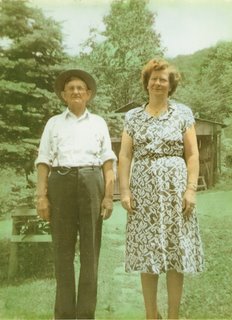
To the left above is a photo of Peggy's folks, Glenn and Virginia (McCoy) Skinner, taken in downtown Orlando in the 1960s. For more detail double click on it.
Comments
comment 1 Dave Kuhl Ocean Springs, MS
Dave Hyre, interesting that you connect K of P to unionists and IOOF to southern sympathizers.
My ggf Christian Kuhl is buried in K of P Burnsville and he was acting company commander of Company D, 31rst VA CSA for the last two years of the war. . . . .- - Dave Kuhl – dbkuhl@bellsouth.net

Friday, January 05, 2007

Hog Butchering

Bonnie (Brown) Neal sends these two 1961 photos of hog butchering on Flesher's Run, just over the hill from Clover Fork. These pictures, taken in 1961, show Frank Kidd, Jim Ratliff, Tommy Conrad, Solomon Brown and Ted Conrad hard at work.

David Hyre shared the following with us: "Mom told me about the family slaughtering hogs each year, hanging them from a teepee shaped tripod in the farmyard. They would skin and butcher them from that position. She spoke of large vats of boiling water as part of that and how there was a terrible stench to the process. The boiling water was used to soak skins to remove boar bristle by scraping with sharp knives. A peddler man with a wagon mounted grinding stone went farm to farm to sharpen scrapers and knives during the fall butchering time."

The photo below shows that process of soaking the skin.

Hogs were integral to farm life in this area from its very earliest settlement. The first settlers along Oil Creek and Clover Fork soon learned that sheep and cows were easy prey to the panthers and other predators that came with the land, and therefore needed to be closely watched. Hogs, on the other hand, with a tough old boar hog at the lead, fit right into the neighborhood, getting fat on the acorns and other nutritious fare that the woods provided.

As the farmers tamed the wilderness hogs became an even more intimate part of the economy and ecology of the household. The home-cured and
-canned pork was a staple all year long. Even more intimately tied to Orlando life was the bacon grease from the home cured bacon. As some cuisines use butter or olive oil, the standard fat used in Orlando was bacon drippings.

Another example of the family's intimate relationship with hogs was the slop bucket that sat next to the stove. Anything edible that we did not eat went into the bucket and every night it was a boy's chore to take it out to the hog pen and slop the hogs.
Double click on the photos to get a better look at them.

Wednesday, December 27, 2006

Grandma Lena's House on Oil Creek

Dave Hyre was kind enough to share his memories of visiting his grandmother's place on Oil Creek in the 1950s. His grandmother was the widow first of Dave's grandfather Frank Lake and then the widow of Frank Fisher. For the memories others have of this time and place, go to Five Remembrances of Orlando, WV

I remember staying a summer with Grandma Lena Gay Fisher's house after [her second and last husband] Frank Fisher’s death . . . what can I say other than “Rail Side Shanty?” It sat on stone piers with a crawl way beneath. I am sure that was a purposeful design for when Oil Creek overflowed it’s banks. It had a front porch, with rocking chairs and chain suspended slat settee swing for two. My sister and I would sit there and watch the never ending coal trains rumble by just yards away.

Thanks to Jim Reese for permisssion to use the photo below. The description accompanying this photo reads, "In the days before AC locomotives, the Chessie System often relied on several six and four axle units on the Burnsville Helper. Just east of Orlando, Western Maryland GP40 #3798 is the trailing unit in the helper as it shoves a loaded drag upgrade in the summer of 1985."

Grandmother Lena lived in an asphalt shingle sided house about a half mile downstream from downtown Orlando. To get to the house, one walked down a dirt road, and crossed over the B&O tracks, stepped down the rail embankment stile (steps) to a house lot eight feet below the tracks and the house 20 feet from the tracks. Huge mile long coal trains would rumble past. Indoor water was a kitchen sink mounted manual pump. The water smelled of sulphur. Baths were heated pots of that smelly water on a kerosene stove. Sixty feet back was the two hole outhouse sitting on the edge of Oil Creek. And yes, it had a Sear's Roebuck catalogue for paper!! Hey, EPA was 45 years away into the future. I would prowl the creek catching crawdads, never considering the outhouse issue!!

Inside was a modest sized living room, eat-in kitchen and two bed rooms. No closets, just free standing wardrobes. The beds were crude but comfortable, hand stuffed sack mattresses, sitting on bare wire spring sets on wood slatted cast iron frames with cast iron head boards. Linens were fresh and hand sewn quilts topped the beds. Washing was in a tub. Stove heated water from a hand pump....Saturday was “Bath Night” and Monday was “Laundry Day” with tub and scrub board.

Furniture in general was modest and typical of period. I do remember the enamel/ceramic topped kitchen table with red trim about the edges. First time ever experiencing grits and hominy for breakfast. Heat was a coal stove in the living room. Plenty of shake loose coal along the tracks to guarantee a ready supply . The kitchen stove was kerosene. Refill of the kerosene dispenser can came from a hand cranked Bung Hole pump mounted on a 55 gallon drum to the side of the house. A delivery man refilled that drum with jerry cans. Small back porch, utilitarian to descend to back yard area and outhouse back by creek.

It also had storage area for mops and brooms and was covered in Morning Glory vines. Gardens provided vegetables, corn, tomatoes, greens, onions, beans, radishes, squash and carrots.

I learned about canning from grandma Lena. Hey I was a city kid from Boston, vegetables came in a can from the A&P Market!! How the hell did they grow those cans in the ground?? I learned to use Mason Jars steaming on a stove to preserve garden harvest. Still do it today, My grown children laugh at me for all the trouble, but still line up for their share when the canning is done.

The photo of the Western Maryland engine above was taken in 1985 just east of the Route 5 crossing in Burnsville (near the old Sugar Shack) where the helpers tie onto loaded trains.

For more on the railroad, see the Northern West Virginia Railroads site, particularly the section on the Cowen Subdivision.
Thanks to Brad Moyers for identifying Jim Reese's photo and assisting us in obtaining permission from WVRailFans to use it.

Mary Lucille's Quilt

Dave Hyre sends this quilt which was made for his mother, Mary Lucille (Lake) Hyre. She was born and raised on Oil Creek. It now belongs to his youngest granddaughter in California.

"Lena created it for the birth of [her daughter] my mom (Mary Lucille) born 1925. It is all cotton, from feed sacks and printed cotton fabric. The backside is plain off-white muslin fabric. The embossment stitchery is carried through the reverse side. It is all hand sewn. Batting is feathers and down ! Size, 3 feet by 5 feet to fit an infant's bed or cradle."

Dave speaks about more ordinary quilts as well.
"I just remembered something unique about the handed down patchwork quilts used when I was a youngster. They had large amounts of green felt swatches [in with the pieces of old men's pants and] were darted with orange yarn!! Good grief, It never before dawned on me to link that quilting oddity of green felt to the fact that Grandpa Victor Hyre owned the pool hall in Burnsville. Thrify is what Thrifty does!!!"

"They were true 'Crazy Quilts' with no pattern, just stitched together. They weighed a ton, one could barely move under their weight. Local Boston area dry cleaners refused to take them for cleaning due to the weight!! My dad used to drive 50 miles to Plymouth twice a year to have them cleaned. They were all hand sewn. These old quilts just plain wore out mid 1960's. They had seen 50+ years of use."

Thursday, December 21, 2006

Hogs & Piglets

From Dave Hyre: "Couple of Hyre kids here raised on lower Oil Creek at Burnsville! (about 1920) This photo is displayed in my office. I often hear comments, "Aren't they cute"? I always ask, "Which two'?"

Dave Hyre shares the following two stories about hogs:

"I remember my grandma Lena telling me how the hog drives filled the main road alongside the tracks. It seems that an overland hog drive to market at Weston was still cheaper early 1900 's than the available railroad focused on serving the coal industry."

"Mom told me about the family slaughtering hogs each year, hanging them from a teepee shaped tripod in the farmyard. They would skin and butcher them from that position. She spoke of large vats of boiling water as part of that and how there was a terrible stench to the process. The boiling water was used to soak skins to remove boar bristle by scraping with sharp knives. A peddler man with a wagon mounted grinding stone went farm to farm to sharpen scrapers and knives during the fall butchering time."

Tuesday, December 19, 2006

Frank and Lena Lake Moved to Orlando


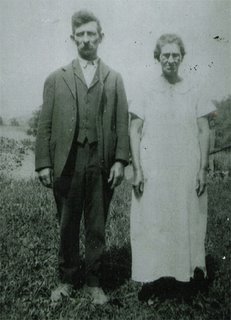
Photo to the right is Franklin Orlando and Lena Gaye (Potters) Lake with older daughters Ellen Vienna (Peggy), born in 1915 and Genevieve (Jim) born about 1917. Youngest daughter, Mary Lucille (Lucille) would be born in 1925.

Frank and Lena (Potters) Lake, from the Falls Mills area, moved to Oil Creek after their marriage in 1913.

When Frank Lake registered for the draft in 1917 there was no mention of sight problems but by the time this photo was made, 1920, maybe, Frank was blind.

Dave Hyre never met his grandfather but his mom told stories about her dad. "He was blind and crawled on his hands and knees to attend to the gardens. He would feel his way along to raise food for the family.

"Mom told me that grandpa Frank hired regular local labor to help run the farm and that they had "large" corn fields. I guess that is a relative term "Large", could mean 1/2 acre or 20 acres, who knows, but it fed their hogs. Mom always told me it was subsistence, just getting by, nothing for extras. As a teen, Mom worked as household help nearby. She told me how it was hard work, and how she would be scolded for trivial mistakes."

Frank Lake died from a stroke in 1943 at the age of 50. Lena re-married to Frank Fisher. He was a farmer, grew corn and potatoes, had chickens and cows. Frank Fisher died after 1950.

Dave Hyre remembers that "Grandmother Lena grew Blue Morning Glorys on the back porch to remember Frank Lake. I grow them still today here in Massachusetts for my grandpa Frank. It is something that I have passed down to my own grandaughter!! My Mom always spoke lovingly of her dad, Frank Lake, and she passed down his legacy by giving me the middle name "Frank", I carried on that legacy by giving my youngest son the middle name "Frank". Hopefully, there is another "Frank" in line soon!"

Saturday, December 09, 2006

The Ballad of Eugene Butcher

"Working for the railroad was not an easy job and certainly not for the fainthearted. The trackmen worked in the weather, rain or boiling sun, and the men had to be a hearty breed. The men worked with sledge hammers, rails, ties, ballast stone and spikes, and there were many mashed fingers, bruised ribs, and aching backs, as well as the tragic deaths."1

The ballad Eugene Butcher tells the story of a young railroad worker who was killed on the job in 1912. He was in Weston, but the experience was repeated throughout the region.2 In this home-made 1986 recording, 82 year old Georgia Ann Carr of Glenville sings the ballad Eugene Butcher.3

Please click on the image to the left to hear Georgie Carr's song. Be patient, it may take a while to load.

Dave Hyre is Eugene Butcher's grand-nephew. Dave's paternal grandmother, Virginia Mae Butcher, was Eugene's sister. The portraits of Gene and Bessie as well as the obituary and additional information that follow are from Dave.

(Weston Democrat. Fri. 2 Feb. 1912)
Obituary BUTCHER, EUGENE (GENE) Freight brakeman, of Haleville, died of injuries received in a railroad accident Wednesday. He died Thursday morning. Body was brought to Weston for interment. Mr. Butcher survived by wife and several children.

"Eugene Butcher was the son of Granville S. M. Butcher and Madora Ann (Knicely) Butcher. He was born October 8, 1889 in Lewis County, and died February 1, 1912 at Weston following a train accident. He was married to Bessie Beatrice Butcher daughter of James Newton Butcher and Margaret Ann Johnson.

"Georgie Carr's ballad speaks of a surviving "Wife and Child". Eugene's obit in newspaper says 'several children' even though they had only been married 2 1/2 years. Bessie re-married to Lester Lemmel Lemons, September 6, 1915.

"Eugene had a life long fascination with trains, I have pictures of him as a boy playing around box cars, with his brother. I have another photo of Eugene as a railroad employee standing next to his fellow railroad employee Lester Lemons."

See the following entries
Oct 06, '06
Orlando Train Wreck in the 1920s
Nov 12, '06
Trackmen & Maintenance of Way Workers
Nov 18, '06
Railroad Tragedies
Nov 30, '06
Another Death On The Rails

1. David Parmer, from the entry November 18, '06 Railroad Tragedies
2. By road, today, Orlando is just under 20 miles from both Glenville and Weston, Glenville and Weston are about 27 miles apart.

3. Glenville State College West Virginia Oral History Collection
4. Dave Hyre, Brockton, MA


Thursday, November 02, 2006

Telling Tales

There's a kind of story that was common sitting on the porch of the post office or around the Sunday dinner table. It poked gentle fun at those we loved as it exaggerated the qualities of human nature we all share. These stories always had some basis in the truth and some bit of the outrageous.

Patricia (McPherson) Stutler, my Aunt Pat, used to tell this story on one of my great aunts, I can't remember which one. When Aunt Pat was maybe 12, the aunt in question asked little Patty if she would wash her dishes for a dime. Well, there was quite a stack of dirty dishes on the table and sink, but 10 cents was a lot of money, so she said, "sure!" Aunt Pat had pumped the well water, heated it on the stove, and was well into the task when the old lady opened the oven and pulled out a pile of greasy, baked-on-dirty pots and pans. Patty kept washing. Then the old lady opened a cupboard, and in it were stacks of dirty dishes! Kids didn't talk back in those days, but, as you might imagine, Aunt Pat never agreed to wash dishes for the old lady again.

To the right is a photo of Aunt Pat with her new husband Bill Stutler on their wedding day in the early 1950s. Bill Stutler was my mother's baby brother.

Dave Hyre sent the following tale told on Claude Linger2 whose exploits in the Burnsville flood of 1943, reported in the The Clarksburg Telegram, appear in the Oct '06 entry The Burnsville Flood of 1943. There are obvious discrepancies between the following tale and the newspaper report. Even if the reader doesn't believe everything printed in the news, that reader would do well to note Denzil Stillwell's comment that Grandpa Vic was not above embellishing a story.

From Dave Hyre.......Brockton, MA.
"I share the following story sent to me October 2004 from Denzil Stilwell, Glenville, WV. - - -
' I remember your grandfather Victor Hyre. I believe he ran a pool hall which was once located between the old bank building across from the Gulf filling station and Carl West's beer joint about half a block west toward the tracks. I believe he sold beer because of a story that was told in which he was involved. That story has Claude Linger assisting Vic in salvaging things as the water began flooding his place, probably during the 1943 big flood. Claude would ferry stuff by john boat over to dry land and Vic would select stuff etc. Finally Vic loaded Claude up with a few cases of beer for some reason. Claude took that load to his house (about 150 ft away just west of Vern Wiant's house) and didn't return. Vic had to swim out.

'Grandpa Vic always embellished the story about how high the water got. That said, the pool hall was on the upper floors of Victor's Barbershop. So, if he thought that the beer supply needed saving, the water was rising pretty damn high. If I had been Claude emptying out Vic's beer supply, I would have taken a break too! '"
- Dave Hyre.......Brockton, MA


This ca. 1915 photo from David Parmer's collection shows the area in Dave Hyre's story at an earlier and drier time. David Bennett and his young sister-in-law Marie Parmer are in front of the bank and Vic's barber shop can been seen just behind them. At this point it the barber shop had only one storey.

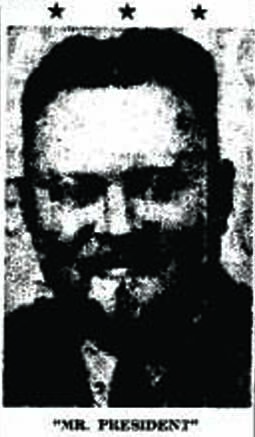
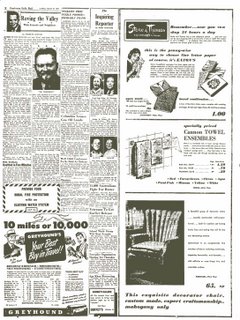
Charles McNemar shares a 1950s article about Claude Linger. Click on the thumbnail of the page on the right to see a readable copy. The article shows that Burnsville's notable Mr. Linger was no stranger to tall tales.

The photo above left of Claude Linger is taken from the newspaper article Charles found for us.
see also
2 Oct '06 entry Buggyride to Burnsville

17 Oct '06 entry The Burnsville Flood of 1943.
3 Nov '06 entry Several of Orlando's Citizens

1. Aunt Pat is Patricia McPherson who married my mother's younger brother, Billy Stutler. I don't recall which of my grandmother Edith Skinner Stutler's sisters was the clever task master, but she would have been a neighbor of Aunt Pat's, and not a relative.

Monday, October 02, 2006

A Buggy Ride to Burnsville

David Parmer shares yet another wonderful old photo of Orlando Folks

"The photo was taken in Burnsville in front of the Burnsville Exchange Bank around 1915 by Cecil Thompson, a local photographer, and shows Dave Bennett of Orlando, husband of Maysel (Parmer) Bennett, and his young sister-in-law Marie Parmer who was around 12 or 13 at the time."

Marie would marry a Barnett and move into the home in downdown Orlando that Dave and Maysel had owned.

For reminders, below right is the photo of Dave and Maysel about 40 years later and below left is the photo of Marie and Maysel's parents, Nathan and Ollie (Skinner) Parmer.


Note the barber pole in the background of the buggy photo. It's in front of Dave Hyre's grandfather's barbershop. He sends the photo below which shows
"Jake Brousis working in Victor Hyre's barbershop in Burnsville , May 1924. Dating the photo was easy with two calendars on the wall. The calendar hanging over the window shade is from the Burnsville Motor Sales. The calendar to the left is from the Burnsville Exchange Bank and displays a picture of Clara Bow. Just below that calendar is a picture of Charlie Chaplin. There is a spittoon on the floor to the left of Jake's knee. In front of the large calendar and mirror, is a lighted gas lamp fixture. The sign above the smaller mirror left of Jake notifies customers that closing time is 8 P.M. Monday through Friday and 10 P.M. on Saturday. The price for a shave and haircut is rung up on the cash register at $ .40. There are three empty Coca Cola bottles on the window sill and you can even see out the window to make out a Coca Cola sign mounted on a building across the street."

See also
Wed, July 12, '06 Ollie & Nathan Parmer
Sun, Sept. 24, '06 The Last Midwife