Showing posts with label Family McPhereson. Show all posts

Tuesday, March 02, 2010

A Widow's Way

Bessie (Riffle) Skinner McPherson
,
by David Parmer

A Can a’ E Taters an’ a’ Can a’ Couch
The barefoot boy, head barely sticking over the counter of Charley Knight’s Store, trying desperately to repeat what his mother Bessie had told him to get from the store, stammered: “A can a’ ‘E Taters’ an’ a can a’ ‘Couch.’” Kindly Charley Knight looked down at young Lester Skinner and said, “I think we have sweet potatoes and kraut.” Charley put the order in a paper bag, handed it to Lester, and the young boy scampered out the door on his way home, proud that he remembered his mother’s instructions. The professional ‘hangers-on’ who loafed at Charley Knight’s store had another little story to tell when they got home that evening from a hard day observing the sights and sounds of the little railroad town of Orlando. Little anecdotal remembrances such as these bring the olden days of Orlando alive.

Right, above, Lester's mom, Bessie (Riffle) Skinner McPhersonItalic


The Aftermath of a Tragedy
The late Mildred Skinner Kotrys, the daughter of Bessie Riffle Skinner McPherson, told her daughter Vicky in their Buffalo, New York home, “We didn’t have it easy,” speaking of the years following the death of Bessie’s husband, Homer Skinner, who was tragically killed in the Delta railroad tunnel at Copen in February 1923. In the days before Social Security and other social welfare programs provided a safety net for young widows such as Bessie, times were indeed tough when the breadwinner of a family met an untimely and early death, leaving a widow and young children to make do on little or nothing. Before Homer Skinner, 39 year old son of Perry and (Emma J. Posey) Skinner, was lowered into his Orlando grave, his young widow Bessie was wondering where the food would come from to feed her young children. Even though Orlando seemed to be on the surface a thriving railroad town, poverty was commonplace and lay heavily beneath the veneer. This was life in Orlando during the 1920’s and 1930’s and the reality facing the widow Bessie (Riffle) Skinner, the daughter of Stewart L. and Abigail (Blake) Riffle, as she left the Orlando Cemetery on a cold and dreary Friday, February 23, 1923.
Left, above: Homer Skinner as a young man
Left below: 2 pictures of Mildred (Skinner) Kotrys with her mom Bessie (Riffle) Skinner McPherson

Right: Bessie's parents Stewart and Abigail (Blake) Riffle

Living on the Hill
Vicky Kotrys, granddaughter of Bessie Riffle Skinner, recalls her mother Mildred telling her that the family lived on the hill above the Orlando School in a small house. She remembers her mother telling her that the house was poorly insulated and that Bessie would stuff old newspapers into the cracks of the walls to ward off the winter drafts. Dale Barnett remembers that the house was owned by Mike Moran and was located at the lower edge of the meadow at the top of the hill, near the home of John Blake, and faced Oil Creek and the Orlando Cemetery. Dale also remembers that he went to school at Orlando with Bessie’s children in the early 1930’s.

Bessie’s granddaughter Vicky also recalls that her mother Mildred told her that Bessie did odd jobs in the community to earn money to support the family. She did laundry in the community and frequently received produce such as butter, eggs and chickens in payment rather than in cash. Dale Barnett recalled that Bessie did domestic work for the widower Oley Ocheltree when he lived with his family in the former Rush home beside St. Michael’s Church. Mildred also told her daughter that the family subsisted on garden produce and an occasional squirrel, rabbit, or raccoon. Bessie also was fond of preparing what was called “leatherbritches,” which was made of rolled up cabbage leaves, fried in bacon grease. And of course, what woman of Orlando couldn’t make great home-made bread, and Bessie was no exception. Mildred also told her daughter Vicky that when the family had a beef or hog, every bit of the butchered animal was used for the family table, without exception. Regardless of Bessie’s ingenuity of finding and putting food on the table, life for a widow with a house full of children was a difficult proposition during the Depression when nearly every family was hustling for ways to put food on the table.

And a Man Takes a Wife
In 1943 at age 52, Bessie married Bill McPherson who was one year older. Bill became a widower in 1942 when his wife, the former Floda Heater died. Life-long acquaintances, Bill renewed his friendship with Bessie which resulted in a trip to the altar. Bill was the son of John McPherson and Maggie Blake, and a half brother of Frank, Tom and Dee McPherson, all well known residents of the Oil Creek area. He was the father of five children of his own. The youngest was Larry, still a toddler, and in need of a mother’s touch. Aside from the emotional aspects of the marriage, this union gave Bessie more security than she had ever had in her life and she no longer had to be worried about what tomorrow would bring. And, importantly for Bill, his youngest child now had a caring and loving mother at a critical stage of life.
.
Left: Bessie and Bill McPherson with Bill's son Larry
.

Life in New York
Bill McPherson’s employment in 1943 was in Buffalo, New York and it was to this western New York city, the couple moved. Bill worked as a welder in a cooperage which made barrels, both wooden and steel, and later worked in a plant which made trailers. Bill owned two homes near his employment, one of which is now the home to Bessie’s granddaughter Vicky. Bessie and Bill lived in Buffalo until around 1955 when he retired and the mountains of West Virginia again drew them home.

Return to Orlando
Larry McPherson was in the 5th grade when his father Bill and his step-mother Bessie returned to Orlando. The family moved to Road Run to a farm owned by Clate Wiant. Larry, now a South Carolina resident, recalls his step-mother as an excellent cook, “a pioneer lady who could take anything and make a meal of it.” Larry recalls his step-mother as a “superb gardener and homemaker” who loved for “company to come visit.” Larry remembers that after living on the Clate Wiant farm on Road Run for a few years, the family moved to the Ruby Brown farm on Three Lick and lived there until he was a sophomore in high school. The family then moved to Burnsville and lived near the iron bridge.

A Marriage of Convenience was a Happy One

When a 52 year old widow marries a 53 year widower with young children, it could be termed a marriage of convenience, but in the case of Bessie and Bill McPherson it was a union with true affection. They had a happy marriage of nearly twenty five years when Bill died in 1967. After Bill’s death, Bessie returned to Buffalo to live near her children where she died in 1970. Bessie and Bill are buried at the Orlando Cemetery.

Left: Bessie (Riffle) Skinner McPherson's obituary. (Click on it to enlarge it.)

. . . . .

Note:
Lester Skinner, the little boy who went to Charley Knight’s Store for his mother for a can of sweet potatoes and a can of kraut, grew up in Orlando and as most Orlando boys have done for the past seventy-years, went away to find employment. Lester lived and worked in Paterson, New Jersey for most of his adult life. He died in Paterson in 1990 at age 72, survived by his wife Lucille, and four children.

Note: Here are three photos of Bessie's Sons.

Left below: Bessie's sons Warren Lambert, Earl, Kennth and Lester Skinner

Right: Bessie's sons Earl and Kenneth

Right below: Bessie's son Warrren Lambert with his sonThomas Lambert Skinner


Monday, November 13, 2006

First Settlers

How did Orlando begin? Earliest land records for Oil Creek and its tributaries are skimpy and until 1850 the census didn't give a clue about where in the district a citizen's property was located. Undocumented family stories do give us clues but still, it is difficult to discern the first settlers in the region that would become Orlando.

The first solid body of information about who lived along Oil Creek and its tributaries comes to us with the 1850 census. The 1850 census gives us names of everyone in the household and some useful details about them.

The 1850 census suggests that by that time the following 30 or so households had formed a community that in time would grow into Confluence and then Orlando.1 Looking at these 30 or s0 families it appears that most if not all of the settlers who had arived by 1850 came from one of three places. Several came from Braxton County2, farther upstream on the Little Kanawha River. The Mace, Sands, Heater and Skinner/Posey3 families can be traced to areas including Bulltown, Flatwoods and Salt Lick. Greenbrier County is the second source of settlers. The extended Williams family came directly from Greenbrier County, VA to settle throughout the Little Kanawha River watershed. The members of this clan who settled along Oil Creek and its tributaries include the names Williams, Blake, and Ocheltree. From Lewis County came Jacob and Dorothy Riffle with several of their children. They died in Braxton County in 1816/17. Several of their children and grandchildren were in the Oil Creek area by the time of the 1850 census.

In 1850 the community that would become Orlando included
In Braxton County
1 Nancy McPherson y/o widow
2 Benjamin Posey 35y/o, widower
. . . Had married Cynthia Robinson who was deceased in 1850, would marry her sister Sephronia Robinson
3 William 38 y/o and Sarah 26 y/o (Ste...) Posey
4 Catherine (Scott) Skinner Posey 68y/o widowed
5 Rebecca (Williams) Ocheltree 56y/o, widowed
6 John B. 42y/o Abigail 42y/o (Crissmore) Blake
7 Samuel 59 y/o and Nancy 54y/o (Hanna) Walton
8 Joseph 24y/o and Elizabeth 36 y/o (Walton) Blake
9 Jacob R. 45y/o and Elizabeth M. 37y/o (Williams) Riffle
10 Francis 69y/o and Elizabeth 45y/o (Conrad) Riffle
11 Jefferson 27y/0 and Elizabeth 23y/o (Heater) Riffle
12 Isaac Jr. 64y/o and Elizabeth 62y/o (Wash) Riffle
13 Jacob J. 29y/o and Francina (Blake) Riffle
14 Jacob 26y/o and Susannah (Riffle) Heater
15 Absolom 42y/o and Susannah 37y/o (Robinson) Riffle
16 James 33y/o and Mary 35y/o (Riffle) Sands
17 William John 27y/o and Elizabeth 32y/o (Riffle) Blake
18 John B. 36y/o and Mary 33y/o (Mace) Conrad
19 John A. 32y/o and Mary Ann 23y/o (unk) Harris
20 James 27y/o and Rebecca 23 y/o (unk) Williams
21 Hugh 49y/o and Jane 49y/o (Howell) Williams
22 Hugh 40y/o and Martha 44y/o (Williams) Blake
23 Marshall 23y/0 and Patience 27y/o (Ocheltree) Williams
24 James 44y/o and Bearsheba 42y/o (Howell) Williams
25 George 34y/o and Nancy 34y/o (Ocheltree) Williams

in Lewis County
26 William 55y/o and Mary 45y/o (Cogar) Heater
27 James 42y/o and Barbara 39y/o (Riffle) Posey
28 Andrew 40 y/o and Catherine 43y/o (Crissmore) Blake
29 Edward 44y/o and Margaret 39y/o (Ocheltree) Williams
30 Alexander 42y/o and Phoebe 35 y/o (Conrad) Skinner
31 John 42y/o and Sarah Ann 38y/o (Posey) Riffle

Four families that lived in this community at this time would be gone before the 1860 census and none of their children married within the Oil Creek community:
Gabriel Denison
Thomas Hudnall

William and Rachel (Emrich) Godfrey moved on west
Robert & Ann (Smith) Godfrey and their children would be found in Gilmer, Calhoon, and other West Virginia counties. Godfreys would move to Orlando.

The sketch above right of building a log cabin is by Alsacian immigrant Joseph H. Diss Debar from West Virginia History and Archives.

1. The assumptions used to determine who in the 1850 census belonged to the community that would become Orlando:
a. the households are listed according to their physical location. The census taker in the 1850 census went from one residence to the next closest and recorded the information that way.

b. there is a tight pattern of intermarriage among the children in the community

2 The Early History of Braxton County http://duskcamp.itgo.com/Post6.htm
"In 1798 Nicholas Gibson, 1800 Benjamin Conrad, John Conrad, Daniel Conrad, Thomas Murphy, in the years to follow: Col. John Hayman, Asa Squires, Elijah Squires, Andres Friend, Thomas Frame, Edward Posey, John F. Singleton, George F. Gerwig, William McCoy, John M. Brown, George W. Greene, Andrew Skidmore. Col. John Hayman, settled in what is now known as Bulltown. So called on fact it was occupied for many years by friendly Indians whose chief was known as Captain Bull."Further on this source says:"The first settlers in the Salt Lick District known as “Flatwoods” were Peter Shields, Asa Squires, in 1807. Soon after joined by P.B. Burns, John Hayman, Issac Riffle. Christian Heater, William McCoy, and John F. Singleton."

3. Because most of the spouses of the Skinner/Posey children were from early Little Kanawha River settlers we suppose this Maryland family came into the Oil Creek area via Braxton County.

Thursday, November 02, 2006

Telling Tales

There's a kind of story that was common sitting on the porch of the post office or around the Sunday dinner table. It poked gentle fun at those we loved as it exaggerated the qualities of human nature we all share. These stories always had some basis in the truth and some bit of the outrageous.

Patricia (McPherson) Stutler, my Aunt Pat, used to tell this story on one of my great aunts, I can't remember which one. When Aunt Pat was maybe 12, the aunt in question asked little Patty if she would wash her dishes for a dime. Well, there was quite a stack of dirty dishes on the table and sink, but 10 cents was a lot of money, so she said, "sure!" Aunt Pat had pumped the well water, heated it on the stove, and was well into the task when the old lady opened the oven and pulled out a pile of greasy, baked-on-dirty pots and pans. Patty kept washing. Then the old lady opened a cupboard, and in it were stacks of dirty dishes! Kids didn't talk back in those days, but, as you might imagine, Aunt Pat never agreed to wash dishes for the old lady again.

To the right is a photo of Aunt Pat with her new husband Bill Stutler on their wedding day in the early 1950s. Bill Stutler was my mother's baby brother.

Dave Hyre sent the following tale told on Claude Linger2 whose exploits in the Burnsville flood of 1943, reported in the The Clarksburg Telegram, appear in the Oct '06 entry The Burnsville Flood of 1943. There are obvious discrepancies between the following tale and the newspaper report. Even if the reader doesn't believe everything printed in the news, that reader would do well to note Denzil Stillwell's comment that Grandpa Vic was not above embellishing a story.

From Dave Hyre.......Brockton, MA.
"I share the following story sent to me October 2004 from Denzil Stilwell, Glenville, WV. - - -
' I remember your grandfather Victor Hyre. I believe he ran a pool hall which was once located between the old bank building across from the Gulf filling station and Carl West's beer joint about half a block west toward the tracks. I believe he sold beer because of a story that was told in which he was involved. That story has Claude Linger assisting Vic in salvaging things as the water began flooding his place, probably during the 1943 big flood. Claude would ferry stuff by john boat over to dry land and Vic would select stuff etc. Finally Vic loaded Claude up with a few cases of beer for some reason. Claude took that load to his house (about 150 ft away just west of Vern Wiant's house) and didn't return. Vic had to swim out.

'Grandpa Vic always embellished the story about how high the water got. That said, the pool hall was on the upper floors of Victor's Barbershop. So, if he thought that the beer supply needed saving, the water was rising pretty damn high. If I had been Claude emptying out Vic's beer supply, I would have taken a break too! '"
- Dave Hyre.......Brockton, MA


This ca. 1915 photo from David Parmer's collection shows the area in Dave Hyre's story at an earlier and drier time. David Bennett and his young sister-in-law Marie Parmer are in front of the bank and Vic's barber shop can been seen just behind them. At this point it the barber shop had only one storey.

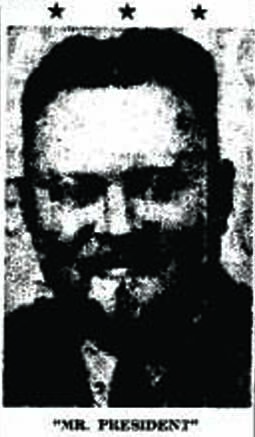
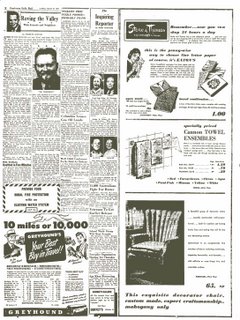
Charles McNemar shares a 1950s article about Claude Linger. Click on the thumbnail of the page on the right to see a readable copy. The article shows that Burnsville's notable Mr. Linger was no stranger to tall tales.

The photo above left of Claude Linger is taken from the newspaper article Charles found for us.
see also
2 Oct '06 entry Buggyride to Burnsville

17 Oct '06 entry The Burnsville Flood of 1943.
3 Nov '06 entry Several of Orlando's Citizens

1. Aunt Pat is Patricia McPherson who married my mother's younger brother, Billy Stutler. I don't recall which of my grandmother Edith Skinner Stutler's sisters was the clever task master, but she would have been a neighbor of Aunt Pat's, and not a relative.