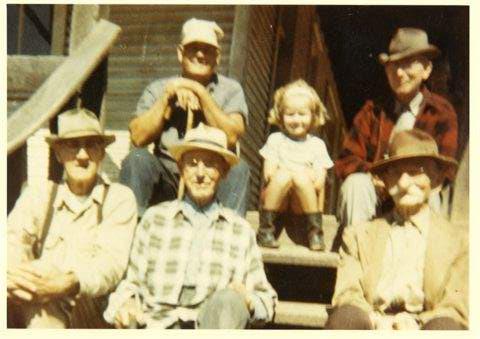
According to his great-grandson Lawrence Conley, Peter Conley, the first of the Orlando C onley family to come to America, hailed from Dublin. Although family history is scant concerning the year of immigration, Paul Vincent Conley, grandson of Peter Conley, who was the family genealogist, offered that Peter, his wife and at least two children, left Ireland during the potato famine, sometime during the late 1840’s. It is believed that Peter’s wife and two children died during the voyage to New York and were buried at sea. Whether they died of disease or of the lingering effects of the famine is unknown. By 1850, Peter appears to have arrived in Harrison County. The census of that year shows a Peter Conley
 working as a laborer. No wife is indicated and presumably Peter had not yet re-married. It is assumed that this Peter Conley later appears as a resident of Posey Run and is the subject of this biographical sketch.
Left: The map shows where Dublin is located. Right: Large, healthy potatoes in the rich earth
Peter Conley Marries
Bridget (Donahoe) Foley
Although the place of marriage of Peter Conley, widower, t
o
Bridget (
Donahoe)
Foley, widow, could not be determined, we do know that by 1860
Peter and
Bridget were living in Braxton County on Posey Run as husband and wife. The other members of the household listed in the 1860 census report were
Patrick, age 14, no last name given, place of birth: Ireland;
Coalman Folia, age 17, place of birth: Ireland;
Mary Folia, age 9, place of birth: Virginia; and
Thomas Folia, age 5, place of birth: Virginia. It is obvious that the census scrivener created confusion for later generations by the misspelling of the last name of “Foley.” Further confusion created by the census taker is the identification of the children
Mary and
Thomas with the last name of Foley, rather than Conley. However, perhaps there was no mistake and the last name of Mary and Thomas may indeed have been Foley rather than Conley. We do know that in the 1870 census,
Mary and
Thomas are identified by the last name of
Conley. This leads to two possibilities: either Mary and Thomas were Bridget’s children by her marriage to Foley, and they simply took their step-father’s name, or, the census taker erred in the 1860 census and incorrectly listed their last name of Foley instead of their actual name of Conley. We are certain however that Mary and Thomas throughout life referred to themselves as children of
Peter Conley. Thomas listed himself as having been born in 1856 at Bridgeport and as the son of Peter and Bridget Conley.
Peter and Bridget Come to Posey Run In 1855, Peter Conley (in the deed spelled Connaly),
Patrick Beirne, and
Patrick Foley bought a tract of one thousand acres for the sum of one thousand dollars from
Joel Yancey and
Elizaberth B. Yancey, his wife, and
Alexander Skinner, acting as trustee for Elizabeth B. Yancey. This tract was located on what is now Dumpling Run, Posey Run, Long Shoal Run (then known as Buffalo Shoal Run), and Oil Creek, and was bounded by lands owned by the
William McPherson heirs,
Benjamin Posey,
William Posey and others. This tract, owne
d by Yancey, an original settler of Burnsville, was then partitioned between
Conley, Beirne, and
Foley, with each presumblyowning one-third of the total. Peter Conley began farming his portion of the land allocated to him which was located on Posey Run.
A Land Book entry under the name of Peter Conley in 1872 indicated that Peter owned tracts of 144 acres and 299 acres on Oil Creek.
At some undetermined date between the 1860 census and the 1870 census,
Peter Conley died. In the 1870 census
Bridget is listed as a widow, with
Mary and
Thomas as the other members of the household.
Pat and
Coleman (no last name given) who were listed in the 1860 census as household members were absent from the 1870 census and are presumed to have been married with their own households, and migrated elsewhere, or died. Also, in the 1880 census and thereafter, Bridget’s daughter
Mary is not listed. No record can be found of her marriage or death. Presumably, Mary died young and her death was not reported. In a deed of record in the Braxton County courthouse executed in 1884 by
Thomas Conley, he stated that he and
Bridget Conley were the heirs of
Peter Conley. This verified instrument would indicate that
Mary, daughter of
Peter and
Bridget, had died at some previous date without issue. Since Bridget’s date of death is listed in the death records of Braxton County as 1883, the aforementioned deed dated 1884, stating that
Thomas and
Bridget
were the heirs of
Peter Conley, must have meant to refer to Bridget in the past tense. At any rate,
Thomas Andrew Conley, the man with a pipe between his lips, by inheritance became the owner of the Peter Conley farm on upper Posey Run.
Thomas Andrew Conley
Thomas Andrew Conley was born in 1856 in Harrison County but lived most of his life on Posey Run, with the exception of his earliest years, until his death in 1937. He became a well-respected member of the Orlando community, farmed for his living, and raised a large family on the family farm.
Right: Tom and Ellen (Dempsey) Conley
In 1876, Thomas married Mary Ellen Dempsey, daughter of James and Hannah (Hanley) Dempsey of Crooked Run in Lewis County. Known as “Ellen”, she was the mother of ten children, all born on Posey Run: Mary, born in 1877; Anna, born in 1880; James, born in 1881; Peter, born in 1884; Thomas Jr., born in 1886; Genevieve, born in 1889; John, born in 1889; Patrick, born in 1894; Coleman, born in 1896; and Nell, born in 1898.
 Left: Thomas Jr. and Mary Loretta (Fahey) Conley with their children.
As with most farmers in the late 1800’s and early 1900’s, most everything the family required was raised on the farm. According to Lawrence Conley, grandson of Thomas and Ellen, his grandparents raised corn, wheat, milk cows, pigs, chickens, and all the usual garden crops on the Posey Run farm. He also had a large apple orchard high on the hill above the home, and had peach and cherry trees in the bottom below the family home. The Posey Run soil seemed to be conducive to the raising of a good pumpkin crop. Uncle Zeke reported in his October 15, 1918 news column that “Speaking about pumpkins, Thomas Conley has one of his acorn squash variety which measures five feet in circumference and about twenty inches in diameter and weighs one hundred pounds.” Thomas also raised his own tobacco crop to keep a steady supply of tobacco for his trusty smoking pipe. He appeared to sometimes lose track of the whereabouts of his pipe. Uncle Zeke noted in his December 12, 1916 news column that “Tom Conley took a five minute hunt for his pipe the other day and when he found it, it was in his mouth.”
 Left to right: Five of Tom and Ella's ten children: Anna, Mary, John, Jim, Pat and Pete Conley
Uncle Zeke continued his jibes at Tom’s propensity to puff his pipe in an August 22, 1929 column. “Tom Conley who is a real Irishman and smokes a pipe as strong as horseradish, was recently seen riding in an automobile. What puzzles us is to know whether it was run by the strength of tobacco or gasoline. Anyhow, you could frequently see a puff of smoke from Conley’s pipe as he sped along.”
 The Tin Mill
As they grew older, some of Tom and Ellen’s children eschewed life on the farm for employment in Clarksburg. According to Lawrence Conley, his father Pat Conley, and several uncles, including Jim, John, Coleman, and Thomas all were employed at one time or another at the “tin mill” in Clarksburg. The “tin mill” was the Phillips Sheet and Tin Mill, which later became the renowned Weirton Steel Corporation. Judging from the frequency of their visits home to Posey Run as duly recorded by Uncle Zeke, Tom’s sons welcomed the respite of fresh Posey Run air instead of the polluted Clarksburg air.
 World War I
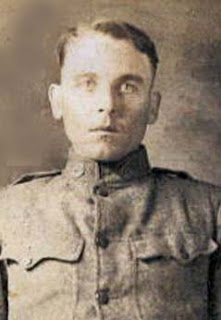
The children of Tom and Ellen Conley did their bit for their country during World War I. John served in France during the hostilities and was wounded during the late stages of the war. Patrick also served his country as a member of the Allied Expeditionary Force. Coleman was a late inductee into the war and was still at Camp Meade, awaiting deployment when the war ended.
Left: One of the three Conley boys who served in World War I: John Conley
A New House
In late 1915, Tom set to work with his sons building a spacious two story clapboarded home  with a wing on the rear and with two story porches on the main house and the rear wing. Uncle Zeke reported in his January 4th, 1916 column that Tom’s new residence was nearing completion. Since the Philadelphia Gas Company had drilled a gas well on Tom’s property in 1915, the home was well heated during the cold winters of that day with free gas. The home burned in 1992. One of the original foundation stones of the home which was hand cut by Tom Conley from the Conley farm now decorates the front lawn of the Burnsville home of Thelma (Conley) West, daughter of Coleman and Macel (McCauley) Conley. Thelma is the granddaughter of Thomas Conley.
Above Right: The house that Tom and his boys built on Posey Run, long after the family had moved on.
A Reunion and Homecoming
By 1930, Tom and Ellen were approaching eighty years of age and were both in bad health. Their children were far-flung across the country. Jim lived in Oakland, California where he was employed by a railroad, Anna McGaffick lived in Houston, Texas, Genevieve Brice lived in Richwood, Mary Gallagher lived on Three Lick, Nell Shepherd lived in Clarksburg, as did her brothers John, Coleman, Peter, Patrick and Thomas Jr. Tom’s children thought it would be fitting to celebrate their parents’ life while they were still living and arranged for a family reunion, at which Uncle Zeke was an invited guest along with all of their Posey Run neighbors. Uncle Zeke of course took paper and pencil to the reunion to record the festivities.
In his July 3rd, 1930 column, Uncle Zeke paid tribute to his friends and neighbors, Tom and Ellen Conley.
“On last Sunday there was a real homecoming and family reunion at the home of Mr. and Mrs. Thomas Conley. Sixty-five persons were present, including eight children, their wives and husbands, twenty-four grandchildren and one great-grandchild. Two of the children, Mrs. Mike Brice and Mrs. Al McGaffic, were unable to be present. An infant child of Mr. and Mrs. Thomas Conley, Jr., thirty-nine days old, was the youngest, and Miss Margaret Gallagher, 77, the oldest person present. The noon hour seemed to be the most attractive and enjoyable hour of the day. A table was spread throughout  the length of the dining room which seemed to groan and tremble under its weight of delicious viands of all sorts. After the tempting repast was over and all present seemed to have satisfied appetites, the afternoon was spent in music, games and gab. When old Sol began to drop behind the western slope and people began to think about repairing to their several places of abode, lo and behold, there came a tumultuous uproar, when, to the surprise of all present, there came a mighty rushing of ice cream and watermelon from all directions, and a second time more than half a hundred appetites were appeased. It was a day well spent and
  everybody present seemed sociable and happy except Pete Conley who was ill from accidentally eating a little too much mutton the evening before; but glad to say before the day was spent Pete was feeling as jubilant and merry as an old sock. No fatalities from overeating have been heard of as yet. But somehow we seem to have a little fear of Johnny Gallagher and Pete Farrell. Now that the pleasure of the day is past, let us hope that the event is so indelibly written on memory’s pages that it will never be forgotten. Mr. and Mrs. Conley, both being in their seventy-sixth year, we hope for them many bright future years. There will be a homecoming and reunion some day in God’s other world, where there will be more joy and gladness in one hour than there would be in a million years. Let us be in readiness for that great day. We hope to meet Mr. and Mrs. Conley and all their children and families over there."
Above, left and right: Some of the many grandchildren Right: Daughters of Pat and Anna Emma (Kreyenbuhl) Conley, Jane, Alice and Irene. Left: Children of Mary and Mike Gallagher in 1912, John, Margaret and Ann Gallagher The Gallaghers lived on Three Lick.
Requiescat in Pace
Tom and Ellen Conley lived a few more quiet years on Posey Run. Ellen was the first to go when she died on May 16th, 1936. Tom lived less than a year, passing on April 21, 1937. They were both buried at St. Bridget’s on Goosepen. Requiescat in pace; rest in peace.
Comments
comment 1 by Donna Gloff
Another Tom Conley lived in Braxton County at the same time as Posey Run’s Tom Andrew Conley, born 1856.
A Tom Conley who was born in Preston County in 1853 (parents unknown) married Amanda Wine, daughter of David Smith and Elizabeth (Conrad) Wine and they lived in the town of Dutch. At least one of their children, Thomas Conley born 1878, lived in Orlando. No connection has been found between these two Conley families.
comment 2 by David Parmer
In his June 25, 1931 Buzzardtown News column, Uncle Zeke mentioned that Tom Conley still had his bow-legged walking cane that he got from Grover Foley as difference in a cow swap. Grover Foley at the time was living at Hyre’s Run and was related to Tom through his mother Bridget (Donahoe) Foley Conley.
If any of the descendants of Tom Conley still has the bow legged walking cane, I would appreciate a photo of it.

comment 3 by Donna Gloff
Some believe that Tom, before he married Ellen, had two daughters with Rosena Heater, a neighbor and daughter of pioneers William and Mary (Cogar) Heater before he married Ellen Dempsey: Catherine Bridget and Ann Heater. Right: Rosena Heater
comment 4 by Judy Castro
My husbands grandfather was James Conley from Posey Run. I came across your blog and was thrilled to death at the information you have posted there. My mother in law was Anne Louise Conley, she had 3 sisters Rose, Marie & Peggy, Anne being the youngest.
My husband and our family came back to Posey Run in 1978 and got to see the old house before it burned down. We picked a cousin in Weston who took us to the property. I wondered who we might contact to get some copies of pictures and more info about the Conleys?
Our kids would be thrilled to learn about they family, Anne was so young when they came to Calif that she didn't remember a lot about WV.
Can you let know if there is someone I might contact. Thank you.
comment 5 by Uncle Zeke
Uncle Zeke frequently mentioned his neighbors in the Buzzardtown area which included the families who lived on Posey Run, Road Run, and those who lived on Oil Creek, within throwing distance.
A novel way in which Uncle Zeke referenced his neighbors was to put them in a poem. In his February 12, 1931 column, Uncle Zeke wrote a poem called "A Census in Rhyme," in which he named the neighborhood residents beginning with those who lived at the head of Posey Run and then farm by farm down to the mouth of Posey Run on Oil Creek and then those families who lived on Road Run. Tom Conley and his son Pete are mentioned in this poem.
Census in Rhyme
Arch McHenry, first at the head of the run,
Tom Conley next, full of fun,
Pete Conley next, with much to say
Then comes Taylor Riffle, old and gray.
Wade Mick appears upon the scene,
Next Alva Riffle, though very green,
Gilbert Riffle steps into view
Then Grafton Riffle, tried and true.
Next Ruddle Posey, he comes in,
Then Manly Posey with a little grin,
Brownie Riffle, next we find,
Then Sanford Posey, good and kind.
Next Bill Beckner steps in sight,
Then Ernie Fox with all his might,
Ray Fox comes next to take his stand,
Then Boss Riffle joins the band.
Now comes Fred Riffle, slim and tall,
George Riffle next, both great and small,
Next Ezra Posey, blithe and gay,
Then Burr Skinner steps this way.
Amos Henline next we greet,
Then Walter Blake with his big feet,
Mart Posey next, whom you all know,
Jim Murphy next, though very slow.
Bruce Posey next comes down the pike,
Closely followed by his son, Mike,
Cam Sharp, the pumper, he comes next,
Then Walter Sharp, so easily vexed.
Now comes Glen Sharp with easy tread,
Next Martin Fox, with whiskers red,
Clem Crislip next with lots of cheek,
Next on the list is Uncle Zeke.
Next we find Jack Posey’s name,
Fred Posey next, of fighting fame,
Young Bennett next, whose name is Holt,
Doyle Skinner next, like a frisky colt.
John Posey next, with pipe in hand,
Then next Linn Strader takes the stand,
Next Early Riffle takes his place,
Then Okey Strader with his fat face.
John Strader next, sly as a fox,
Then Floyd Posey, dumb as an ox,
Billy the Newspacker completes the list,
Unless there’s more we may have missed.
 Left: Mike Moran
 Gertrude Rush, whose family lived up Three Lick and owned the Rush Hotel, remembered the good times so fondly the younger generation remembers to this day her stories about the weekend dances. See the March '08 entry Michael Rush's Family
  Church. This will take place in the Moran Club Hall, opposite the Union depot. The doors will be thrown open at noon at that day and closed at midnight. During that period dancing will be held on the second floor while all kinds of refreshments are served on the lower floor. Outdoor sports commencing at 3:30 p.m.: One hundred yard dash, boys under sixteen, prize given by M. V. Moran and Company; Climbing the Greasy pole, free for all, prize given by Dolan House; Stand-hop-step and jump, boys under eighteen, prize given by Central Hotel; Sack race, boys under fifteen, prize given by J. B. Dolan and C. F. Moran; Prettiest horse on the grounds, purse made up that day. After the outdoor sports are over, the doors will be thrown open for supper and closed at eight o’clock p.m. All are cordially invited to come early, stay late and help to make this a success.
 Church was located on the bluff (Flint Knob) overlooking Orlando. Built of frame construction in 1907, the church was located well out of the area of flooding that chronically plagued the Oil Creek Valley. Struck by lightning, this original church burned to the ground in 1915. It was re-built, using brick, along the Coal and Coke Railroad right of way, in the lower area of Orlando.