Wednesday, September 05, 2012

Books about Orlando


David Parmer,  the major contributor to this blog, has written two books about Orlando: 

Tales of Old Orlando
This large format book (8 ½ x 11) has over 400 pages, is blessed with around 300 photographs and is fully indexed. This book of stories about the Orlando area and its people of by-gone years includes stories of murder and mayhem, fun and frolic, railroading and farming, and the trials and tribulations of the hard working people who pioneered and populated the hills and valleys around this former railroad town. This book preserves Orlando's story for those of us who seek America's roots and our own. 

The cost of the book is $45 plus $5 for shipping, and is available from David L. Parmer, P. O. Box 39, Hinton, WV 25951. You may contact him at gbrcliffs@frontier.com or by phone at (304) 466-4466.

Uncle Zeke, the Bard of Buzzard Town
  P. N. “Newt” Blake was born just after the Civil War, in 1867, and lived his entire life in the Orlando area until his death in 1951.  Writing a news column titled the “Buzzard Town News” under the pen name “Uncle Zeke” for several area newspapers, Blake delighted readers with his wit and wisdom from 1894 until 1936.


Although his formal education spanned but a few months of primary school, his writing and insight belie his lack of academic credentials.  He wrote from the heart about issues that mattered to him and was of import to his community and the nation, provoking laughter and moralistic thought.  For over four decades he entertained, cajoled, preached and gave his view of the news to his friends and neighbors of Buzzard Town, and to his thousands of readers.

 Uncle Zeke's simple home on Oil Creek, alongside the Baltimore and Ohio Railroad track, is now rotted into the ground without a trace.  No museum bears his name; no obelisk marks his grave site.  No books have told his story; and no highway marker proclaims where he lived.  Only a few are left who knew his name when his newspaper columns were being read throughout central West Virginia from the time of the presidency of Grover Cleveland to the third term of Franklin Roosevelt.  The Bard of Buzzard Town has lain  for over sixty years, in a hilltop cemetery in Orlando.  This book seeks to introduce a new generation of readers to this humble man of humble birth, who wielded a mighty pen.

The Bard of Buzzardtown will be of interest to American, Appalachian and Central West Virginia historians, collectors of humorists and folk stories, railroad aficionados, and descendants of the Oil Creek area, among others.

This hardback book with dust jacket, with 182 pages and index, can be purchased from the author for $25 plus $5 shipping.  Contact David Parmer, P. O. Box 39, Hinton, WV 25951 or at gbrcliffs@frontier.com.  


editor's note: Hooray for David! This is the best!

Sunday, May 27, 2012

William O. Skinner Went West

David Parmer shared this story in 2006:
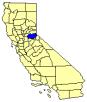
William O. Skinner was was born in 1849 to Alexander & Phoebe (Conrad) Skinner1. He was, to the best of our research to date, the only one of their 14 children to leave central West Virgina. It was shortly after the Civil War that he joined his aunt and uncle, Matthias and Elizabeth (Conrad) Nail, in the migration to California. He lived in ElDorado, California (see map at left) for 20-some years. He married a California girl, Belle Nichols around 1880. They had three daughters and one son, Bertha Barto, Velma Etzenhouser, Arden O. Skinner and Ruth Price.


A blacksmith by trade, he was ordained a priest in the Reorganized Church of Jesus Christ of Latter Day Saints2 in 1887 and ten years later he relocated to Independence, Missouri where the denomination is headquartered. Shortly after that he began making annual trips back to Orlando, where he began a congregation known as "Mission Number 1930." About 1930 the Orlando congregation had a church building near the mouth of Posey Run. The tiny congregation lasted into the early 1960s.

William O. Skinner died in Independence, Missouri in 1923 and was buried in the Mound
Grove Cemetery in Independence.

. . . . .
The following comes from Barbara Diane (Etzenhouser) Edwards:
William Otto Skinner (my maternal grandfather) married Belle Dynan Nichols in Sacramento City in 1880. She was only 16, having been born on August 13, 1863 in Amador, California (in the California gold country). She had been orphaned at about age 11 and along with several of her siblings had been placed in the Christian Women's Orphan Asylum in Sacramento. This orphanage is now called Sacramento Childrens Home. The home still has a card on the Dynan children, giving their names, ages at admission, ages at discharge and to whom discharged.
Left: wedding picture of William and Belle (Dynan Nichols) Skinner

A few years later, she was released to the care of and adoption by a Mrs. Nichols. Family lore is that she had to go to bars to buy buckets of beer for Mrs. Nichols. (A younger brother, Ben, was adopted by a family named Fertig.) I heard somewhere that she married William Skinner because he was religious and she thought he would be good to her. He was a blacksmith. Their first two children, Bertha and Arden, were born in Grizzly Flats, California. Bertha Mabel Skinner was born on November 25, 1882 and died in Independence, Missouri in December 1941. Arden O. Skinner was born on March 11, 1884 and died on March 17th, 1982 in Lombard, Illinois, a suburb of Chicago. Ruth Emma Skinner was born on May 9, 1888 in Roseville, California and died on May 6, 1972 in Independence, Missouri. The youngest child, Velma
Alverta Skinner, was born on March 6, 1899 in Independence, Missouri and died December 21, 1978 in West Chester, Pennsylvania.

My mother, Velma Skinner, married my father, Leonard Raymond Etzenhouser, in about 1926 or 1927. They had both grown up in Independence where William Skinner was a blacksmith. They were both raised in the Reorganized Latter Day Church. Mother worked as a legal secretary in Kansas City while Dad was attending Kansas City Dental College. I believe that William Skinner died July 31, 1923 in Independence. He had left Belle four houses so she was able to live comfortably. By the time she died in about 1941, she had had to sell all of her property. Through the years, members of the younger generation would borrow money from her. My Dad borrowed money from her in order to set up a dental practice in Smithville, now part of Kansas City. Missouri. However, the depression hit, and he was fortunate to be accepted into the United States Public Health Service in which he remained until his retirement. He was transferred frequently and we lived in all parts of the country.

. . . . .

additional information from David Parmer in June, 2012:

Matthias Nail, a Comment by David Parmer

In the late 1960’s or early 1970’s, I visited Margaret (Henline) Nixon who lived in Weston. Mrs. Nixon, who died in January 1981, was the daughter of Beham Henline and Samantha (Skinner) Conrad, the latter of whom was the daughter of Alexander Skinner and Phoebe (Conrad) Skinner of Orlando.

Mrs. Nixon had a number of old photographic images which had belonged to her mother, Samantha (Skinner) Henline, and presumably they had originally belonged to Phoebe Conrad Skinner, grandmother of Mrs. Nixon. Three of the photographic images were tin types, one of Alexander Skinner, one of Phoebe (Conrad) Skinner, and another of Matthias Nail.

Mrs. Nixon graciously allowed me to borrow the tin types for copying. About a dozen copies of each of the tin types were made, and then distributed by me to various descendants of Alexander and Phoebe Skinner. These photographs have been copied and re-copied many times over the years by the original recipients of the first copies and are now very familiar to Skinner genealogists.

The third tin type of Matthias Nail was an interesting image. I inquired of Mrs. Nixon about the relationship of Matthias Nail to the Skinner family. Mrs. Nixon advised me that Mr. Nail’s wife was the sister of Phoebe (Conrad) Skinner. She believed that the Nail family had lived in the Randolph County neighborhood and that shortly before the Civil War, Mr. Nail had contracted “gold fever” and set his sights on going to California in order to find the “cure.” The entire Nail family planned to make this trek across the wild West to California and reinforcements were needed because of the dangers which lay to the west. Mrs. Nixon advised me that according to family lore, Mr. Nail solicited volunteers from the family of his brother-in-law, Alexander Skinner, to join in the expedition. William Skinner, the youngest son of Alexander and Phoebe (Conrad) Skinner, and only around twelve years of age or so, also was struck by the “gold fever wanderlust” and begged his parents to go to the West with his aunt and uncle to California. Permission was granted and William Skinner joined the Nail wagon train for the journey.

Right: Matthias Nail

Mrs. Nixon also recalled that George Nail, a son of Matthias Nail, drowned in the Missouri River during the adventure.

As is well-known to Skinner family genealogists, the Nail Expedition was successful in reaching California. Whether a “cure” for the “gold fever” was found is unknown. The subsequent history of William Skinner is also well-known and needs no repeating in this comment.

On the back-side Matthias Nail tin type, the name of the photographer was stamped. The information given was “William Shew’s Photographic Est., San Francisco, California # 33925.” The address of the photographic studio was given as 115 Kearney Street.


Notes:
1. More about William's parents: Alexander Skinner's will & photo can be found in the April 19, '06 entry and the March 23, '06 entry about Phoebe (Conrad) Skinner contains her photo.
2. a denomination which is a cousin to the Mormans, the LDS. More information on the Reorganized Church of Jesus Christ of Latter Day Saints, now know as The Community of Christ, can be found at http://cofchrist.org/history/intro.asp

Wednesday, December 21, 2011

Miss Thomas

Virginia Thomas Funkhouser

by David Parmer and Philip Thomas

After I completed my trying third grade experience at Burnsville Grade School in 1951, I thought that the rest of elementary school would be a piece of cake. Miss Georgia Haymond, my venerable third grade teacher, would brook no nonsense or senseless chatter from the roomful of testy students, and had a thick maple paddle to back up her short stature. I came to know the business-end of that well-worn paddle on quite a few occasions, as did most of the boys in her class, and a few of the girls as well.

Needless to say, I was glad to move on to the fourth grade.

I was hoping to be able to sit in the same fourth grade chair that Sue Knight, a cute blonde haired girl on whom I had a secret crush, had sat in. The only problem was- I didn’t know what chair she had sat in. But, being only a fourth grader, a school-boy crush only lasted until the next cute girl passed by. So, in the fall of 1951, I moved on to the fourth grade, only one year to go before I could enter the fifth grade and move to the second floor of the Burnsville school building. What an accomplishment that would be! But first, I had the fourth grade to contend with.

Left: the author David Parmer
Right: Virginia (Thomas) Funkhouser

An Astonishing Sight
She stood military erect beside the teacher’s desk at the front of the room, quietly observing the hordes of bare-footed boys and an equal number of girls who were trying their best to ignore the “smelly” boys. Her hair was coal-black, her lips a bright red, and a lighter shade of red adorned her high cheek bones, a contrast to her olive toned complexion. She wore a dress of a type I had never seen before which must have come from New York or some far-off place. Made of a black silky material, the dress displayed colorful swirls of flowers, almost hypnotic to a fourth grade boy. A wide red leather belt matched her bright red high-heeled shoes. Truly, this fourth grader had never seen a truly chic person, which was of course a word I had never heard of before. The other students appeared to be equally mesmerized by the colorful apparition standing beside the desk in the front of the room. This was my memorable introduction to Miss Thomas, my fourth grade teacher.

The fourth grade room at Burnsville Grade School was a large room, filled with stationary desks, securely fastened to the floor. A large gas burning stove stood in the middle of the room, entirely adequate to heat the room beyond need during the months of winter. Approximately 42 desks surrounded the stove and most all of the desks were filled with urchins, still rambunctious from summer vacation. It took all of about sixty seconds for this wild bunch to be broken, tamed, and put securely in their place, never again to act the rogue, or to test the patience of Miss Thomas. Only once did this writer test her resolve to be the absolute ruler of her domain. A math test containing fifty division problems involving dollars and cents was distributed during the first weeks of class. Since I was a fair math student, I finished the assignment quickly and with the utmost confidence that I had gotten all fifty of the questions correctly answered. I strode to the teacher’s desk, the first to finish the test, and handed it to the unblinking, unimpressed and stoic Miss Thomas. Smugness, you might say, quickly changed to doom when Miss Thomas just as confidently strode to my desk and handed me my test, marked with a big red “O.” No, that was not for “Outstanding” but rather because out of fifty questions, I had gotten zero correct. Her admonition was that if I were dividing dollars and cents, the quotient must include a dollar sign, and, in forgetting this important detail, all of my answers were incorrect. I quickly learned that when Miss Thomas acted, there was to be no reaction other than to express remorse in a silent, non-demonstrative way. I forget just exactly what my ill-timed response was, but I do remember that it was followed by a quick trip to the cloak room and a painful introduction to the fourth grade paddle. After school that day, I sullenly made my way home, thinking about the story I was going to tell my mother about my unjust punishment. After relating to her my tale of woe, much to my surprise, I received another paddling because I had received a paddling at school. Thus, I learned the moral of the story. If you get a paddling at school, don’t say a thing about it at home, because there is always more of that where that came from.

The Rest of the School Year
It’s always good to learn an early lesson, and even better not to repeat the same mistake twice. The expression, “once burned, twice shy” is probably apropos and the remainder of my fourth grade year was uneventful, at least in the sense that I encountered no further tragedies of discipline. I remained enamored of her coal black hair, red lips and red rouged cheeks, and particularly of her dazzling dresses. At the end of that school year, Miss Thomas left Burnsville to teach in northern Virginia. I am sure that when school opened the next school year, the students at her Virginia school were as dazzled as I had been the year before.

A Sequel
A couple of years ago, I called Miss Thomas (now Mrs. Funkhouser) about a story I had been researching about the Henline family of Orlando. She was very pleasant. Her memory was vivid and her recollection of me as her student was very surprising, particularly since her memory of my scholarship was flattering. She never mentioned the math test, or its tragic aftermath. I never raised the subject either. The conversation ended with me having a renewed sense of my worth, particularly since Miss Thomas said it.

Right: Marshal and Virginia (Thomas) Funkhouser at their home in Florida.

Sadly, I was informed a few days ago that Virginia (Thomas) Funkhouser had passed away. Not only had she
been my favorite fourth grade teacher, but she was also my wife’s cousin, so my fealty is owed. Often this writer writes “tongue-in-cheek” and actually as my fourth grade experience evolved from a rocky beginning as the school year ended I was sorry that she would not be my teacher when I climbed the long stairs to the fifth grade classroom to be the student of another icon of Burnsville school history – Mr. Harry Wiant.

A Tribute to Miss Thomas
Philip Thomas, a nephew of Miss Thomas and a former Orlando student who moved to Belington to finish school, forwarded the following biographical tribute to Virginia Thomas Funkhouser which was distributed at her funeral in Alexandria, Virginia.


VIRGINIA KATRINE THOMAS FUNKHOUSER
Virginia Funkhouser was born Virginia Katrine Thomas on March 17, 1917 in Orlando, Braxton County, West Virginia, daughter of Mike and Estelle (Henline) Thomas. Virginia was the youngest of 8 siblings: Harry Gofrey, Sofia Jarvis, Tom

Thomas, Bill Thomas, Owen Thomas, Marie Thomas, and Arden Thomas (all deceased). She had 20 nieces and nephews.

Left: Mike Thomas
Right: Estie Thomas, Margaret Nixon (sisters) and Marie Thomas, Virginia (Thomas) Funkhouser and Sophia Jarvis (daughters of Estie Thomas


Virginia’s father, Mike Thomas, emigrated to the United States from Turkey in 1904. He and his brothers settled in the bus
tling railroad town of Orlando, West Virginia where Mike started out as a pack peddler and later worked in a restaurant. In 1905 he married Estelle Henline, a widow with 2 children. Together they had 6 more children, of which Virginia was the youngest. As a young child, she was known as Kate, short for her middle name, Katrine. During their time in Orlando, her mother was introduced to and joined the Reorganized Church of Jesus Christ of Latter Day Saints. The family later moved to Alton, Upshur County, West Virginia, where Mike opened a pool hall. Mike Thomas died at age 52 in 1925 when Virginia was only 7 years old. During her childhood years, Virginia and her brother, Arden, operated a paper route together. She also had her own AVON route by age 11. The Thomas family moved again to Copen, Braxton County, West Virginia. In her early school years, she walked 4 miles each way along a railroad track from Copen to her school and back. From the first day she went to school and set foot in a classroom, she knew immediately that she wanted to become a school teacher. So at an early age, she set her sights on getting a formal education in order to reach that goal. She graduated from Burnsville High School. Her brothers spent many years working for the Baltimore and Ohio Railroad. At age 16, Virginia was given some fabric by her uncle Lewis Thomas and sewed dresses for herself and for her sister, Marie, both made without a printed pattern.

Since her family was unable to meet college expenses, Virginia found a way to borrow $100 to start her freshman year at Glenville State College in nearby Glenville, WV. She earned enough education credits in her first year to receive an interim teaching certificate. In 1941, she used that certificate to land her first teaching job at Squires School, a one room schoolhouse in Gem, WV where she taught 16 students at multiple grade levels. She taught during the school year and studied at college over several summers to complete her Bachelor of Science degree at Glenville State College, Glenville, WV in 1946. While at college, she also waited tables at a boarding house in exchange for meals. After teaching one year at Squires School, 1941-42, she went on to 2 years at Hutchinson School in Gem, WV (1942-43-44), then 7 years at Burnsville, WV Graded School from 1944 to 1951.

In Copen, she used a horse to carry children across a creek to get to school. She talked to local officials about the need for a bridge across that creek, and was so convincing that crews were there the very next day making plans for the bridge. A bridge soon was built to accommodate both children and adults.

She met her future husband, Marshall Funkhouser, from south central Virginia. They were secretly married on December 28, 1950 at the home of Marshall’s aunt Seville in Fairfax County, VA without her mother’s knowledge. At first, her mother didn’t care for Mr. Funkhouser; however, that changed as he frequently took her out for ice cream and on other errands. Together, Mr. and Mrs. Funkhouser owned several horses which were stabled and groomed as racing horses near the Charles Town, West Virginia Race Track. Virginia went back to her hometown of Orlando, WV where she was baptized and became a member of the Reorganized Church of Jesus Christ of Latter Day Saints. Shortly thereafter, following a professor’s recommendation, she and Marshall moved in 1951 to northern Virginia and resided in southern Fairfax County, VA. They later moved to Alexandria, where in September 1951 she started her 31 year career as an educator with the City of Alexandria school system while her husband continued his career with the Virginia Electric Power Company. They were each other’s constant companions in over 45 years of marriage beforeMr. Funkh ouser passed away in 1996 in Naples, Florida at their second home where they enjoyed the area and spending time with friends.

She was an avid walker, and upon her retirement, she enjoyed walking in her Alexandria neighborhood every day as the weather and her health would allow. She was well known in her neighborhood by those walks and by chatting with passersby as she tended to her property. She loved to garden, and was known to grow some of the best tomatoes and green peppers on Russell Road in Alexandria.

From 1951, Mrs. Funkhouser was an active member of the Reorganized Church of Jesus Christ of Latter Day Saints, now known as the Community of Christ. She was a member of this church in Washington, DC and instrumental in founding a new mission and congregation in Springfield, VA. She wanted the best for the children, and saw to it through her benevolent financing that new carpeting and curtains were installed in all the children’s church school classrooms, and that a wonderful playground was provided for the children to have a safe and fun place to play. She was a strong supporter of a children’s Peace Pavilion, initiated by her church denomination at its International Headquarters in Independence, Missouri.

Virginia was a leader and promoter of a nationwide children’s reading program called Reading Is Fundamental (RIF), for many years headed up by Lynda Johnson Robb, who frequently visited schools in the Alexandria school system. In 1991, Mrs. Funkhouser was awarded the Distinguished National Service Award by the RIF Foundation. In 1981, as principal of the James K. Polk Elementary School, she played a part in the production of a National RIF movie. She served as co-President of RIF for Northern Virginia in 1986-87, and remained active as the chairperson for the Alexandria area RIF program for many more years. Virginia even traveled to the White House to represent the interests of that group/foundation before the President of the United States. The nonprofit RIF program helps more than 13 million children across the nation to read with the assistance of more than 120,000 volunteers. Mrs. Funkhouser was passionate in her desire that all children learn to read. It was her gift to them, one that remains with each person throughout his/her life.

Mrs. Funkhouser always stressed the value of getting a good education. Through the years she became quite fond of her church-sponsored college, Graceland University, located in Lamoni, Iowa, between Kansas City and Des Moines. She and Marshall generously supported Graceland, to the point of establishing a scholarship fund in both her and Marshall’s name, a scholarship which continues even today.

Mrs. Funkhouser’s career as an educator in the City of Alexandria began in 1951 as elementary teacher at Mt. Vernon Elementary School, under the leadership of Principal Beatrice Franklin, a pillar among her elementary school peers. Knowing the value of an advanced degree, while teaching during the school year, she used her summers to complete a Master’s Degree at the George Peabody College for Teachers at Vanderbilt University in Nashville, Tennessee in 1955. After four years at Mt. Vernon as a teacher, upon receiving her Master’s, she was promoted to Assistant Principal. The superintendent of the Alexandria Schools, Mr. T.C. Williams, soon recognized Mrs. Funkhouser’s talents and skills, and made the most of her expertise by shifting her to other schools where a strong, energetic leader was needed.

In 1956, Mrs. Funkhouser became Assistant Principal at MacArthur Elementary School. She moved to Minnie Howard Elementary School as Assistant Principal in 1957-58. She then transferred to Prince Street Elementary School as Principal (1958-Feb 60). From Feb. 1960 to 1967, she was Principal at Robert E. Lee Elementary School on Washington Street, near the Woodrow Wilson Bridge. From there, she went to Charles Barrett Elementary School as Principal for 6 years (1968-1973). And in 1973, she transferred to James K. Polk Elementary School where she was Principal for 9 years from 1973 to 1982. Several of her teachers from the earlier schools transferred to Polk to continue their professional association with Virginia. Each time she moved to a new school, it was at the request of Mr. T.C. Williams because he had such faith and trust in Virginia’s leadership and management skills to get the best results, from both teachers and students. She was noted for being able to “straighten out” some of the problems being experienced at schools around the Alexandria school system. While she was principal she led the school through the period of desegregating schools and bussing. She was always known as a dedicated, hard worker, revered by her staff. She would regularly get to school quite early, and stay late most days. She established an excellent reputation by demonstrating her leadership in elementary education, both in teaching and in principal positions at several schools in Alexandria. She was a hard taskmaster, but she inspired teachers and students alike, gaining recognition as a superior educator for the Alexandria community.

Mrs. Funkhouser was invited to join Delta Kappa Gamma, an international professional honor society of women educators with over 150,000 members that promotes professional and personal growth of its members and excellence in education. She enjoyed participating in, and supporting, its several functions for many years.

She was truly admired by all who knew her. Well after her retirement from Polk Elementary School and the Alexandria school system in 1982 she continued to be in the forefront of organizations promoting excellence in education, and maintained her contact and close friendships with many of her teachers, secretaries, other principals, and even superintendents in the school system. She often invited her friends to visit at her home where she enjoyed preparing lunch for them. Perhaps her most favorite dish was crab cakes, for which she was always a popular cook. She was also known for being a “sharp” dresser. For many years after retiring, she maintained her membership in and attended the meetings of the Alexandria Retired Teachers Association.

Virginia was such a lover of good books. She especially enjoyed good children’s books, and she considered herself quite privileged to be a close personal friend to Cheryl Barnes, another Alexandria resident who is an accomplished author of children’s books, many of which are in Virginia’s home library. Virginia thoroughly enjoyed Cheryl’s books and would often give them as gifts to young children who were very special to her.

Virginia was an avid Washington Redskins Football Team fan, and together with Marshall, for many years they would attend all of the Redskins home games. They took pride in having a pair of those “hard to come by” Season Tickets, which offered an excellent view of the field at the 45 yard line on the home team’s side. They’ve held that pair of tickets for over 50 years! She even became good friends with Joe Theismann, the once-star quarterback for the Redskins, who accepted her invitation to come visit her and her students at Polk Elementary School on more than one occasion. She always cherished the “number 7” autographed jersey which Joe personally gave to her, proudly displaying it on the wall of the family room in her Alexandria home.

Her leadership and support of education gained her many friendships with persons in leadership positions at the city, state, and national levels. Often she received invitations to attend special banquets in both Washington, DC and northern Virginia. For many years she received Christmas cards and letters from U.S. Senators as well as the President of the United States.

Though she claimed to be shy, others would recount that she was never bashful, never hesitating to make her views well known. There was no doubt where she stood on just about any issue that you might want to discuss with her. She had a keen sense of humor. Professionally and personally, she was an inspiration to all. She will long be remembered as a highly respected leader in the Alexandria school system.

Mrs. Funkhouser left a legacy of high principles, and stressed the need for studying hard and doing well in school in order to succeed in life. She was admired, respected, and loved by so many people whose lives she touched along her own pathway of life. Many people have had success and been enriched in their own lives by being touched somewhere along the way by Virginia Funkhouser.

Sunday, July 31, 2011

Orlando Community Reunion

The 5th annual Orlando Community Reunion will be held on
Saturday, September 3rd, 2011
beginning at 10:00 a.m.
The reunion will be held in the same location as last year,
in the large field beyond the Post Office on Cemetery Road.
Plenty of Parking!
Their will also be signs posted.

This is a covered dish affair.
So please bring a lawn chair, your beverage of choice, a covered dish
and lots of memories of the “good ole’ days”.

Once again we will hold the “ penny a vote” King and Queen challenge.
Your candidates this year will be…For Queen, Betty Mitchell and Sue Wymer Posey. The King candidates are Darrell Skinner and Bob Mitchell. If you cannot attend the reunion and wish to cast your “ penny a vote”, contact those individuals directly. There will be voting cans at the registration table the day of the reunion and you may vote there as well.
Let us once again show these folks our support and help to make this a special day for them. All votes must
be turned in by 1:30 p.m. to allow ample time to tally the results. The crowning will take place @ approximately 2:30. The 2010 King and Queen, Bill Beckner and Ethel Doyle will crown the 2011 King and Queen. Winners for the Chinese Auction will be drawn following the crowning of the 2011 King and Queen.

Entertainment for this year’s reunion will be provided by “ Old Glory”. This group consists of Larry Gay, Donald Gay and Eugene Blake. All of these gentlemen have ties to Orlando and we are confident that they will receive a “ down home welcome”. They play a variety of music such as, the 50’s, country and gospel.
There will be door prize drawings throughout the day, so please remember to sign in at the registration table in order to be included in the drawings. There will be games such as corn hole and horseshoes available, etc. under the direction of Nycole Wymer.

The Orlando Reunion Committee will also be selling our cookbooks we printed last year. If your recipe was not included, it was merely because we did not receive it in time. All proceeds from the sale of cookbooks, King/Queen
, Chinese Auction will benefit the 2012 reunion. We want to once again, take this opportunity to say thank you to all attendees and their families for helping to make all the previous reunions so successful. We could not accomplish this without
your attendance and continued support. So thank you again and we are looking forward to seeing
you there.

There will be no alcohol or drugs permitted at this event.

Thank you,
Orlando Community Reunion Officers/Board Members


. . . . . .
Minutes of the 5th Orlando Community Reunion, held Sept 3, 2011

Orlando Holds 5th Community Reunion
The 5th Orlando Community Reunion was held on September 3rd, 2011 in Orlando, WV. President Marilyn Posey welcomed the crowd and then read a list of those who, with Orlando ties, had passed since last year’s reunion. Those names were, Michael Wymer Sr., Jacob Persinger, Donna Skinner, Carol Lou Mick, Veon Singleton, Dawson Lee Skinner, Susan Catherine Blake Gould, Bernice Skinner Mick Blake, Betty Riffle Stout, Ruth Conrad and Kim Huffman. Pres. Posey and board member Charlie Cole sang, “ Who Will Sing For Me”, in honor and memory of those individuals. Mr. Bob Mitchell ( Oil Creek Methodist Church) then delivered the invocation for all in attendance. The pledge was led by our Lewis County House of Delegate representative, Mrs. Peggy Donaldson Smith of Weston. Mina Strader Luzader of the Orlando Methodist Church gave the blessing before the noon meal. We were honored to have television coverage this year from WBOY-Tv in Clarksburg, WV. Pres. Posey outlined the days events which included Chinese Auction, Games, Door Prize drawings, 50/50 raffle, Auction and the annual crowning of the Orlando Community Reunion King/Queen. Mr./Mrs. Raymond Posey, made and donated home-made apple butter to the organization to sell. Delegate Smith donated a beautiful red blanket embossed with Orlando, WV. for the auction. Mrs. Sandy Burgett Conrad also donated a large red vase and mug as auction items. Mrs. Wilma Beckner made and donated many items she had hand-painted, some with the early pictures of Orlando. Several were used for auction items. Pres. Posey introduced the current King and Queen, Bill Beckner and Ethel Doyle and announced the candidates for the 2011 King/Queen. They were Bob Mitchell, Darrell Skinner, Betty Mitchell and Sue Wymer Posey. Each candidate was furnished with a container located at the registration table. All attendees had the opportunity, throughout the day, to vote for their choice of King and Queen. Board member Ann Willey, once again compiled a take home pamphlet containing stories taken from the website, orlandostonesoup.blogspot.com. This site was designed and is owned by Donna Gloff of Michigan who has family ties to Orlando. Please visit the site and read the collection of stories and view very early photos of Orlando and it’s people. Entertainment was provided by “ Old Glory”. This group consists of Larry Gay, his brother Donald Gay and Eugene Blake. All of these gentleman have ties to Orlando also. Pres. Posey and board member Charlie Cole once again sang the song they had written about Orlando a few years ago called “ Take Me Back”, which will be recorded at a later date. At approximately 2:30 p.m. the votes were tallied and President Posey announced the 2011 Orlando Community Reunion King and Queen.
The King was Darrell Skinner and Queen Betty Mitchell. They were crowned by last years royalty. In 2009, Raymond Posey and Ruth Gay were crowned as the first King and Queen of the Orlando Community Reunion.
It was a scramble to disburse all the door prizes that had been donated in order to draw the winning tickets for the 50/50 and the Chinese Auction. The last event of the day was the auction. Board member Charlie Cole served as the auctioneer. Funds raised, donated etc. are utilized for the next years reunion, as well as, helping those in need. In the past, the organization worked with a local church in assisting a family after they had lost their home and belongings in a tragic fire. We also sponsored 4 children, attending Burnsville Grade School, for the Christmas holidays. We are a non-profit organization and desire the attendees and the general public to know that we have fundraisers throughout the year to enable us to help those in need, as well as, sponsor the next years reunion. Those attending the 2011 reunion were: Larry Gay, Donald Gay, Bob Mitchell, Wayne Eagle (TN), Anna Skinner Baker(FL.), Bobbie Skinner Miller, Delegate Peggy Donaldson Smith, 2011 King Darrell Skinner, Sue Wymer Posey, 2009 King Raymond Posey, 2009 Queen Ruth Gay, Ralph Miller, Effie Blake, Eugene Blake, Casey Blake, Forrest McNemar, Millie McNemar, Sondra Dean, Jim Dean, 2011 Queen Betty Mitchell, Claudette Gannon, Randy Strader, Carol Strader (OH), Carl Bee, Rena Bee, Larry Knight, Rose Caltrider(TN), Toni Wymer, George Blake, Barbara Jeffries Parmer, David Parmer, Helen Jeffries, Beverly Perrine, Dale Barnett, 2010 King Bill Beckner (MI), Neal Beckner(OH), Joan Stilner, 2010 Queen Ethel Doyle, Shirley Heater, Deandra Short, Ernie Posey, Don Brown, Sue Brown, Mina Luzader, Sue Kearns, Frank Strader, John Burgett, Junior Strader, Tom Jeffries, Andrew Jeffries, Robert Jeffries, Casper Cutright, Treagan Cutright, Ryan Wentzel, Tisha Cutright, Patty Radabaugh, Patsy Reckhart, Jack Dean, Nathan Lewis, Michelle Smith, Donna McClain, Skip Heater, Peggy Blankenship Heater, Brittany Blake, Jean Skinner Bean, Dick Bean, Jack Skinner, Bob Skinner, Gary Riffle, Tammy Heater McDonald, Tom Rooney, Bob Fletcher, Barbara Fletcher, John Jeffries, Charles Jeffries, Janet Riffle, Don Riffle, Sharon Jeffries, Jean Lantz, Barbara Nelson, Becky Conley, Jarod Conley, Carol Skinner, Kelly Arbogast, Hank Tenney, Orville Skinner, Charles Skinner, Edna Skinner, Carla Mick Conley, Charlie, Jan Morgan, Anna Crim, Christina Crim, Jerry Posey, Vickie Posey, Roger Parker, Cecil Mick, Kylie Rowan, Codey Rowan, Kyran Rowan, Terra Rowan, Melanie Conrad, Brenda Dobbins, Braedan Pullin, Bruce Riffle, Timmy Pasternak, Jeremy Pasternak, Avis Capak (OH) , Richard Skinner (CO), Sonny Wymer, Dochie Wymer, Nycole Wymer, Ann Willey, Jerry Wilson, Dana Ramey, Peggy Ramey, Charlie Cole and Marilyn Posey. The 2012 Orlando Community Reunion will be held on Saturday of Labor Day weekend at the same location. A big thank you to all who participated, attended or aided us in anyway to make this years reunion a huge success. With your continued attendance and support…we will see you next year!

Friday, July 08, 2011

Rosa Kuhl's Obituary

Rosa Kuhl Benecke(1870 – 1930)
The Braxton Democrat 1930
Transcribed by Lila Powers
It is with deep sorrow that I write of the death of my sister, Rosa H. Kuhl Martin Tenny Benecke, daughter of Christian and Emsey E. Kuhl, who lived for many years at Burnsville, West Virginia and who lie buried in the Burnsville cemetery. Rosa was born August 13, 1870, near old Dekalb, Gilmer county, West Virginia. She grew to womanhood near Cedarville, Gilmer County. On Christmas day, 1890, she was married to “Chub” Martin [Lonzo M. Martin], of Cedarville. To them were born two children, Ada and Badgie. Mr. Martin died September 17, 1893. Badgie died January 27, 1894. Rosa then broke up housekeeping, brought Ada to live with her grandfather Kuhl, and she went out and taught several schools in Webster county, West Virginia. On August 13, 1898 she married Prof. Fielding Tenny of Weston, Lewis county, West Virginia. To this union was born one girl, Mabel Tenny, October 28, 1901. Mr. Tenny died on May 19, 1911 of pneumonia. Again Rosa broke up housekeeping and returned to her father’s home at Burnsville, where she stayed a year with her father and mother, who were now getting very feeble, and needed her badly.

In November, 1913, as we were again going to Florida, Rosa and Mabel, father and mother, came with us. We had brought Ada with us the first trip we came to Florida, and she had married J. C. Enright, of Titusville, and has lived there ever since. A short time after arriving at Titusville, Rosa met and married Mr. Henry Benecke, a German, who upon graduating from a German college in Germany, had come to America and established
a 160 acre homestead in Florida on Merritt Island in Brevard county. Their home was surrounded with Banana Creek, which came up to their lawn and was 300 yards across in front of their door.

Rosa was surrounded by fruits and flowers and vegetables the whole year ‘round, game fish in abundance, birds and all the beauties of nature and the love and adoration of the most wonderful husband any woman could hope to have, with music, literature, and cars and boats. They could go anywhere they pleased by land or water, which they often did, and Rosa remarked on her death bed that her seventeen years in Florida had seeme
d like a sweet short dream. Their combined generosity knew no bounds. While not known as rich people, they always had something to give. The island on which th
ey lived was entered by homesteaders since she went there, and no one ever left their door without something. They gave fruit and game, fish, vegetables, honey, clothing and often money to all the needy, and to the rich visitors and tourists
they gave fruits and flowers, music and entertainment.
Rosa died January 29, 1930 of that dreaded disease for which there seems to be no cure, cancer of the uterus. Had she lived until August 13th, she would have been 60 years old. One who did not know, would have guessed her age at half that number of years, she was so cheerful and girlish looking. She made a profession of religion early in life and joined the Southern Methodist church and lived her profession every day.

She leaves two daughters, Mrs. Ada Enright, of Titusville, Florida, and Miss Mabel Tenny, who was bor
n in Sutton, West Virginia, to mourn her death. Also a most devoted husband, two sisters, one brother and a number of nieces and nephews in West Virginia; two aunts, Mrs. J. E. Morris, of Sutton, West Virginia, and Mrs. Perry Piercy, of Cartersville, Virginia. Such are the few points in the life of one who made no pretensions to be rich or good or set herself for a model for anyone—just lived and worked and loved and gave. “Blessed are the dead who d
ie in the Lord.”

by Rosa’s Sister, Mrs. Cornelia N. Brooks

The Reverend Christian Kuhl's Obituary

Obituary, Nov. 21, 1918
The Braxton Democrat

Transcribed by Lila Powers
Rev. Christian Kuhl, son of Henry and Catherine Kuhl, was born near Baltimore, Md., October 19, 1839, and departed this life at the home of his daughter, Mrs. C. N. Brooks, October 25, 1918, at 3:30 o’clock a.m. having been sick but nine and one-half days, of paralysis.

He was 79 years and 6 days of age at the time of his death, and his going was that of peace and ease. “The hoary head is a crown of glory if it be found in the way of righteousness.” Prov. 16: 31. Thou shalt rise up before the hoary head and honor the face of the old man, and fear thy God: I am the Lord.” Lev. 19: 32.

Left: Christian Kuhl
Right: Emsey Heater

He was united in marriage to Emsey E. Heater October 28, 1866. To this union were born six children, two boys and four girls. The youngest girl (Martha R.) preceded him to the Spirit Land January 5, 1879, at the age of six years. He leaves to mourn their loss a loving, devoted wife, five children, eight grandchildren, two brothers, one sister, two half sisters and one half brother, and many friends and acquaintances who have loved and revered him for many years. Their children are: Mrs. Cornelia N. Brooks, of Burnsville, W. Va.; Mrs. Addie Nicholson, of Hettie, W. Va.; Mrs. Rosa H. Benecke, of Titusville, Fla.; Luther J. Kuhl, of Frametown, W. Va.; and Robert F. Kuhl, of Clarksburg, W. Va.

He was a man of strong convictions and would stand up for what he thought was right, and would endure all kinds of hardships for its furtherance. He was true to the principles of his convictions. He was a Confederate soldier during the late civil war, having enlisted at Glenville, W. Va. In Company D, Thirty-first Regiment, Virginia Volunteers, under Captain John E. Mitchell, on May 31, 1861, and served the cause for which he fought faithfully, bravely and heroically. He was four times wounded, the last time seriously, on March 25, 1865, in the charge of Ft. Steadman, having been shot in the right shoulder. He was then captured and sent to Lincoln hospital in Washington City, and was there when Lee surrendered, and did not get home until June 1, 1865. He was distinguished in service, having been promoted to the rank of orderly sergeant for meritorious conduct. He was always at his post of duty, was never absent without leave, and was never punished for any offense during the entire war.

Brother Kuhl was converted to the religion of Jesus Christ when about 21 years of age and joined the M. F. Church, South, in 1866. He was a very active church worker. He was licensed to exhort in 1866, was licensed a local preacher in 1888; and was ordained a local deacon September 18, 1892, by Bishop J. C. Keener at Clarksburg, Va. He preached until November 16, 1901, eighty-one sermons. He always helped to support the Gospel and helped his pastors with their revivals. He administered the ordinance of baptism to quite a number of persons, both children and adults, and filled the place of class leader, Sunday-school superintendent, etc., and also married quite a number of couples.

Above, left: Emsey with daughter Cornelia
Above, right: Christian and Emsey (Heater) Kuhl
Below, left: Christian Kuhl’s Family
. . . Front row (L-R): Christian Kuhl, Emsey Ellen Heater Kuhl, Hezekiah Stout, and Rebecca Kuhl Stout.
. . . Second row (L-R): Luther J. Kuhl, Robert F. Kuhl, Rosa H. Kuhl, Lewis Brooks.
. . . Third row (L-R): Elisha A Nicholson, Laura Addie Kuhl Nicholson, Cornelia Kuhl Brooks.
Photo is from Dave Kuhl’s Collection.

He was a farmer by occupation, but had bookselling and colportage as side lines. He would raise his yearly crop, then he would go out and sell books of various kinds. He was colporteur for the American Tract Society and sold $1,116.86 worth of books and distributed $161.18 free. He also supplied many destitute families with cheap Bibles and Testaments from the American Bible Society.

Brother Kuhl was very earnest in his home religion. Shortly after he was married he and his faithful companion set up their family altar and continued it as long as they kept house to themselves. Night and morning would they have prayer, and they led all of their children to be professors of religion, and when the parents were away from home, the children would each take their turn conducting the family worship.

Brother Kuhl marked hymn No. 605 in his church hymnal, saying the words fit him, dated June 5, 1910:
We may say of him:
“Servant of God, well done!
Thy glorious warfare’s past;
The battle’s fought, the race is won,
And thou art crowned at last.”

“Nobly thy course is run,
Splendor is round it.
Bravely thy fight is won,
Victory crowned it.”

“In thy warfare of heaven,
Grown old and hoary,
Thou’rt like the summer sun
Shrouded in glory.”

“I cannot say, and will not say,
That he is dead; he is just away!
With a cheery smile, and a wave of the hand,
He has wandered into an unknown land.
Think of him faring on, as dear
In the love of there as the love of here.”

The above was taken from an obituary written and read at the funeral service of the deceased in the home of his daughter by his pastor, Rev. U. S. G. Allen.
We wish you to publish the above in the Braxton Democrat.
Mrs. Emsey E. Kuhl

Saturday, June 18, 2011

To Make an Example of Them


by Lila Powers


What Happened
Henry Kuhl’s son, Christian, wrote in his memoirs (written in 1911) that, “On the 31st day of May, 1861, there arose a cry. The Abolitionists are coming over from Ohio and elsewhere from the North to invade Virginia (now West Virginia), overrunning our country, destroying property, compelling our men to enlist, taking horses, cattle, arms, ammunitions, and insulting mothers and wives where the men had fled or refugeed. This was too strong a proposition for freemen to sit still and cross arms in a chair and do nothing, or to take sides with. I, with many of my fellow citizens of Gilmer County, gathered all available arms and ammunitions, which in the main consisted of a squirrel rifle, a few rounds of ammunition, sometimes a dirk knife, a revolver, or old fashioned revolver then known by the name of Pepper boxes.”1 These citizens organized a company of infantry volunteers, which afterward became Company D of the 31st Regiment Virginia Volunteer Infantry.

Left, Henry Kuhl and his first wife, Catherine Yeagle. Catherine died in 1854 at the age of 50. Henry and Catherine and several children came to America from the Rheinland.

Right: Henry's second wife, Elizabeth Skidmore.
Right, below: examples of pepper box revolvers

A couple of months later (on or about the first day of August, 1861), a boy around 15 or 16 years old dressed as a Union soldier came to Henry Kuhl’s home. Henry Kuhl, Conrad Kuhl, Hamilton Windon, and John Conrad were out working in Henry’s field when Henry’s wife, Elizabeth, came out to tell the men that the boy had been at the house again. The boy had come to the house the previous day as well. Elizabeth said she had given the boy food, and he was leaving the farm. Two of the men went after him, and brought him back to the field where they confronted him. The details of what actually happened on that summer day in 1861 are unclear, but before the day had ended, the boy had been mortally wounded.

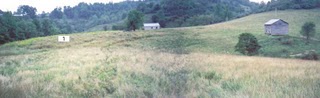
Left, above and right:
These are recent photos of the former Kuhl farm where the event unfolded. They were provided by Marilyn (Cole) Posey. Identified are
1. where the house stood
2. where the boy was killed
3. the stone grave where the boy was found.


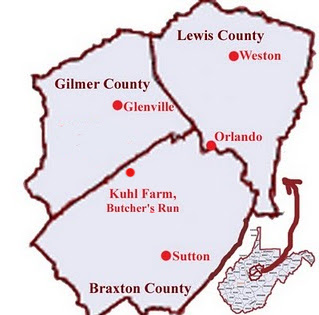
Left, below: a map of 3 central WV counties, Braxton, Gilmer and Lewis, illustrating the approximate location of the Kuhl farm.

During the same period in 1861, Companies B, C, and H of the 7th Ohio Volunteer Infantry (O.V.I.) were in the Glenville area looking for “rebels”. Corporal Adams of Company C was shot and seriously wounded there by a “bushwhacker” on the 21st of July. “The whole regiment came out, but failed to discover the rebel after diligent search.”11 The fact that the boy arrived at Henry Kuhl’s farm around this time must have caused some concern, especially when the boy said he was looking for secessionists, good horses, and guns. Two of Henry’s sons were Confederate soldiers, so the men knew they could expect to be treated as the enemy if this i
nformation were to reach the Union soldiers. A Federal Confiscation Act was about to be approved that would authorize the military to take property from Confederate sympathizers.15 These farmers were not secessionists or rebels, but Union soldiers would most likely not find that believable. Recent news of the brutal killing of a local citizen, Thomas Stout, by a Union soldier who had mistaken him for a rebel12, strengthened the farmers’ resolve to be cautious. The War was upon them, and the dangers were real. If they were to let the boy go, what kind of information could he take back to the Union soldiers? Sadly and tragically, the circumstances of the times compelled the men in Henry Kuhl’s field to act in the belief that they were defending their lives and property.

Henry Kuhl’s neighbor, Frederick Gerwig who was loyal to the Union side of the Civil War, testified eight months later at a military tribunal in Charleston, Virginia: “James Putnam had told that Henry Kuhl and Hamilton W. Windon (prisoner) were the two men who killed the boy. Then I and two of my brothers, Mathias and Jake Gerwig, and my father and Daniel Engle went out and looked.”2 Gerwig described how they all made a secretive trip to the boy’s burial site on or near Henry’s farm. They went in the middle of the night in order to avoid being seen. It is doubtful that any of these men had the authority or skill to inspect the site. Gerwig said they dug up and examined the body, which must have destroyed evidence. “. . . the neck bone was all washed away and we could not tell anything hardly.”2


Questions

Sometime after the Gerwigs and Engle examined the body, all men who had been in Henry Kuhl’s field that day (except John Conrad) were brought before Justice of the Peace, William Corley, in Sutton where they were charged with murder. John Conrad had fled from the farm, and was not captured for the trials. It is not clear who reported the boy’s death to the authorities. Why had the military taken control of the prisoners? Why were these men denied the right to a trial by jury? Henry and his son, Conrad, were civilians. Why were they tried and sentenced by a military tribunal? This was 1861, but martial law was not imposed until 1863.13 Why were the trials held in Charleston, far from Sutton? And why were some of the key witnesses not present at the trials? Elizabeth Kuhl had been a witness to what had happened at the house while the men were out working in the field. Two of the children, Henry Jr. (age 17) and Rebecca (age 14) may have also been present. What had provoked the men to go after the boy that day? Had there been some kind of conflict at the house? Were these three witnesses given an opportunity to testify? They were not present at the trials.

Henry Kuhl, his son Conrad, and Hamilton Windon may not have been informed of their legal rights through legal counsel while they were incarcerated. In 1866, the U. S. Supreme Court unanimously ruled that military tribunals used to try civilians in any jurisdiction where the civil courts were functioning were unconstitutional.3 Although the ruling came too late to help Henry and his son, it does question the legality of military tribunals in civilian cases during the Civil War. “The guaranty of trial by jury contained in the Constitution was intended for a state of war, as well as a state of peace, and is equally binding upon rulers and people at all times and under all circumstances. . . . A citizen not connected with the military service and a resident in a State where the courts are open and in the proper exercise or their jurisdiction cannot, even when the privilege of the writ of habeas corpus is suspended, be tried, convicted, or sentenced otherwise than by the ordinary courts of law.”3 John D. Sutton, in his “History of Braxton County and Central West Virginia” noted that “throughout the war the courts were open, and their authority was respected.”4 He mentions several cases in which citizens were detained by Federal military authorities, and when applied to civil authorities, were released.4


After the Military Commission tried and sentenced the three men in Charleston, Henry Kuhl and Hamilton Windon were executed by public hanging on May 9, 1862 in Sutton, Virginia. Henry’s son, Conrad, was sentenced to be “kept at hard labor, with ball and chain attached to the left ankle, during the war”.2


Those Involved

Who were the individuals involved in this Civil War tragedy—the victim, the accused, the witnesses, the judges? What were their actions and responses in all of this?

Casper Presler”: Very little is known about the boy whose name might have been Casper Presler. Frederick Gerwig, witness for the prosecution at Henry Kuhl’s trial, stated, “I supposed the boy to be a soldier. The old man [Henry Kuhl] said the boy belonged to Captain Moore’s Company. Capt. Moore was of the 10th Regt. O.V.I. . . . The name of the deceased was not known. He wrote it on a slate at my father’s house as Casper Presler, that he said was his name. He looked like a likely boy. He looked like he might have been fifteen or sixteen years old.”2 Searches through the soldier lists of this regiment as well as the 7th Ohio Volunteer Infantry, did not find a Casper Presler. Conrad Kuhl, witness at Hamilton Windon’s trial, stated “the boy was uniformed like a United States soldier. I did not know his name.”2 Hamilton Windon, witness at Conrad Kuhl’s trial, said, “The boy was a German boy. The old man [Henry Kuhl] talked to him in German.”2 The record of the Military Commission states that the boy was “one of the soldiers of the United States Army whose name is unknown”2. Apparently there had never been an investigation to determine the identity of the boy. His identity was ignored and made irrelevant. The evidence does not seem to support the claim that he was a soldier, which would mean the case should have been tried in a civil court.13 If the boy had been a soldier, where are the military records of his service and his death?

Henry Kuhl: Henry pleaded guilty to the charge of murder. John Morrison, Union soldier, Co. F, 10th Infantry Regiment Virginia 5, witness for the prosecution in Henry Kuhl’s case, stated that he was present when Henry confessed to the Justice of the Peace in Sutton. Morrison said that Henry first denied killing the boy, but later confessed. No written record of this was mentioned in the trial record. Such a record must have existed. We are left wondering why Henry changed his plea. Was he pressured? Was some kind of deal made?

Right: Henry Kuhl

Hamilton W. Windon: Windon pleaded not guilty to the charge of murder. By his own admission, he witnessed the death of the boy soldier, but he said Henry Kuhl killed the boy. Windon was not provided with any kind of defense, but John Morrison and Frederick Gerwig were both witnesses for the prosecution. Henry Kuhl’s son, Conrad, served as witness for the defense, but would have been considered a hostile witness in a normal trial. Conrad said, “Windon and my father (Henry Kuhl) told me afterward that they had killed the boy. . . . The way they told me was that Windon gave the first lick and my father (Henry Kuhl) the second.”2 Windon was tried as a civilian, yet military records show that he was a Confederate soldier, who had enlisted as a Private in Company D, 31st Virginia Regiment Volunteers5. After the trials, Judge Advocate General Cornine responded to the actions of the Military Commission by writing: “Some of these men belonged to the army at the time the crime was committed. This circumstance has given me trouble, but careful investigation and reflection have brought me to the conclusion that the Military Commission had ample justification to try them.”2


John Conrad: The 1860 Federal Census for Braxton County, Virginia, shows a 17-year-old John Conrad living on a farm as one of Christopher Conrad’s children. The 1880 Federal Census shows a John S. Conrad living in Braxton County, and his birth year is 1843, which would have made him a 17 year old youth in 1861. The 1880 record indicates that he was a farm laborer, divorced, and housing three boarders. Was this the John Conrad who fled the farm and escaped the trials? Additional research would be required to answer this question.

Conrad Kuhl: Conrad’s trial was the last case to be tried by the Commission. He pleaded not guilty. He was provided with two witnesses for the prosecution, and none for his defense. The testimony of these two men, however, may have saved Conrad’s life. Union soldier, Private Ezekiel Marple’s testimony was especially helpful. When the Judge Advocate ordered Marple to state what kind of a character the prisoner had in Braxton County, Marple replied, “The people in and about Sutton who know the prisoner say that he is a quiet and peaceable man, that there is not a stain upon his character, and that he is very much afraid of his father who is a very hard man.”2 The other witness, Hamilton W. Windon, testified that Henry Kuhl killed the boy, and Conrad Kuhl had no part in it other than going up on the hill to act as a lookout to see if anyone was coming to the farm.

James Putnam: The testimony of Frederick Gerwig provided hearsay evidence that James Putnam had reported the boy’s death. Gerwig, stated, “It was reported that one James Putnam had told that Henry Kuhl and Hamilton W. Windon (prisoner) were the two men who killed the boy.”2 Elsewhere in the court proceedings, Gerwig said, “Hamilton W. Windon told James Putnam about killing the boy and Putnam let it out.”2 James Putnam enlisted in Company D, Virginia 31st Infantry Regiment on May 31, 1861, and served the Confederacy5 along with two of Henry Kuhl’s sons, Christian and John, who were also in Company D. Putnam was not present during the court proceedings, and was probably with Company D on the battlefield. Was Gerwig’s claim based on fact or rumor?

Frederick Gerwig: Gerwig, a farmer living half a mile from Henry Kuhl’s farm, said he had known Henry for 20 to 23 years. Both men were born in Germany, immigrated to the United States, and settled in Braxton County as neighbors. Gerwig provided damaging testimony against both Henry and Hamilton Windon at their trials. Gerwig does not appear to have enlisted for military service on either side of the Civil War, but indicated in his testimony that he was a Union supporter.

William L. Corley: Corley was Deputy Sheriff of Braxton County when he enlisted in the Confederate Army, Company C, 9th Battalion Infantry Regiment Virginia on May 18, 1861.5 The trial record shows that “Justice Corley in Sutton, Virginia” heard the statements of the men arraigned for the murder of the boy. On May 1, 1862, Corley transferred out of the 9th Regiment and into Company C, 25th Infantry Regiment Virginia.5 This transfer occurred only nine days before Henry Kuhl and Hamilton Windon were executed in Sutton.

John Morrison: Morrison had been Sheriff of Braxton County for a number of years. At the beginning of the Civil War, the Confederate guerilla company known as the “Moccasin Rangers” came to Morrison’s 300 acre farm, burned his home and drove off all his cattle and horses.4 After that, Morrison enlisted at the age of 44 as a Union Private in Company F, 10th Virginia Infantry.6 He served as witness for the prosecution against both Henry Kuhl and Hamilton Windon.

Ezekiel Marple: Marple was a Private in the Union Army, Company A, 10th Regiment, West Virginia Infantry.7 He was 39 years old at the time of the trial, where he served as witness for the prosecution in Conrad Kuhl’s case. As mentioned above, Marple’s testimony probably saved Conrad’s life. According to the 1860 Federal Census, Marple was a farmer with a large family. He died May 21, 1869, only 7 years after the trial.8

Hugh Ewing: Colonel Ewing, President of the Military Commission, was educated at the United States Military Academy, and became a lawyer. Long after the trials, on March 13, 1865, Ewing was promoted to Brevet Major-General “for gallant and meritorious service during the war.”5 His military training may have predisposed him to accept military tribunal justice, a form alien to common law, which provides for trial by jury and the presumption of innocence. In his letter to the Provost Marshal who was in charge of the three prisoners prior to the trials, he ordered the Marshal “to confine, under heavy chains, in the securest dungeon you have in your control, Henry Kuhl, Hamilton W. Windon, and Conrad Kuhl, and to keep them until you are otherwise ordered by proper authority.”9

Above, right: Colonel Hugh Ewing.
Below, right: Colonel George Crook.

George Crook: Crook graduated at West Point in 1852. He was commissioned an officer in Company S, Ohio 36th Infantry Regiment on Sept. 23, 1861.5 He was a member of the Military Commission in Charleston along with Hugh Ewing. Colonel Crook was known for his severe treatment of civilians during the Civil War. He typically followed a no-prisoners policy.16 When his troops encountered heavy guerilla resistance north of Sutton, Braxton County, Virginia in January, 1862, he responded by burning citizens’ houses and towns along his march.16 In one of his reports dated May 24, 1862, he wrote, concerning civilians who shot and wounded some of his soldiers, “The houses which can be fully identified as having been fired from will be burned, and if I can capture any of the parties engaged they will be hung in the street as an example to all such assassins.”10

General Jacob D. Cox: Cox, a lawyer, commanded Union troops in the Kanawha Valley that occupied Charleston, Virginia. In his May 24, 1862 letter to Col. George Crook, he writes, “Your retaliation upon the citizens who fired on your wounded will be approved.”10

Right: General Jacob D. Cox
Right, below: Major General John Fremont

Major General John Fremont: Fremont likewise thought it appropriate to carry out public executions of civilians to make an example of them so that others would know what to expect if they were to fire at Union soldiers. In his General Orders No. 17, dated April 25, 1862, he gave the same order for both Henry Kuhl and Hamilton Windon, stating for each case, “The finding and sentence in the above case are approved and confirmed, and to the end that just example may be made, the sentence will be carried into effect at Suttonville, Braxton Co., Virginia, on Friday, the 9th day of May, 1862, between the hours of 12 M. and 1 P. M.”2 The two men were then moved from Charleston, Virginia, and taken through the wilderness, probably in chains, by Union troops under the command of Colonel George Crook to Sutton where they were publicly executed by hanging.


In Conclusion


What did this effort to make an example of the men through public hanging accomplish? It is difficult to say what effect it had on the population as a whole. It may have intensified resentments in some of the people. It is known to have humiliated innocent members of the Kuhl family. To this day, the location of Henry Kuhl’s grave is unknown, and legends abound. In 1897, following the last public hanging in West Virginia, the body of prisoner John Morgan was placed in a pauper’s coffin, his remains were sent to the home of his wife and were buried on her father’s farm.14 Could Henry’s resting place exist in some secluded area of his farm? Time heals, generations pass, and Society evolves. By the end of the 19th Century, the barbaric spectacle of public executions had been abolished in the state of West Virginia.

Endnotes
1. Memoirs of Christian Kuhl, written in 1911, edited by historian, Roy B. Cook, Charleston, WV., Lila V. Powers collection of family papers.

2. Proceedings of a Military Commission Convened at Charleston, Virginia, March 31-April 3, 1862 in Record Group 153, Records of the Office of the Judge Advocate General, file # II-832, National Archives, Washington, D.C.

3. Ex Parte Milligan, 71 U.S. 2 (1866), Syllabus Supreme Court of the United States, digital copy, Cornell University Law School.

4. John D. Sutton, History of Braxton County and Central West Virginia, McClain Printing Company, Parsons, WV, 1919, p. 191.

5. U. S. Civil War Soldier Records and Profiles [database on-line], Provo, UT, USA: The Generations Network, Inc., 2009.

6. American Civil War Soldiers [database on-line], Provo, UT, USA: Ancestry.com Operations Inc., 1999.

7. U.S. Civil War Soldiers, 1861-1865 [database on-line], Provo, UT, USA: Ancestry.com Operations Inc., 2007.

8. Headstones Provided for Deceased Union Civil War Veterans, 1879-1903 [database on-line], Provo, UT, USA: Ancestry.com Operations Inc., 2007.

9. Union Provost Marshal’s File-Citizens, Two or More Names (Entry 465) in Record Group 109, War Department Collection of Confederate Records, File #885, National Archives, Washington, D.C.

10. The War of the Rebellion: A Compilation of the Official Records of the Union and Confederate Armies.; Series 1 – Volume 12 (Part 1), Chapter XXIV, p. 807.

11. Lawrence Wilson, Itinerary of the Seventh Ohio Volunteer Infantry, 1861-1864, The Neale Publishing Company, New York, 1907, p. 51.

12. Jacob Heater, “Some Civil War Reminiscences”, The Braxton Democrat, March 4, 1920. [Reprinted at orlandostonesoup.blogspot.com]

13. Two websites that refer to the Sept. 15, 1863 Congressionally-authorized martial law: [www.usconstitution.net/consttop_mlaw.html] and [www.presidency.ucsb.edu/ws/]

14. Stan Bumgardner and Christine Kreiser, “ ‘Thy Brother’s Blood’: Capital Punishment in West Virginia”, West Virginia Historical Society Quarterly, Vol. IX, No 4 and Vol. X, No. 1, March 1996. [www.wvculture.org/history]

15. The First Confiscation Act, Chap. LX.—An Act to Confiscate Property used for Insurrectionary Purposes, August 6, 1861. U.S., Statutes at Large, Treaties, and Proclamations of the United States of America, Vol. 12 (Boston, 1863), p. 319.

16. Kenneth W. Noe, “Exterminating Savages”, The Civil War in Appalachia, Univ. of Tennessee Press, 1997, pp. 115-116.


. . . . .


Notes

a. To the right is Henry Kuhl's (spelled "Cool" here) land grant for his property at the head of Butcher's Run, which is illustrated above. Click oh the image to open a larger copy of the document.

b. Henry Kuhl's farm at the head of Butcher's Run is a 40 mile ride from Orlando; much closer "as the crow flies." However. many of his descendents settled in the Orlando area. Henry Kuhl's grandson Henry Kuhl/Cole was in the Three Lick area and Henry Kuhl's son Christian Kuhl's farm was at the tip of Gilmer County where it meets Braxton and Lewis Counties.

c. The photograph of Henry and Catherine (Yeagle) Kuhl and of Elizabeth (Skidmore) Kuhl were taken from the Wilt/James/Brewer/Kuhl family tree belonging to jnnfbl91, a descendent of Conrad "Koanard" Kuhl who was imprisoned for the duration of the war for his part in killing the young Union man.